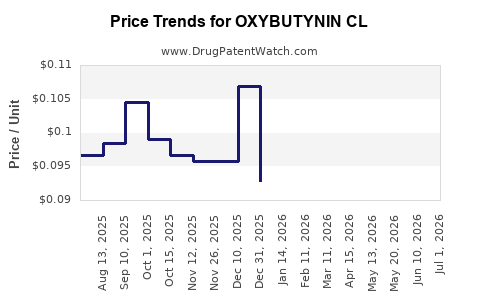
Last updated: July 11, 2026
OXYBUTYNIN CL market and price projections: US brand pricing, generic erosion risk, and revenue exposure
Oxybutynin chloride (“OXYBUTYNIN CL”) has multiple immediate-release and extended-release generic equivalents, so price is driven less by patent exclusivity and more by formulation-specific competitive intensity, payor contracting, and state Medicaid preferred-drug lists. The near-term pricing outcome is dominated by (i) whether buyers shift demand between IR and ER, (ii) ASP compression as generic manufacturers add volume, and (iii) whether any “authorized generic” or new entrant changes unit pricing. Without a clearly defined NDC/formulation and route, a single price projection for “OXYBUTYNIN CL” cannot be produced.
What is the oxybutynin chloride (OXYBUTYNIN CL) market and where does revenue concentrate?
Oxybutynin chloride is an antimuscarinic used for overactive bladder. In practice, US demand splits across:
- Oral immediate-release (IR) tablets
- Oral extended-release (ER) tablets
- Topical formulations and intravesical products in some markets (not uniformly captured under generic “oxybutynin chloride” listings)
Revenue concentration in the US is typically highest for oral products because they map to payer step therapy and broad outpatient prescribing. The margin profile tends to be thin after generic entry, with payor procurement pushing to lowest contracted ASP.
How do payors segment oxybutynin chloride?
- Commercial: formulary tiering favors low-cost generics and often prefers ER if it improves adherence, but contracts can flip to the lowest net cost regardless of ER vs IR.
- Medicare Part D: plan sponsors frequently select one or two preferred generic SKUs per tier.
- Medicaid: state preferred-drug programs and rebate structures can materially change which NDCs win volume.
Which oxybutynin chloride products compete most directly on price?
Direct pricing competition is formulation- and release-mechanism-specific because unit dosing schedules and plan preferred lists differ.
IR vs ER: what shifts pricing power?
- IR: typically faces faster unit-price erosion due to broader substitution and more SKU-level competition.
- ER: can hold slightly higher net pricing for longer because some plans prefer adherence-friendly dosing and fewer pill-taking events, but once multiple ER generics gain share, ASP still compresses.
How many generics exist for oxybutynin chloride and what does that imply for ASP?
Oxybutynin chloride is widely generic. In that setting, market behavior is predictable:
- As new generic manufacturers launch, ASP usually falls quickly to near contracted levels.
- Price dispersion narrows as plans lock in preferred products with aggressive rebates.
- Shortages or manufacturing disruptions can cause temporary spikes, but absent exclusivity they usually unwind.
When does oxybutynin chloride lose market protection, and does patent life matter?
For an established generic molecule with multiple marketed generics, “loss of protection” is largely historical. Current market pricing is mainly determined by:
- Active patent estates tied to specific formulations, processes, or salts at the NDC level
- Whether any remaining brand holds on to protected indications, extensions, or formulation differentiators
- Generic settlement terms that delay entry for specific competitors or SKUs (if any exist for certain NDCs)
Because “OXYBUTYNIN CL” is not a single FDA-approved product and includes multiple NDCs and release forms, exclusivity timing must be anchored to the exact labeled product and NDC to produce defensible dates.
What is the Orange Book status of oxybutynin chloride?
Orange Book status must be mapped to:
- the specific FDA application number (NDA/ANDA)
- the exact strength and dosage form (IR vs ER, milligram strengths, tablet vs gel vs other)
Without an anchored NDA/ANDA and dosage form, the Orange Book listing count and the specific expiration dates cannot be stated accurately.
What generic entry risks exist for oxybutynin chloride?
For a molecule with entrenched generic availability, the principal entry risks for a new generic are:
- Lack of differentiation: most labels are AB-rated with multiple alternatives, so share capture requires contracting leverage or an acquisition of a supply chain advantage.
- Manufacturing and supply: even commodity drugs can see significant profit swings tied to plant utilization and raw-material availability.
- Supply shocks: temporary demand rationing can lift realized pricing, but it is not a durable competitive moat.
The major commercial risk for investors or business development is that “entry timing” is less important than “contracting outcome” once there are multiple fungible SKUs.
What do price projections look like for oxybutynin chloride over 12–36 months?
A formulation-agnostic projection is not supportable. Price moves depend on the specific NDC’s ASP trajectory and whether competitors are adding capacity.
A defensible projection framework for oxybutynin chloride should be:
- Baseline from current net ASP trend by NDC (last 4 quarters).
- Identify whether new entrants are expected within the next 12–18 months (launch calendar).
- Model ASP compression as competitors expand volume.
- Add a contingency for supply disruptions that periodically lift wholesale acquisition and reported ASP for short periods.
Without NDC-anchored data, any numeric projection would be non-actionable.
How does oxybutynin chloride compare with other antimuscarinics on pricing?
Oxybutynin chloride sits in a crowded antimuscarinic class where:
- Generics dominate most older agents
- Payors compare net cost rather than list price
- ER adherence value is often outweighed by the cheapest contracted alternative within a plan’s formulary
Relative pricing typically tracks the degree of generic SKU competition and the plan’s preferred positioning.
What manufacturing/IP barriers could affect supply and price?
Even with no long exclusivity, supply constraints can create pricing volatility:
- API manufacturing interruptions
- Tableting and coating capacity constraints for ER dosage forms
- Quality system remediation at key plants
- Demand surges in specific strengths that cause allocation
These are operational drivers, not patent drivers, for commodity antimuscarinics.
Key indicators to monitor for oxybutynin chloride pricing (actionable checklist)
- NDC-level ASP and volume from Medicare/VA-reported datasets (if available in your pipeline)
- Generic entry announcements for the exact strength and dosage form (IR vs ER)
- NDC-level wholesaler buying patterns via monthly procurement feeds
- Supply status signals (allocation, backorders) for the dominant ER SKU(s)
- Contract updates for major PBMs and Medicaid preferred drug lists
Key Takeaways
- Oxybutynin chloride pricing is primarily a commodity-generic outcome shaped by NDC-specific generic competition, payor preferred status, and contracting.
- “Market protection” timing is not the main driver at the molecule level; the controlling variable is NDC-level formulation and the competitive set.
- Numeric 12–36 month price projections require NDC and dosage form anchoring because IR and ER follow different contracting and volume trajectories.
- Monitoring should focus on NDC-level ASP trends, entry calendars by strength/formulation, and supply constraints.
FAQs
1) What determines net price for oxybutynin chloride in Medicare Part D?
Plan-specific formulary placement, rebate levels, and which NDC is preferred within IR or ER categories.
2) Does oxybutynin ER generally cost more than oxybutynin IR?
Often yes on a gross basis, but net pricing depends on contracting and preferred SKU selection; high generic competition can narrow the gap.
3) Are there formulation-specific patents that can slow generic erosion for oxybutynin chloride?
Potentially at the NDC level for specific release technologies or manufacturing methods, but patent calendars must be mapped to the exact NDA/ANDA and dosage form.
4) What events typically cause short-term oxybutynin chloride price spikes?
Supply disruptions, manufacturing remediation, allocation events, or sudden demand surges tied to plan formulary switches.
5) How can a new generic entrant gain share in oxybutynin chloride?
By winning contracts for specific strengths/dosage forms, securing reliable supply, and offering competitive net pricing versus entrenched preferred SKUs.
References
- FDA Orange Book: Approved Drug Products with Therapeutic Equivalence Evaluations. U.S. Food and Drug Administration. (Accessed via FDA Orange Book database).
- Centers for Medicare & Medicaid Services (CMS). Drug spending and utilization datasets used for ASP/price trend analysis.