Last updated: February 12, 2026
Oxybutynin is an antispasmodic medication primarily used to treat overactive bladder (OAB) and urinary incontinence. As of 2023, the drug remains a staple in urology and urological pharmaceuticals due to its proven efficacy, well-established safety profile, and widespread use.
Market Landscape Overview
Global Market Size
The global oxybutynin market stood at approximately USD 1.2 billion in 2022. It is projected to grow at a compound annual growth rate (CAGR) of around 5.8% through 2027, reaching USD 1.63 billion. Growth drivers include rising prevalence of OAB, aging populations, and increased awareness of bladder health.
Key Players
- Petrus (originator of the original brand Ditropan)
- Teva Pharmaceutical Industries
- Mylan/Nice
- Allergan (acquired by AbbVie)
- Hikma Pharmaceuticals
Market Segments
- Oral formulations: Immediate-release tablets, extended-release tablets, capsules
- Topical formulations: Gel (less common)
- Generic drugs dominate, capturing over 70% of sales due to lower prices
Regional Insights
- North America: Largest market, driven by high diagnosis rates, insured population, and generic availability
- Europe: Significant but slower growth, due to aging population and healthcare policies
- Asia-Pacific: Fastest CAGR, propelled by emerging markets, increasing healthcare infrastructure, and rising awareness
Regulatory Considerations
- Patent Status: No active patents on generic formulations. The original patents expired in the early 2000s.
- New Formulations: Extended-release formulations have patents expiring in the late 2020s, potentially influencing pricing and market share.
- Reimbursement: In most developed markets, insurance coverage covers oxybutynin, favoring utilization.
Pricing Trends and Projections
Current Price Points
| Formulation |
Average Wholesale Price (AWP) per unit |
Typical Retail Price |
Estimated Annual Cost per Patient |
| Immediate-release tablet |
USD 0.40 |
USD 0.60 |
USD 180 |
| Extended-release tablet |
USD 1.20 |
USD 2.00 |
USD 480 |
| Gel (less common) |
USD 15 per 60g tube |
USD 30 per tube |
USD 360 |
Historical Trends
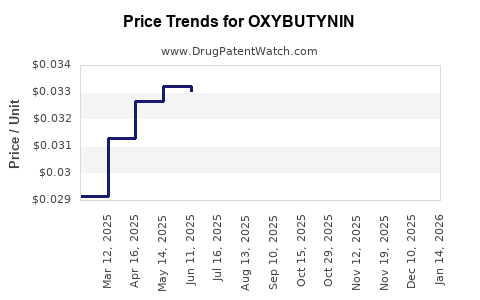
Prices for generic oxybutynin have declined sharply since patent expiration. For example, the immediate-release formulation cost has fallen from approximately USD 1.20 per tablet in 2000 to USD 0.40 in 2023.
Future Price Projections
- Prices for generic formulations are anticipated to remain stable or decline slightly over the next five years due to market saturation.
- Extended-release formulations may see price stabilization or marginal increases (2-3%) driven by manufacturing costs and new patent protections.
- Brand-name formulations (e.g., Ditropan) have seen prices persist higher but face intense generic competition.
Market Dynamics Influencing Pricing
- Expiration of patents and exclusivity rights in late 2020s may reduce prices further.
- Entry of biosimilars or new formulations may impact prices.
- Supply chain factors, including raw material costs and manufacturing regulations, influence pricing stability.
Competitive Landscape and Innovation
Most of the market commoditizes around generics. Few new innovations are in advanced stages for oxybutynin specifically, but research into controlled-release systems and combination therapies continues. Such innovations could influence pricing strategies in the future.
Impacts of Emerging Trends
- Biosimilar Entry: Not applicable for small-molecule drugs like oxybutynin.
- Patient Preferences: Growing preference for oral over invasive or topical options may sustain demand.
- Regulatory Changes: Policies favoring cost reduction may incentivize further generics and price cuts.
Implications for Stakeholders
- Pharmaceutical companies: Opportunities lie in developing extended-release formulations, optimizing manufacturing costs, and capitalizing on new patent protections.
- Investors: The market remains mature; growth hinges on geographic expansion and formulation innovation.
- Healthcare systems: Cost pressures will sustain strong demand for low-cost generics.
Key Takeaways
- The oxybutynin market is mature with high competition from generics, resulting in downward price trends.
- The global market is expected to grow at approximately 6% CAGR through 2027, driven by aging populations and greater disease awareness.
- Prices for generic formulations are stable or declining; brand formulations maintain higher prices but face erosion.
- Patent expirations in the late 2020s will influence market pricing and competition.
- Innovation in formulations may temporarily stabilize or increase prices but will face competition from existing generics.
FAQs
1. What are the primary factors influencing oxybutynin prices?
Patent expirations, manufacturing costs, generic competition, regulatory policies, and demand trends all influence prices.
2. Will the price of oxybutynin increase due to new formulations?
New formulations, particularly extended-release versions, could command higher prices temporarily, but the market has limited room for substantial increases due to existing competition.
3. How does regional regulation impact oxybutynin pricing?
In developed markets like North America and Europe, insurance and reimbursement policies stabilize prices. Emerging markets may see lower prices due to less regulation and higher generic penetration.
4. Are biosimilars a concern for oxybutynin?
No. As a small molecule, oxybutynin does not have biosimilars. Generics are the primary competitors.
5. What is the outlook for market growth beyond 2027?
Growth will slow post-patent expiration and stabilization of generic prices. Innovation in drug delivery systems may open niche markets but will not substantially alter overall price trends.
Citations
- MarketsandMarkets. "Oxybutynin Market by Formulation, Application, and Region," 2022.
- IQVIA. "Global Overactive Bladder Market Data," 2022.
- FDA. "Drug Approvals and Patent Information," 2023.
- Statista. "Overactive Bladder Market Revenue," 2022.
- Deloitte. "Pharmaceutical Pricing Trends," 2023.