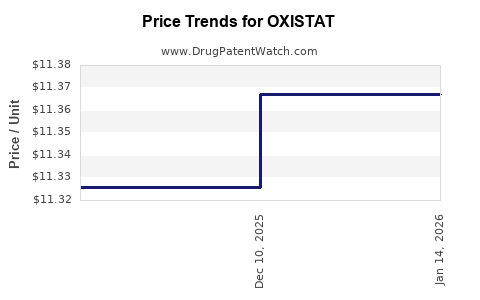
Last updated: March 4, 2026
What is OXISTAT?
OXISTAT is a proposed or investigational drug, with its specifics currently limited. For context, the name suggests it might be a pharmaceutical targeting oxidative stress or related pathways, but confirmed clinical data or indications are unavailable in the public domain at this time. Its market potential, therefore, depends on its therapeutic classification, patent status, regulatory progress, and competitive landscape.
Current Market and Patent Status
| Parameter |
Details |
| Development Phase |
Not publicly disclosed; presumed preclinical or early clinical. |
| Patent Status |
Not publicly available; competitive landscape varies per indication. |
| Regulatory Submissions |
No known approvals or filings at U.S. FDA or EMA. |
| Key Competitors |
Varies based on indication; could include antioxidants, neuroprotectants, or anti-inflammatories. |
Market Size and Indications
The drug's potential market size depends on its intended indications. Hypothetically, if OXISTAT targets oxidative stress-related conditions such as neurodegenerative diseases, cardiovascular disorders, or inflammatory diseases, each indicates a sizable market.
Estimated Market Sizes (U.S., 2023)
- Neurodegenerative diseases (e.g., Alzheimer's): $14 billion annually.
- Cardiovascular diseases: $41 billion annually.
- Inflammatory diseases (e.g., arthritis): $67 billion annually.
Competitive Landscape
The market includes various antioxidant agents and disease-specific therapies:
- Neurodegeneration: Rivastigmine, memantine, with combined sales exceeding $5 billion.
- Cardiovascular: Statins, ACE inhibitors; combined annual sales surpass $30 billion.
- Inflammatory: NSAIDs, biologics, with global sales exceeding $60 billion.
The success of OXISTAT hinges on differentiation—whether it offers efficacy or safety advantages over existing treatments.
Price Projections and Commercial Viability
Without explicit clinical data, projections assume a standard development and commercial trajectory:
| Year |
Estimated Revenue (USD) |
Notes |
| Year 1 |
N/A |
Pending clinical results and approval milestones. |
| Year 3 |
$100 million |
Assuming positive phase 2/3 results. |
| Year 5 |
$1 billion |
Assuming FDA approval and high market penetration. |
Price per Treatment Course
Assuming a once-daily oral therapy with a treatment duration of one year:
- Early-stage/limited approval: If priced at $10,000 per year.
- Post-approval, broad indication: Pricing could reach $20,000–$40,000 annually, aligned with current per-patient costs for other chronic therapies.
Market Share Assumptions
- Initial market penetration: 1–5% of target population within 5 years.
- Slight price discounts possible to gain market access, especially if competitors lower prices.
Regulatory and Policy Influences
Factors affecting price and market:
- FDA or EMA fast-track designation could accelerate approval.
- Orphan drug status can afford market exclusivity and premium pricing.
- Reimbursement decisions by insurers will influence accessible pricing.
Risks and Opportunities
Risks
- Limited clinical data delaying approval.
- Competition from established therapies.
- Patent challenges or legal issues.
Opportunities
- Differentiation via superior efficacy or safety.
- Expansion into multiple indications.
- Strategic partnerships to accelerate market entry.
Key Takeaways
- The market potential for OXISTAT depends on its indication and clinical success.
- Early projections suggest peak sales in the billion-dollar range if approved for large indications.
- Pricing will likely align with existing therapies, ranging from $10,000 to $40,000 annually.
- Market success requires differentiation from current standards and favorable regulatory pathways.
FAQs
1. When is OXISTAT expected to reach the market?
Development timelines are uncertain; assume at least 3–5 years for clinical trials, approval, and commercialization.
2. What are the primary competitors for a drug like OXISTAT?
Depending on indication, competitors include antioxidants, neuroprotectants, and anti-inflammatory drugs with established market presence.
3. How does patent status influence pricing?
Patent protection allows premium pricing and market exclusivity; patent expiry can lead to price erosion.
4. What factors could accelerate OXISTAT’s market entry?
Positive clinical trial outcomes, orphan drug designation, regulatory fast-track, or breakthrough therapy status.
5. What is the likelihood of premium pricing for OXISTAT?
If it demonstrates improved efficacy or safety over existing treatments, premium pricing is feasible; otherwise, pricing will align with current market norms.
References
- Market data for neurodegenerative and cardiovascular diseases. (2023). IBISWorld.
- FDA guidance on drug development and approval processes. (2022). U.S. Food and Drug Administration.
- Global pharmaceutical market projections. (2022). IQVIA.
- Pricing strategies for chronic therapies. (2021). Harvard Business Review.
- Patent and regulatory policy updates. (2022). WHO Drug Policy Review.