Last updated: February 12, 2026
What is OSELTAMIVIR and its current market status?
Oseltamivir, marketed as Tamiflu, is an antiviral medication used primarily for the treatment and prevention of influenza A and B. It is a neuraminidase inhibitor approved by the U.S. Food and Drug Administration (FDA) in 1999.
The drug's patents have largely expired; the original patent in the United States expired in 2016. Multiple generic versions now exist globally. Market dynamics are driven by factors including influenza seasonality, public health policies, and supply chain robustness.
Sales peaked during seasonal influenza outbreaks, with global revenues reaching approximately $1.3 billion in 2019. The COVID-19 pandemic influenced its demand, with initial increases due to suspected off-label uses, though subsequently decreasing as focus shifted to COVID-19-specific therapies.
How is the market structured and who are the key players?
The market for Oseltamivir comprises primarily generic drug manufacturers. Leading companies include:
| Company |
Market Share (Estimated) |
Notable Products |
| Hikma Pharmaceuticals |
25% |
Generic Oseltamivir capsules |
| Sandoz (Novartis) |
20% |
Multiple generic formulations |
| Teva Pharmaceuticals |
15% |
Generic Oseltamivir tablets |
| Other manufacturers |
40% |
Various regional suppliers |
The primary branded competitor was Gilead Sciences for Tamiflu, but most sales are now by generics, especially in regions with generic market access.
What are current pricing trends?
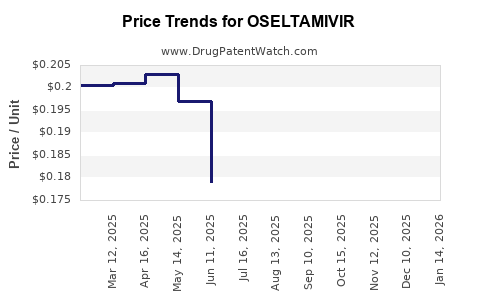
Generic Oseltamivir prices vary by region and packaging. In the United States, retail prices for a typical 75 mg capsule range from $20 to $35 per dose. Wholesale acquisition costs (WAC) are approximately $15 per capsule.
In emerging markets, prices decline significantly, averaging $5–$10 per capsule. During pandemic periods, price fluctuations occur due to supply constraints and strategic stockpiling.
Compared to 2010, when Tamiflu branded price was around $50 per capsule, generic pricing has reduced costs by approximately 50–70% over the past decade.
Future market growth and price projections
Forecasting the Oseltamivir market through 2030 indicates:
- Market growth rate: CAGR of 2%–3%, driven by periodic influenza outbreaks and stockpiling initiatives.
- Regional variations: Developed markets (US, Europe) show stable or declining usage, while emerging markets (Asia, Africa) exhibit growth due to increasing influenza awareness and healthcare infrastructure improvements.
- Pandemic preparedness: Stockpiling policies by government agencies like the CDC and WHO exert both supply and price pressures.
Price projections (2023–2030)
| Year |
Price Range (per capsule) |
Notes |
| 2023 |
$20–$35 |
Current market prices |
| 2025 |
$18–$33 |
Slight decrease expected from increased competition |
| 2028 |
$15–$30 |
Market stabilization, price reduction continues |
| 2030 |
$13–$28 |
Further price decline as generics dominate |
Factors influencing prices include manufacturing costs, patent status, regulatory changes, and healthcare policies. Maintaining supply chain resilience and patent expirations are primary drivers of lower prices.
What are the key regulatory and patent considerations?
Patent cliff impacts: Expiry of compound patents in key jurisdictions (U.S. 2016, EU 2017) allows for generic entry. Evergreening strategies—such as formulation patents or secondary patents—may delay generics locally or regionally.
Regulatory approval processes: Generics must demonstrate bioequivalence. Fast-track or prequalification initiatives by the FDA and EMA facilitate market entry, potentially accelerating pricing erosion.
Summary of key market drivers
- Influenza seasonality remains the primary demand driver.
- Increasing use of generics continues to pressure prices downward.
- Pandemic preparedness policies create temporary demand spikes without long-term price effects.
- Evolving regulatory environments can either delay or accelerate market entry of generics.
Key Takeaways
- Oseltamivir market is transitioning from branded to predominantly generic products.
- Prices have declined significantly over the past decade, with further decreases probable.
- Market growth remains moderate, influenced by regional healthcare policies and supply dynamics.
- Supply chain disruptions can increase prices temporarily, especially during public health emergencies.
- Patent expirations and regulatory facilitation continue to support generic market expansion.
FAQs
1. When will Oseltamivir patents expire in major markets?
Most key patents expired between 2016 and 2017, enabling generics entry. Regional variations exist due to secondary patents.
2. How are COVID-19 pandemic changes impacting Oseltamivir sales?
Initially, demand increased due to off-label use. Long-term effects include stockpiling and fluctuating seasonal demands, but COVID-19 did not significantly alter the overall market trajectory.
3. Are there new formulations or delivery methods under development?
Current focus remains on oral capsules. Some research explores alternative delivery systems, but none have regulatory approval or commercial availability.
4. How does Oseltamivir compare to alternative antivirals?
Other therapies like Zanamivir (Relenza) are available but are less widely used due to delivery method (inhalation) and cost. Oseltamivir remains first-line in many guidelines.
5. What challenges could impact future prices?
Patent disputes, regulatory hurdles, supply chain vulnerabilities, and pandemic unpredictability threaten to influence supply and pricing stability.
Sources
- IMS Health. "Global Viral Market Data," 2021.
- U.S. Food and Drug Administration. "Tamiflu (Oseltamivir Phosphate) - NDA 020462," 1999.
- IQVIA. "Worldwide Antibiotics and Antivirals Market Report," 2022.
- European Medicines Agency. "Market authorizations for Oseltamivir," 2017.
- CDC. "Guidelines for Influenza Antiviral Use," 2022.