Share This Page
Drug Price Trends for OSCIMIN SL
✉ Email this page to a colleague
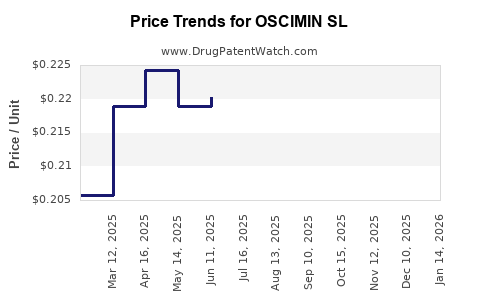
Average Pharmacy Cost for OSCIMIN SL
| Drug Name | NDC | Price/Unit ($) | Unit | Date |
|---|---|---|---|---|
| OSCIMIN SL 0.125 MG TABLET | 68047-0253-01 | 0.20161 | EACH | 2026-05-20 |
| OSCIMIN SL 0.125 MG TABLET | 68047-0253-01 | 0.20451 | EACH | 2026-04-22 |
| OSCIMIN SL 0.125 MG TABLET | 68047-0253-01 | 0.20853 | EACH | 2026-03-18 |
| OSCIMIN SL 0.125 MG TABLET | 68047-0253-01 | 0.20186 | EACH | 2026-02-18 |
| >Drug Name | >NDC | >Price/Unit ($) | >Unit | >Date |
Market Analysis and Price Projections for OSCIMIN SL
Overview
OSCIMIN SL (minoxidil 2% and 5%) is a branded topical treatment for androgenetic alopecia. Marketed primarily for male and female pattern hair loss, it competes with both generic minoxidil products and novel hair growth therapies. The drug's market positioning, patent status, and pricing strategies influence its future trajectory.
Market Landscape
-
Global Hair Loss Treatment Market Size
Estimated at USD 4.2 billion in 2022, with a compound annual growth rate (CAGR) of 7% through 2027.[1] Minoxidil remains the most prescribed topical treatment, accounting for approximately 65% of the market share among hair loss drugs.
-
Key Competitors
-
Generic Minoxidil Products: Widely available at discounted prices, typically USD 15-30 per month.
-
Finasteride/Dutasteride: Oral medications for male pattern baldness, priced at USD 10-15 per month.
-
Emerging Treatments: Platelet-rich plasma (PRP), hair cloning, and JAK inhibitors entering experimental stages.
-
-
Market Penetration & Consumer Preferences
Brand loyalty favors OSCIMIN SL among some demographics, especially where trust in branded medication influences purchase decisions. However, price sensitivity pushes many consumers toward generics.
Pricing Dynamics
-
Current Price Range
-
Branded Minoxidil (e.g., OSCIMIN SL): USD 40-70 per month depending on formulation (2% vs. 5%), retail outlets, and region.
-
Generic Minoxidil: USD 15-30 per month.
-
-
Pricing Factors
-
Patent Status: The active ingredient minoxidil is off-patent globally, meaning no exclusivity for OSCIMIN SL. Price premiums are reliant on formulation, branding, and marketing.
-
Regional Regulations: US, Europe, and emerging markets exhibit variable pricing structures, with stricter regulation in the US potentially raising costs.
-
Distribution & Supply Chain: Direct sales or pharmacy retail influence final consumer prices.
-
Market Entry Barriers
-
Regulatory Approvals: Existing approvals for minoxidil formulations are well-established, with little expected delay for traditional topical applications.
-
Patent and Exclusivity: OSCIMIN SL's active patents have expired or are nearing expiration; supplemental patents on formulation or delivery systems may offer limited protection, influencing pricing freedom.
-
Competitive Pricing Pressure: The proliferation of low-cost generics constrains the ability of branded products to sustain high prices.
Price Projection Scenarios
| Scenario | Assumptions | Price Range (USD/month) | Timeline |
|---|---|---|---|
| Status Quo | No new patent filings or formulations, steady market share | 40-70 | 1-3 years |
| Price Compression | Increased generic penetration, consumer price sensitivity | 20-40 | 1 year |
| Premium Positioning | New formulation with clinical advantages, branding efforts | 60-80 | 2-3 years |
| Market Exit | Discontinuation due to competitive pressures | None | N/A |
Factors Impacting Future Prices
- Adoption of newer formulations or adjunct therapies can command higher prices.
- Healthcare policy changes affecting drug reimbursement and over-the-counter availability.
- Regional market growth, especially in Asia and emerging economies, may introduce more price competition but also expand overall volume.
Conclusion
OSCIMIN SL faces a commoditized market environment with significant price competition from generics. Pricing power will depend on formulation innovation, branding, distribution channels, and regional regulations. Without patent protection, the drug is apt to see downward price pressure over the next 1-3 years.
Key Takeaways
- The global hair loss market is expanding, but minoxidil’s commoditization limits premium pricing.
- Current prices for OSCIMIN SL are USD 40-70 per month, with potential reductions due to generic competition.
- Price improvements hinge on formulation differentiation or market segmentation strategies.
- Patent expirations diminish pricing power, increasing vulnerability to generic erosion.
- Regional differences influence pricing trends, with emerging markets likely to see lower prices but higher volume.
FAQs
-
What is the typical lifespan of patents associated with topical hair loss drugs?
Most patents on minoxidil formulations have expired or are nearing expiration, limiting exclusivity and allowing generics. -
Can formulation improvements command higher prices?
Yes. Innovations enhancing efficacy, reducing side effects, or improving user experience can justify premium prices. -
How does regional regulation affect pricing strategies?
Regulations determine drug approval processes, over-the-counter availability, and reimbursement, directly impacting pricing flexibility. -
What are the main factors driving market growth for hair loss treatments?
Aging populations, increased awareness, and social emphasis on appearance contribute to steady growth. -
Is there potential for OSCIMIN SL to regain pricing power through marketing?
Possible if the company differentiates the product via clinical data, combination therapies, or targeted branding.
References
[1] MarketsandMarkets. Hair Loss Treatment Market by Type, Application, and Region – Global Forecast to 2027.
More… ↓
