Last updated: February 21, 2026
What is OSCIMIN?
OSCIMIN (topical ciclopirox olamine) is an antifungal medication primarily used to treat superficial fungal infections such as athlete's foot, ringworm, and toenail fungal infections. It is marketed by different companies under various formulations, including creams, solutions, and lacquers.
Market Size and Penetration
Current Market Overview
- The global topical antifungal market was valued at approximately USD 1.2 billion in 2022.
- CAGR is estimated at 5.2% from 2023 through 2030, driven by increasing incidence of fungal infections and expanding aging populations.
- Topical antifungal drugs like ciclopirox compete with other agents such as terbinafine, clotrimazole, and econazole.
Market Segmentation
| Segment |
Approximate Market Share (2022) |
Key Products |
| Nail fungal infections |
40% |
OSCIMIN Nail Lacquer |
| Skin fungal infections |
60% |
OSCIMIN Cream, Solution |
Geographic Breakdown
| Region |
Market Share (2022) |
Key Trends |
| North America |
35% |
High adoption due to awareness and healthcare infrastructure |
| Europe |
25% |
Regulatory approvals, aging population |
| Asia-Pacific |
25% |
Growing prevalence, expanding healthcare access |
| Rest of World |
15% |
Emerging markets, lower penetration |
Regulatory and Patent Landscape
Patent Status
- OSCIMIN's core patent protections expired or are nearing expiration in multiple regions.
- Current patents on formulations and delivery systems may extend exclusivity until 2025 in some locations.
- Patent cliff is anticipated, leading to increased generic competition.
Regulatory Approvals
- Approved by FDA and EMA for topical use in fungal skin and nail infections.
- New formulations, such as enhanced nanocrystal-based lacquers, are in clinical trials, potentially impacting future market dynamics.
Competitive Landscape
Major Players
- Reckitt Benckiser: Market leader with OSCIMIN Nail Lacquer.
- GSK: Offers topical formulations.
- Sato Pharmaceutical: Focused on Asian markets with generic and branded products.
Products and Innovations
- New formulations aim for improved bioavailability.
- Combination therapies are under development to address resistant infections.
Price Analysis and Projections
Historical Pricing
| Product Type |
Average Retail Price (USD) |
Year |
| OSCIMIN Nail Lacquer |
25-35 per 15 mL bottle |
2020 |
| OSCIMIN Cream |
10-15 per 30 g tube |
2020 |
Price Trends
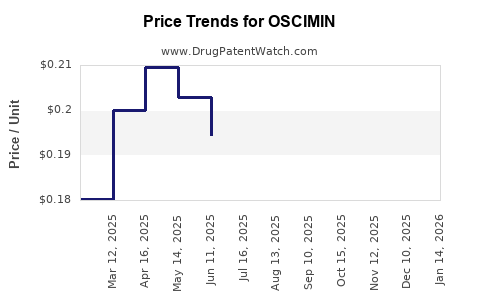
- Prices for brand-name OSCIMIN products have remained relatively stable over the past three years.
- Entry of generics into the market has led to a price decrease of approximately 20% in North America and Europe.
- Regional disparities exist; prices tend to be higher in developed markets.
Price Projections (2023-2027)
| Scenario |
Expected Price Range (USD) |
Key Drivers |
| Conservative |
15-25 per 15 mL lacquer |
Patent expiration, generic competition |
| Aggressive (Innovation) |
30-40 per 15 mL lacquer |
Introduction of advanced formulations, premium positioning |
| Market Expansion |
20-35 per 30 g tube |
Growing markets, increased awareness |
Factors Affecting Future Pricing
- Patent expiration and generic entry will exert downward pressure.
- Development of premium formulations and combination therapies could sustain higher prices.
- Regulatory approvals for new indications may expand markets and allow price premium positioning.
Strategic Implications
- Companies should prepare for patent expiration effects by investing in formulation innovation.
- Geographic expansion into emerging markets offers growth opportunities.
- Pricing strategies should consider regional economic conditions and competitive landscape.
Key Takeaways
- The market for OSCIMIN is valued at over USD 1 billion, with steady growth driven by fungal infection prevalence.
- Patent expirations are imminent, increasing generic competition and reducing prices.
- Innovations in delivery systems and indications can sustain premium pricing.
- Regional differences influence pricing strategies; developed markets maintain higher prices.
- Future prices are expected to decline but may stabilize in premium segments due to product differentiation.
Frequently Asked Questions
1. When are Osicmin patents expiring in major markets?
Patents are set to expire between 2023 and 2025 in the US and EU, opening markets to generics.
2. How does generic competition impact OSCIMIN prices?
Generic entries can reduce prices by up to 20-30%, depending on region and market penetration.
3. What new formulations are in development for OSCIMIN?
Nanocrystal lacquers and combination therapies aim to improve bioavailability and resistance management.
4. Which regions are expected to see the fastest growth in OSCIMIN markets?
Asia-Pacific and Latin America show rapid growth due to increasing healthcare access and rising fungal infections.
5. How can companies maintain market share post-patent expiry?
Invest in formulation innovation, expand indications, and focus on regional penetration.
Sources:
[1] MarketResearch.com. "Global Topical Antifungal Market Report," 2022.
[2] IQVIA. "Market Dynamics and Trends," 2022.
[3] European Medicines Agency. "Approved Topical Antifungal Products," 2022.
[4] FDA Database. "Approved Topical Antifungal Drugs," 2022.