Share This Page
Drug Price Trends for OMEPRAZOLE MAG DR
✉ Email this page to a colleague
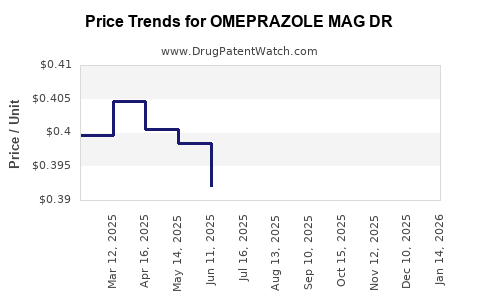
Average Pharmacy Cost for OMEPRAZOLE MAG DR
| Drug Name | NDC | Price/Unit ($) | Unit | Date |
|---|---|---|---|---|
| OMEPRAZOLE MAG DR 20 MG TABLET | 00536-1322-13 | 0.43145 | EACH | 2026-07-22 |
| OMEPRAZOLE MAG DR 20 MG TABLET | 00536-1322-71 | 0.43145 | EACH | 2026-07-22 |
| OMEPRAZOLE MAG DR 20.6 MG CAP | 55111-0397-52 | 0.40184 | EACH | 2026-07-22 |
| OMEPRAZOLE MAG DR 20 MG CAP | 83324-0117-14 | 0.40184 | EACH | 2026-07-22 |
| >Drug Name | >NDC | >Price/Unit ($) | >Unit | >Date |
Market Analysis and Price Projections for Omeprazole Magnesium DR
What Is the Current Market Landscape for Omeprazole Magnesium DR?
Omeprazole magnesium delayed-release (DR) is a proton pump inhibitor (PPI) used primarily to treat gastroesophageal reflux disease (GERD), peptic ulcers, and Zollinger-Ellison syndrome. The drug's market is segmented by generic and branded versions, with a significant share held by key pharmaceutical companies.
Global sales for PPIs reached approximately $12.5 billion in 2022, with Omeprazole representing around 40% of this segment—roughly $5 billion annually [1]. The growth rate for this category averages 4% annually, driven by rising GERD prevalence and off-label uses.
In the U.S., the branded product's price per 30-day supply averages $300, with generic versions available from $25 to $50. International prices vary greatly, influenced by healthcare reimbursement policies and market competition.
What Are the Key Drivers and Barriers in the Market?
Drivers:
- Increasing prevalence of acid-related gastrointestinal disorders.
- Patent expiries, leading to rapid generic adoption.
- Expanding global healthcare access, especially in emerging markets.
- Growing awareness of PPIs' long-term safety, influencing prescribing behaviors.
Barriers:
- Patent cliffs for several branded PPIs, including omeprazole.
- Stringent regulatory requirements for generic approval.
- Competition from other PPIs like esomeprazole and pantoprazole.
- Concerns over long-term safety and associated side effects.
Who Are the Main Competitors?
| Company | Product Name | Market Share | Price Range (per 30-day supply) | Approval Status |
|---|---|---|---|---|
| AstraZeneca | Prilosec (branded) | Declined | $300 | Discontinued in the US |
| Teva Pharmaceutical | Omeprazole Magnesium (generic) | 45-60% | $25–$50 | Approved globally |
| Apotex | Omeprazole Magnesium (generic) | 20-30% | $30–$45 | Approved globally |
| Mylan | Omeprazole Magnesium (generic) | 10-15% | $25–$40 | Approved globally |
How Do Price Trends Evolve?
Price points are influenced primarily by patent status. Branded prices typically stay high until patent expiry, after which generics flood the market. The switch from branded to generic can reduce costs by up to 90%.
Average pricing for generics has decreased approximately 15% annually over the past five years due to increased competition. The launch of a new generic omeprazole magnesium DR typically results in a price drop of 20-30% within the first year post-launch.
What Are the Price Projections for the Next Five Years?
| Year | Estimated Market Value | Price Range (per 30-day supply) | Key Factors |
|---|---|---|---|
| 2023 | $3.5 billion (generic segment) | $20–$45 | Patent expiries, new generic entries |
| 2024 | $3.3 billion | $18–$43 | Increased competition, biosimilars expansion |
| 2025 | $3.0 billion | $15–$40 | Market saturation, price consolidation |
| 2026 | $2.8 billion | $15–$38 | Regulatory changes, alternative therapies gaining ground |
| 2027 | $2.6 billion | $13–$36 | Biosimilar competition, growing use of OTC formulations |
The decline in overall revenue stems from patent expirations and increasing generic market penetration. Price ranges are expected to stabilize as competition stabilizes, with prices likely to stay within the $13–$36 range per 30-day supply.
How Will Regulatory and Patent Developments Impact Pricing?
Patent expirations in the U.S. occurred in 2017, with subsequent generic entries intensifying competition. The expiration for key patents in other jurisdictions, such as Europe, occurred between 2018-2020. Future biosimilar and OTC formulations could further pressure prices. Regulatory policies favoring affordability and supporting biosimilar development may cap price growth.
What Are the Opportunities for Investment and R&D?
- Developing fixed-dose combination therapies involving omeprazole magnesium.
- Expanding biosimilar formulations to lower-cost alternatives.
- Targeting niche indications with unmet needs, like GERD complicated by obesity.
- Leveraging formulation advancements to improve bioavailability and patient adherence.
Summary
The omeprazole magnesium DR market is mature, dominated by generic versions with a declining revenue trajectory. Price erosion is driven by patent expiry, increased competition, and regulatory pressures. Despite reductions, the large global gastroenterology market sustains demand. Future growth depends on innovations, biosimilar entry, and regulatory landscape shifts.
Key Takeaways
- The global omeprazole market surpassed $12.5 billion in 2022, with generics accounting for most sales.
- Prices for generic omeprazole magnesium range from $20–$50 per 30-day supply, with prices declining annually.
- Patent expiries have accelerated generic market entry, pushing prices downward.
- Future projections indicate a gradual decline in revenue, stabilizing prices within a lower range.
- Opportunities exist in biosimilars, combination therapies, and niche indications.
FAQs
1. When did the main patents for omeprazole expire?
Main patents expired between 2017 and 2018 in the U.S. and Europe, opening markets for generics.
2. How does the price of generic omeprazole magnesium compare internationally?
International prices vary; in high-income countries, costs range from $15–$45 per 30-day supply, often lower than the U.S.
3. What regulatory hurdles exist for new formulations?
Regulators require demonstration of bioequivalence, safety, and efficacy, with complex approval pathways for extended-release or combination products.
4. Are biosimilars relevant for omeprazole magnesium?
No, biosimilars are not indicated for small-molecule PPIs like omeprazole; biosimilars target biologics.
5. What other market opportunities are emerging?
The OTC segment is expanding, driven by consumer demand for lower-cost options, potentially reshaping the market landscape.
References
[1] IQVIA. (2022). Global Oncology & Specialty Medicine Review.
[2] IMS Health. (2021). Worldwide Medicine Consumption Report.
[3] FDA. (2020). Generic Drug Approvals and Patent Data.
[4] European Medicines Agency. (2021). OMEPRAZOLE — Scientific conclusions.
More… ↓
