Share This Page
Drug Price Trends for OLUMIANT
✉ Email this page to a colleague
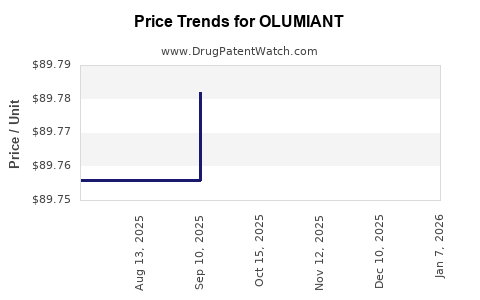
Average Pharmacy Cost for OLUMIANT
| Drug Name | NDC | Price/Unit ($) | Unit | Date |
|---|---|---|---|---|
| OLUMIANT 2 MG TABLET | 00002-4182-30 | 92.51958 | EACH | 2026-07-22 |
| OLUMIANT 2 MG TABLET | 00002-4182-30 | 92.25833 | EACH | 2026-06-17 |
| OLUMIANT 2 MG TABLET | 00002-4182-30 | 92.29356 | EACH | 2026-01-01 |
| >Drug Name | >NDC | >Price/Unit ($) | >Unit | >Date |
What is the Current Market Position of Olumiant?
Olumiant (baricitinib) is a Janus kinase (JAK) inhibitor developed by Eli Lilly and approved by the FDA in 2018 for rheumatoid arthritis. It also received Emergency Use Authorization in 2020 for COVID-19 treatment, specifically in cases involving severe symptoms. As of 2023, it maintains FDA approval for rheumatoid arthritis in adult patients who have had an inadequate response to other treatments.
The drug competes primarily with other JAK inhibitors such as Pfizer's Xeljanz (tofacitinib), AbbVie's Rinvoq (upadacitinib), and Gilead's Jyseleca (filgotinib). Its market presence hinges on its application for rheumatoid arthritis and, potentially, emerging indications like COVID-19-related complications.
How Large Is The Market for Olumiant?
The global rheumatoid arthritis (RA) drug market was estimated at approximately $25 billion in 2022, with JAK inhibitors accounting for roughly 30% of that, roughly $7.5 billion (source: IQVIA). Olumiant's share within this segment is limited by its late entry and competitive portfolio, capturing an estimated $500 million in sales in 2022, according to Eli Lilly’s filings.
The COVID-19 indication provided a temporary boost in sales, though that has declined as vaccines and other treatments have matured. The total addressable COVID-related market for drugs like Olumiant was estimated at around $2 billion in 2020 but has since contracted.
Projected markets suggest steady growth in RA therapy, with a compounded annual growth rate (CAGR) of about 4% expected through 2030 (source: Evaluate Pharma). Conversely, COVID-19 treatment applications have diminished, suggesting that future revenues for Olumiant will largely depend on its performance as an RA agent.
What are the Price Points for Olumiant?
The pricing varies by region and indication. In the United States, the wholesale acquisition cost (WAC) for Olumiant is roughly $4,600 per 30-day supply for RA treatment. This is comparable to other JAK inhibitors: Xeljanz costs approximately $4,700 per month, and Rinvoq around $6,000 per month.
In Europe, prices are generally lower, with some countries reimbursing around €2,500-€3,000 per month. Its market penetration is also influenced by biosimilar competition and formulary inclusion.
How Are Price Trends Expected to Evolve?
Price stability has been observed in the U.S. over recent years. Future price adjustments are unlikely to be significant due to the competitive landscape and reimbursement pressures. However, the introduction of biosimilars and generics could influence pricing strategies; Eli Lilly has not announced biosimilar development specifically for Olumiant, but generic versions of originator drugs often erode prices over time.
Reimbursement policies in key markets could exert downward pressure. For example, in the U.S., payers increasingly favor cheaper or biosimilar options to manage costs, which might influence Olumiant's pricing and market share.
What Are the Key Drivers and Risks for Olumiant's Market and Pricing?
Drivers:
- Clinical efficacy relative to competitors
- Expanded approvals for additional indications
- Inclusion in treatment guidelines
- Market adoption in emerging countries
Risks:
- Competitive pressure from existing JAK inhibitors
- Delays in new indications approval
- Safety concerns impacting prescribing habits
- Biosimilar and generic erosion of prices
What Do Market Projections Indicate?
By 2030, sales for Olumiant in RA could reach between $1.2 billion and $2 billion globally, assuming increased penetration and new indications. These projections consider evolving reimbursement policies, competitive landscape changes, and broader acceptance of JAK inhibitors.
With pricing remaining relatively stable, revenue growth hinges mostly on volume expansion and indication expansion. Roche's Actemra, another RA treatment, has seen prices fluctuate due to biosimilar entry, an outcome that could supply a precedent for Olumiant’s price trajectory.
Closing Summary
Olumiant remains a mid-tier player within the JAK inhibitor class. Its revenue generation depends on sustained efficacy, additional approvals, and competitive positioning. The drug's current price in the U.S. is around $4,600 per month — stable amidst competitive pressures. Future sales likely hinge on expansion beyond RA, particularly as biosimilars and generics press downward on prices. Strategic focus on indication growth could alter this dynamic.
Key Takeaways
- Olumiant's 2022 sales: approximately $500 million
- U.S. monthly price: around $4,600
- Global RA market: $25 billion; JAK inhibitors: 30%, or ~$7.5 billion
- Price stability expected; biosimilar entry could weaken prices
- 2030 sales forecast: up to $2 billion, contingent on adoption and approvals
FAQs
1. How does Olumiant compare to its competitors?
It has similar efficacy to other JAK inhibitors but faces competition from Xeljanz and Rinvoq, which have broader market share and earlier approval for additional indications.
2. Will expansion into new indications improve market outlook?
Yes, approval for COVID-19 or other autoimmune conditions could boost sales. Regulatory delays or safety issues could limit this potential.
3. Is pricing sustainable amid biosimilar pressure?
Current prices are stable. Biosimilar competition in RA could lead to price reductions over the next five years.
4. How do reimbursement policies affect Olumiant’s pricing?
Payers favor cost-effective options, which could pressure Eli Lilly to adjust pricing or improve formulary positioning.
5. What’s the outlook for market share growth?
Growth depends on clinical positioning, regulatory approvals, and positioning relative to existing therapies. Market share expansion in emerging markets remains a key opportunity.
Sources:
- IQVIA, "The Global Use of Medicines," 2022.
- Eli Lilly, Annual Report, 2022.
- Evaluate Pharma, "Pharma Market Forecast," 2022.
- U.S. FDA, "Olumiant (baricitinib) approval information," 2018.
- European Medicines Agency, "Olumiant summary," 2022.
More… ↓
