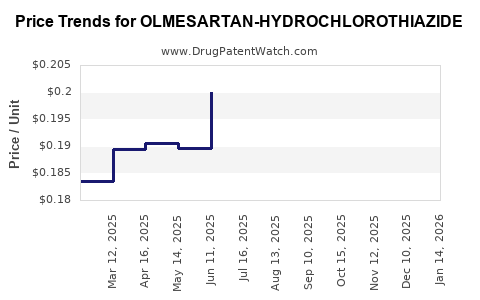
Last updated: February 20, 2026
What is the current market landscape for Olmesartan-Hydrochlorothiazide?
Olmesartan-Hydrochlorothiazide (Olmesartan-HCTZ) is a fixed-dose combination antihypertensive medication. It combines an angiotensin II receptor blocker (Olmesartan) with a thiazide diuretic (Hydrochlorothiazide). Approved primarily for hypertension management, it competes within the broader anti-hypertensive segment.
The global antihypertensive market, valued at approximately USD 29.5 billion in 2022, grows at a compound annual growth rate (CAGR) of 3.9% (Grand View Research). Olmesartan-HCTZ accounts for an estimated 4-6% of this market. The drug faces competition from other ARB-based combinations (e.g., losartan-HCTZ, valsartan-HCTZ) and single-agent therapies.
Key manufacturers include Daiichi Sankyo, Novartis, and generic producers. The availability of generic versions since patent expiration influences price competition. Currently, the United States market is the most mature, with annual sales approximating USD 400 million, according to IQVIA data (2021).
What are the regulatory and patent considerations?
Daiichi Sankyo holds an FDA-approved patent for Olmesartan-HCTZ, expiring around 2027-2028. Generics entered the market following patent expiry, decreasing prices. Regulatory pathways for generics are well-established, with multiple approved versions from Indian, Chinese, and domestic manufacturers.
In the EU, the expiration of basic patents and supplementary protection certificates (SPCs) occurred in the last phase of the 2010s, boosting generic competition.
How does generics influence pricing and market share?
Generics significantly lower prices, reducing the brand-name’s market share by up to 80% within three years of generic entry. High volume and low margins characterize generics, leading to the necessity for manufacturers to focus on cost reduction.
In the United States, list prices for brand-name Olmesartan-HCTZ can reach USD 150-180 per month per patient. Generics are priced around USD 25-50 per month, depending on manufacturer and formulation.
What is the projection for future sales and pricing?
Analysts project that by 2030, Olmesartan-HCTZ sales may decline by approximately 30-40% due to market saturation and increased generic availability. However, emerging markets are expected to offset some losses with an estimated compounded growth rate of 2.8% from 2022 to 2030, driven by increasing hypertension prevalence and expanding healthcare access.
Price projections (USD per month per patient):
| Year |
Brand-Name Price |
Generic Price |
Comments |
| 2023 |
150-180 |
25-50 |
US market; multiple generics available |
| 2025 |
140-170 |
20-45 |
Slight price reductions due to competition |
| 2030 |
130-160 |
15-40 |
Overall decline; emerging markets' contribution |
Total global sales estimates:
| Year |
Sales (USD billion) |
CAGR |
Notes |
| 2022 |
0.4 |
— |
US market dominance |
| 2025 |
0.36 |
-4% |
Competition, patent expiries |
| 2030 |
0.28 |
-6% |
Market saturation, price pressures |
What are key competitive factors?
- Patent status: Expiration opens the market for generics.
- Regulatory environment: Approval processes for generics vary by country but are well-established.
- Pricing strategies: Generics' affordability accelerates market share shifts.
- Clinical efficacy and safety: The combination's widespread use is based on established hypertension management standards.
- Market access and reimbursement policies: Variability affects sales volume and pricing.
What are the implications for stakeholders?
- Pharmaceutical companies: Should anticipate declining prices post-patent expiration, focus on cost efficiencies.
- Investors: Must adjust expectations for steady revenue from Olmesartan-HCTZ beyond 2027.
- Healthcare systems: Cost-containment favors generic uptake, influencing future treatment prescriptions.
Closing summary
Olmesartan-Hydrochlorothiazide faces an evolving market with declining brand-name revenues due to patent expiration and rising generic competition. Sales are expected to diminish by 30-40% by 2030, with prices decreasing substantially. Markets like India and China provide growth avenues, driven by hypertension prevalence. Stakeholders must plan for post-patent generics volumes and pricing dynamics.
Key Takeaways
- Olmesartan-HCTZ is a key antihypertensive combo with a growing generic market.
- US sales hover around USD 400 million annually, with prices declining due to generics.
- Patent expiration around 2027-2028 will accelerate price erosion.
- Projected market decline of 30-40% by 2030, tempered by emerging market growth.
- Competitive landscape emphasizes cost-savings and regulatory agility.
FAQs
Q1: When will patent protection for Olmesartan-HCTZ expire?
A1: Patent protections are expected to expire around 2027-2028 in key markets such as the US.
Q2: How much do generics reduce the drug’s price?
A2: Generics typically cost 15-25% of the brand-name price, translating to USD 25-50 monthly in the US.
Q3: Which markets are likely to see growth despite patent expirations?
A3: Emerging markets like India, China, and parts of Latin America are expected to see growth driven by increased hypertension treatment.
Q4: What are the main competitors to Olmesartan-HCTZ?
A4: Other ARB-thiazide combinations, such as losartan-HCTZ and valsartan-HCTZ, alongside single-agent therapies.
Q5: How do regulatory differences impact generic entry?
A5: Variations in approval processes can delay or facilitate generic market entry, influencing price competition and timing.
References
[1] Grand View Research. (2022). Hypertension Drugs Market Size, Share & Trends.
[2] IQVIA. (2021). US Prescription Drug Market Data.
[3] European Medicines Agency. (2019). Patent and Supplementary Protection Certificates.
[4] MarketWatch. (2023). Antihypertensive Drugs Price Trends.
[5] FDA. (2022). Bioequivalence and Generic Drug Approvals.