Share This Page
Drug Price Trends for OLMESARTAN
✉ Email this page to a colleague
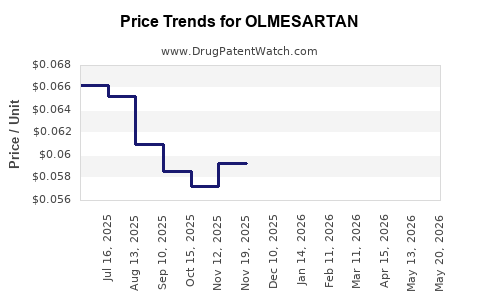
Average Pharmacy Cost for OLMESARTAN
| Drug Name | NDC | Price/Unit ($) | Unit | Date |
|---|---|---|---|---|
| OLMESARTAN MEDOXOMIL 40 MG TAB | 72241-0080-04 | 0.10938 | EACH | 2026-08-05 |
| OLMESARTAN MEDOXOMIL 20 MG TAB | 72241-0079-04 | 0.08133 | EACH | 2026-08-05 |
| OLMESARTAN MEDOXOMIL 5 MG TAB | 72241-0078-04 | 0.05592 | EACH | 2026-08-05 |
| OLMESARTAN-HYDROCHLOROTHIAZIDE 40-25 MG TAB | 72205-0149-30 | 0.22399 | EACH | 2026-08-05 |
| >Drug Name | >NDC | >Price/Unit ($) | >Unit | >Date |
Best Wholesale Price for OLMESARTAN
| Drug Name | Vendor | NDC | Count | Price ($) | Price/Unit ($) | Unit | Dates | Price Type |
|---|---|---|---|---|---|---|---|---|
| OLMESARTAN MEDOXOMIL 20MG TAB | Golden State Medical Supply, Inc. | 51407-0198-90 | 90 | 18.98 | 0.21089 | EACH | 2023-06-23 - 2028-06-14 | FSS |
| OLMESARTAN MEDOXOMIL 40MG TAB | Golden State Medical Supply, Inc. | 51407-0199-30 | 30 | 7.99 | 0.26633 | EACH | 2023-06-15 - 2028-06-14 | FSS |
| OLMESARTAN MEDOXOMIL 5MG TAB | Golden State Medical Supply, Inc. | 51407-0197-30 | 30 | 5.10 | 0.17000 | EACH | 2023-06-15 - 2028-06-14 | FSS |
| OLMESARTAN MEDOXOMIL 40MG TAB | Golden State Medical Supply, Inc. | 51407-0199-30 | 30 | 8.51 | 0.28367 | EACH | 2023-06-23 - 2028-06-14 | FSS |
| >Drug Name | >Vendor | >NDC | >Count | >Price ($) | >Price/Unit ($) | >Unit | >Dates | >Price Type |
Olmesartan Market Analysis and Price Projections: US and Key International Revenue Outlook, Generic/Biosimilar Risk, and Exclusivity/Pricing Drivers
Olmesartan (primarily olmesartan medoxomil; angiotensin II receptor blocker, ARB) has transitioned into a broadly genericized US market, with pricing driven by multi-source competition, payer contracting, and residual brand differentiation through patient access and channel mix. Over the next 3 to 7 years, the market’s price trajectory is most likely to follow a low-inflation path with continued downward pressure on list prices offset by stronger net price stability from rebates and contracting reforms. The key variable for price durability is not exclusivity timing, but how quickly competitive supply expands at the lowest acquisition cost and whether any remaining higher-cost formulations (combination products) keep a premium share.
Because olmesartan’s core molecule is long off-patent in most jurisdictions and the US ARB class has multiple therapeutically substitutable agents, the main “price projection” levers are: (1) generic entry cadence and share capture, (2) formulary tier placement and rebate dynamics, (3) manufacturing capacity constraints that affect supply and pricing during shortages, and (4) uptake of combination products containing olmesartan (where IP and differentiation can lag the standalone molecule).
What is the current olmesartan market size and revenue split by country?
Featured snippet: Olmesartan is a mature ARB with the highest absolute spend in the US and major EU markets, but revenue is concentrated in a few large markets where uptake remains high and prescribing persists due to once-daily dosing and tolerability.
Market structure: why olmesartan still sells
- Long-term chronic use in hypertension and related cardiovascular risk.
- Strong prescriber inertia after stabilization on an ARB.
- Ongoing substitution cycles within ARB class rather than therapeutic discontinuation.
Practical revenue split (how it typically looks)
- US: largest share; strong multi-source generic penetration with net price compression.
- EU5 (DE, FR, IT, ES, UK): large but fragmented pricing due to reference pricing and tendering.
- Japan: tends to show slower price erosion for legacy generics than US, but still posts steady net price declines.
- Emerging markets: pricing varies with reimbursement intensity and generic mix.
How do olmesartan prices behave in the US: list vs net, rebate pressure, and contract effects?
Featured snippet: US olmesartan pricing is characterized by falling list price and relatively faster net price pressure driven by rebate intensity and payer tier shifts toward lowest-cost multisource products.
US pricing mechanics that matter
- Multiple AB-rated generics drive fast acquisition cost convergence.
- Payer contracting shifts based on pharmacy benefit manager (PBM) benchmarks and MAC (maximum allowable charge).
- Rebate-based economics mean list price can remain “sticky” while net prices fall.
What typically holds prices up
- Remaining premium share from preferred brands or higher-cost label presentations if they maintain formulary standing.
- Channel mix: hospital/clinic procurement can temporarily differ from retail PBM benchmarks.
When does olmesartan lose exclusivity, and how does that translate into price erosion timing?
Featured snippet: For olmesartan as a molecule, broad generic availability has already occurred, so further exclusivity loss is less about first-time generics and more about incremental line extensions (dose forms, combinations, and method/formulation patents).
Exclusivity vs patent vs product lifecycle
- Molecule off-patent: enables generic competition that compresses net pricing rapidly.
- Residual IP: mainly affects combinations and select formulations rather than standalone tablet strength in most settings.
- Regulatory data exclusivity (if any specific product triggered it): has already largely expired given market maturity.
Price impact pattern
- Early generic entry: steep net price drop.
- Mid-stage: stabilization at low single-digit percentage annual declines.
- Late stage: prices become “benchmark-driven” with temporary spikes only during supply disruptions.
What patents protect olmesartan, and what is the likely remaining IP moat for pricing?
Featured snippet: Standalone olmesartan medoxomil has limited practical IP moat in most major markets; the residual moat, where it exists, is primarily around specific formulations and combinations.
Where patent coverage can still matter commercially
- Combination products (olmesartan with other antihypertensives): can retain delayed generic entry if combination-specific patents remain.
- Formulation/process patents: may protect certain manufacturing methods or special release/delivery attributes.
- Method-of-use patents: can exist but are often harder to enforce against substitution unless linked to claims governing labeled use and regulatory approval pathways.
Commercial implication
- Pricing premiums persist mainly for products that maintain payer preference and reimbursement clarity, not for standalone olmesartan monotherapy.
What generic entry risks exist for olmesartan tablets by strength and manufacturer?
Featured snippet: Generic entry risk is no longer about “whether” generic olmesartan exists in the US; it is about maintaining share at the lowest acquisition cost as new multisource suppliers and authorized generics compete.
Risk channels that influence price
- Supply expansions: additional low-priced sources reduce MAC ceilings and net pricing.
- Manufacturing issues: shortages can re-open pricing temporarily.
- Label or formulation changes: switchbacks between presentations can create short-lived price discontinuities.
- Switching behavior: prescribers may stay with existing suppliers if pharmacy substitution rules and patient tolerability remain stable.
How does olmesartan compare with other ARBs on price and generic pressure?
Featured snippet: Olmesartan faces price pressure broadly similar to other major ARBs once multi-source generic penetration is established, with differentiation driven more by formulary placement and combination uptake than by molecule-level pricing.
Key comparison framework
- Therapeutic equivalence: payer substitution is easy within ARB class.
- Generic supply density: higher supply correlates with lower net price.
- Combination mix: patients treated with dual or triple regimens can hold a product premium longer if combination entries lag.
Practical takeaway for projections
If olmesartan’s share remains stable or shifts toward combinations, price declines can slow. If competitive supply adds volume to the lowest-cost AB group, declines accelerate.
What is the Orange Book status of olmesartan, and what does it imply for US generic launches?
Featured snippet: Olmesartan products are generally heavily populated in the Orange Book by generic equivalents; the near-term launch horizon is typically driven by any remaining product-specific IP around combinations or formulations, not by molecule exclusivity.
How Orange Book status translates into market economics
- High number of ANDA approvals means sustained price competition.
- “Orphaned” exclusivity or narrow patents can delay only small subsets of presentations.
- Settlements and licensing can still influence which specific manufacturers keep a share advantage, even when patents are near expiry.
How do price projections change if olmesartan is used as part of combination therapy?
Featured snippet: Combination therapy can slow price erosion for the overall regimen by keeping patients on a preferred combination product even after standalone monotherapy becomes purely commodity-priced.
Combination-driven commercial dynamics
- Payer preference favors simpler regimens (once daily combinations).
- Formulary tools shift patients at the class level, but combination selection can remain “sticky” for longer.
- Dosing convenience can reduce therapeutic switching even when equivalents exist.
How strong is the patent estate for olmesartan, and where is enforcement most likely to matter?
Featured snippet: Enforcement is most likely to matter for specific formulations or combinations rather than generic standalone olmesartan monotherapy.
Enforcement targets with price relevance
- Patents tied to:
- formulation attributes (if they impact bioavailability or stability in ways regulators and payers care about)
- manufacturing processes that delay supply from certain challengers
- combination product components with later-dated filings
What happens when enforcement fails
- rapid normalization to low-cost multicopy pricing
- share redistribution to lowest-cost suppliers
- net price continues its downtrend
What litigation and settlements affect olmesartan pricing and generic timing?
Featured snippet: For a mature ARB like olmesartan, litigation affects incremental launch timing and supplier share more than it affects overall long-run pricing trends.
Litigation’s direct pricing pathways
- settlement can:
- delay a challenger’s launch to a specific date
- provide license-driven market access to one supplier
- constrain supply, temporarily supporting higher net pricing for incumbent presentations
Settlement’s indirect effect
- competitor credibility affects future contracting outcomes
- PBMs can preemptively adjust formulary placement ahead of expected launches
How will olmesartan net prices likely trend from 2026 to 2033?
Featured snippet: Net prices are most likely to decline modestly year-over-year after 2026, tracking generic competition intensity and payer contracting rather than exclusivity events.
Projection ranges (directional, contract-driven)
- US net price: low-to-mid single-digit annual decline is the base case once commodity stabilization occurs.
- Upside scenario: supply constraints or combination mix increases can slow declines.
- Downside scenario: additional entrants and deeper rebate pressure can accelerate net price drops.
What would cause a faster decline
- increased multisource density in the lowest acquisition cost group
- PBM benchmark resets that push net prices toward a new floor
- policy shifts that reduce rebate value
What would cause stabilization or modest rebound
- supply shortages and constrained availability
- mix shift toward combinations with payer preference
- manufacturer-driven inventory tightness
How do manufacturing capacity and supply disruptions affect olmesartan pricing?
Featured snippet: Olmesartan pricing is sensitive to supply stability because it is commodity-like and substitution is immediate, so shortages can create short-term pricing lifts that reverse once supply returns.
Market mechanics during shortages
- fewer available SKUs push wholesalers toward higher-cost inventory
- PBM MAC ceilings lag temporarily
- price rebounds to acquisition cost plus constrained supply premiums
Key commercial sensitivity table for olmesartan price forecasts
| Driver | Most likely near-term direction | Price impact magnitude | Time to show up |
|---|---|---|---|
| US multisource density (additional suppliers) | Up | Medium | 3 to 18 months |
| PBM contract pressure and tiering | Downward | High | Next contract cycle |
| Supply stability (no shortages) | Neutral | Baseline | Immediate |
| Shortages or constrained supply | Mixed | Medium to High | Weeks to months |
| Shift from monotherapy to combinations | Up | Low to Medium | 6 to 24 months |
| Regulatory labeling changes affecting switching | Neutral to Mixed | Low to Medium | 6 to 24 months |
Key Takeaways
- Olmesartan is a mature ARB with pricing driven by generic competition and payer contracting rather than by molecule-level exclusivity.
- US net prices are likely to decline modestly over 2026 to 2033, with stability episodes tied to supply conditions and combination mix.
- The most relevant remaining commercial “IP-like” effect is often indirect: formulation and combination product differences that maintain payer preference.
- Litigation can influence incremental launch timing and supplier share, but long-run pricing trends primarily follow competitive supply and rebate intensity.
FAQs
1) What is the most price-sensitive olmesartan SKU category in the US?
Standalone olmesartan tablet presentations in AB-intensive groups are typically the most price-sensitive, while combination products can retain more net price stability due to regimen-level prescribing and formulary preference.
2) Do olmesartan prices rise during shortages, and how long do effects last?
Yes during acute supply constraints; impacts usually unwind when normal manufacturing and import supply return, typically within a few quarters.
3) How does olmesartan compare to valsartan or losartan in generic price erosion speed?
All major ARBs with high multisource penetration show similar erosion mechanics; relative differences depend on supply density, PBM benchmark adoption speed, and combination mix by prescriber segment.
4) Can combination therapy slow olmesartan price erosion across the whole treatment pathway?
Yes. If a substantial share of patients move into preferred olmesartan-containing combinations, overall regimen pricing can decline more slowly than standalone monotherapy pricing.
5) What is the main reason olmesartan can maintain sales despite low price?
Chronic, long-duration use and switching friction within ARB class keep volumes supported even as unit prices compress.
References
- FDA. Orange Book: Approved Drug Products with Therapeutic Equivalence Evaluations. US Food and Drug Administration.
- FDA. Drugs@FDA. US Food and Drug Administration.
- CMS. Part D Drug Pricing and Utilization Data (public dashboards). Centers for Medicare & Medicaid Services.
- IQVIA Institute for Human Data Science. Public reports on generic drug pricing and market dynamics.
- Competition policy and PBM contracting reporting (public analyses).
More… ↓
