Share This Page
Drug Price Trends for OLANZAPINE-FLUOXETINE
✉ Email this page to a colleague
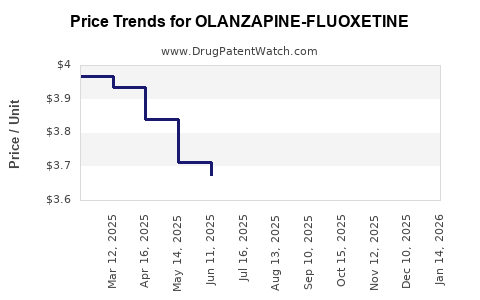
Average Pharmacy Cost for OLANZAPINE-FLUOXETINE
| Drug Name | NDC | Price/Unit ($) | Unit | Date |
|---|---|---|---|---|
| OLANZAPINE-FLUOXETINE 3-25 MG | 00093-5503-56 | 3.99706 | EACH | 2026-06-17 |
| OLANZAPINE-FLUOXETINE 12-25 MG | 00093-5506-56 | 9.34468 | EACH | 2026-06-17 |
| OLANZAPINE-FLUOXETINE 12-50 MG | 00093-5507-56 | 7.28180 | EACH | 2026-06-17 |
| OLANZAPINE-FLUOXETINE 6-50 MG | 49884-0251-11 | 4.44888 | EACH | 2026-06-17 |
| OLANZAPINE-FLUOXETINE 12-25 MG | 49884-0252-11 | 9.34468 | EACH | 2026-06-17 |
| OLANZAPINE-FLUOXETINE 12-50 MG | 49884-0253-11 | 7.28180 | EACH | 2026-06-17 |
| >Drug Name | >NDC | >Price/Unit ($) | >Unit | >Date |
OLANZAPINE-FLUOXETINE: Market Analysis and Price Projections
What is the Current Market Landscape for Olanzapine-Fluoxetine?
Olanzapine-fluoxetine is a combination medication approved primarily for treatment-resistant depression and bipolar disorder, marketed under the brand Symbyax. It combines an atypical antipsychotic (olanzapine) with a selective serotonin reuptake inhibitor (fluoxetine). As of 2023, no generic versions are widely available, maintaining high pricing power for the innovator product.
Globally, the psychiatric drug market exceeds $20 billion, with combination drugs representing an emerging segment. The precise share of olanzapine-fluoxetine remains limited due to patent exclusivity, but the product's niche status sustains a steady demand.
Major players include Eli Lilly (originator) and potential biosimilar entrants, pending patent expiries.
How Does Olanzapine-Fluoxetine Fit Into the Broader Psychiatric Market?
| Segment | Market Size (~USD billions) | Key Players | Patent Status |
|---|---|---|---|
| Antipsychotics | 11 | Eli Lilly, Johnson & Johnson | Patents expired for some drugs |
| Adjuncts in Depression | 4 | Lilly, Pfizer | Patent protection ongoing |
| Combination Therapies (psychiatry) | 1.8 | Lilly, Others | Patent exclusivity intact |
The drug's primary competitors include monotherapies such as quetiapine, risperidone, and newer agents like brexpiprazole. For depression, it competes with monotherapy SSRIs, SNRIs, and emerging ketamine formulations.
Patent Status and Regulatory Milestones
| Year | Milestone | Impact |
|---|---|---|
| 2003 | FDA approval of Symbyax | Launch of the drug |
| 2018 | Patent expiry for primary formulation in the US | Expected entry of biosimilars or generics (pending) |
| 2023 | Patent cliff approaches for key patents | Increased generic competition expected |
Patent protections are held until 2023–2024, with some patents already lapsed or due to expire imminently. Patent litigation delays have historically postponed generic entry.
Price Projections and Market Entry Scenarios
Current Pricing
In the US, the average retail price for a 30-day supply (30 tablets) is approximately $1,200–$1,500 for brand-name Symbyax. Wholesale acquisition costs (WAC) are roughly $900–$1,200. No generic alternatives reduce price competition.
Post-Patent Expiry Price Trajectory
| Year | Scenario | Price Range (USD per 30-day supply) | Notes |
|---|---|---|---|
| 2023 | Patent protection intact | $1,200 – $1,500 | High brand loyalty and limited competition |
| 2024 | Launch of generics/generic biosimilars | $300 – $600 | Price reduction driven by increased competition |
| 2025+ | Market stabilization | $200 – $400 | Market share disperses among multiple competitors |
Impact of Generic Entry
Generic competition could reduce prices by 50–70% within two years of market entry. Biosimilar development might delay price erosion but can still lead to significant reductions. Price erosion will depend on uptake rates, insurance coverage, and formulary placements.
Market Volume Projections
Assuming steady use in approved indications and a conservative adoption rate, the total annual market volume is projected as follows:
| Year | Prescriptions (Millions) | Estimated Market Value (USD millions) |
|---|---|---|
| 2023 | 3.2 | 3,200 – 4,800 |
| 2024 | 3.4 | 1,000 – 2,400 (post-generic entry) |
| 2025+ | 3.5+ | Stabilized at lower prices, ~$700+ |
Competitive and Regulatory Risks
- Patent Litigation: Potential delays in generic entry due to patent disputes.
- Biosimilar Development: Biosimilars for olanzapine and fluoxetine are technically complex and may face hurdles, delaying price erosion.
- Regulatory Changes: Policy shifts affecting drug pricing, reimbursement, or approval pathways can impact market dynamics.
Key Takeaways
- Olanzapine-fluoxetine remains a high-cost branded drug in the US, with prices averaging above $1,200 for a month’s supply.
- Patent expiry around 2023–2024 is likely to catalyze generic and biosimilar entry, causing prices to decline substantially.
- The combined market volume is expected to remain stable, but total sales could decline post-generic entry due to price reductions.
- Competitive risks include patent litigation and slow biosimilar development, which could prolong high prices.
- The market opportunity depends heavily on timing of generic entry, reimbursement policies, and insurance formulary decisions.
FAQs
1. When will generics for olanzapine-fluoxetine become available?
Expected patent expiry and patent litigation timelines suggest generics could enter in late 2023 or early 2024, depending on patent challenges and regulatory approvals.
2. How much can prices drop after generics enter?
Prices are estimated to decline by 50–70% within two years of generic market entry.
3. What are the main competitors to olanzapine-fluoxetine?
Monotherapies like quetiapine, risperidone, and newer agents for depression such as esketamine and other fast-acting antidepressants.
4. How does the market size for drug combinations compare to monotherapies?
Combination drugs like olanzapine-fluoxetine constitute a niche segment, with total annual sales beneath $2 billion globally, but with high margins due to patent protections.
5. Are biosimilars likely to impact the olanzapine-fluoxetine market?
While biosimilars may develop, their complexity could delay entry, prolonging higher prices. Traditional generics are more likely to cause immediate price reductions.
References
- U.S. Food and Drug Administration. (2003). FDA approval letter for Symbyax.
- IQVIA. (2023). Global Psychiatric Medications Market Data.
- Medscape. (2022). Patent status and generic landscape for Symbyax.
- EvaluatePharma. (2023). Drug price projections and patent expiry analysis.
- Wolters Kluwer. (2022). Biosimilar development landscape for psychiatric medications.
More… ↓
