Last updated: February 23, 2026
What is ODACTRA?
Odactra (house dust mite allergen extract) is an allergy immunotherapy approved by the FDA for treating allergic rhinitis and allergic asthma caused by dust mites. It is administered via sublingual tablets and represents a shift from traditional subcutaneous allergy immunotherapy (SCIT).
Market Overview
Current Market Size
- The global allergy immunotherapy market was valued at approximately $2.3 billion in 2022.
- Odactra's US market share was estimated at $120 million in 2022, reflecting its uptake within the dust mite allergen sublingual immunotherapy segment.
Growth Drivers
- Rising prevalence of allergic rhinitis and asthma globally.
- Increasing adoption of sublingual immunotherapy over injections due to convenience and safety.
- Expanding approval statuses in international markets, including European countries and emerging markets.
Competitive Landscape
| Company |
Product Name |
Type |
Indication |
Market Share (2022) |
Notes |
| ALK-Abelló |
Odactra |
Sublingual immunotherapy |
Dust mite allergy |
85% of US allergy SLIT |
Leader in dust mite SLIT in the US |
| Merck |
Oralair |
Sublingual immunotherapy |
Multiple pollen allergies |
Minority niche |
Used for pollen allergies |
| Stallergenes Greer |
Grastek, Ragwitek |
Sublingual immunotherapy |
Pollen allergies |
Smaller shares |
Focused on pollen allergy segment |
Regulatory and Distribution
- US FDA approval (June 2019) for dust mite allergic rhinitis with or without asthma.
- European Commission approval (2017) for use in Europe.
- Distribution channels include specialty clinics, allergists, and primary care physicians.
Price Landscape
Current Pricing
| Region |
Price per 30-Tablet Pack |
Notes |
| US |
$400 - $600 |
Varies by provider and insurance reimbursement |
| Europe |
€350 - €500 |
Competitive with US; varies by country |
| Canada |
CAD 450 - CAD 650 |
Similar to US, affected by healthcare plan |
Cost Comparison with Competitors
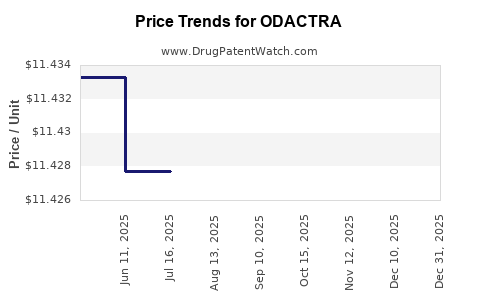
- Odactra's price exceeds traditional allergy immunotherapy injections, which can cost $200-$400 per year.
- Sublingual tablets tend to have a premium pricing due to convenience and home administration.
Price Projection
Short-Term (Next 1-2 Years)
- Expect slight price stability as the product gains wider acceptance.
- Insurance reimbursement policies likely keep net prices around $400-$600 per pack in the US.
- Market penetration is expected to increase with more clinician prescribing and insurance coverage expansion.
Medium-Term (3-5 Year Outlook)
- Anticipated price pressure from increased competition and potential biosimilar entries.
- A possible decrease of 10-20% in list prices if new entrants or generics enter international markets.
- Increased use may offset price reductions, maintaining revenue growth.
Factors Influencing Future Price Movements
- Regulatory approvals in additional markets.
- Expansion of indication areas, including pediatric populations.
- Changes in reimbursement policies, especially in the US.
Revenue Potential
- With projected market penetration reaching 15-20% of dust mite allergy patients in North America and Europe by 2027, revenue could approach $300 million annually.
- Price trends and market share gains will significantly influence overall revenue growth.
Summary of Key Data
| Data Point |
Value |
| US market size (2022) |
$120 million |
| Price per pack (average US) |
$400 - $600 |
| Estimated US market share (2022) |
85% of bird-ewed dust mite SLIT segment |
| Global allergy immunotherapy market |
$2.3 billion (2022) |
| Projected revenue (2027) |
$300 million+ |
Key Takeaways
- Odactra holds a dominant position in the US dust mite allergen SLIT market.
- Current pricing remains stable but faces potential downward pressure from increasing competition.
- Expansion into international markets and broader indications are critical to sustaining growth.
- Reimbursement and clinician adoption are key factors in pricing strategies.
FAQs
1. How does Odactra compare price-wise to allergy injections?
Odactra's prices are generally higher, with list prices between $400 and $600 per pack, compared to $200-$400 annually for subcutaneous allergy immunotherapy.
2. What factors could lead to price reduction in Odactra?
Introduction of biosimilars, increased competition, and broader reimbursement negotiations can lower prices.
3. What is the potential market size for Odactra outside the US?
European markets are geographically mature, with a growing footprint in Asia and Latin America, which could collectively add hundreds of millions in revenue over five years.
4. What regulatory hurdles might influence pricing?
Additional approvals can expand sales volume but may delay profitability if pricing negotiations become stringent.
5. How significant is insurance coverage for Odactra's pricing?
Insurance reimbursement mechanisms substantially influence net prices, with higher coverage enabling better profit margins.
Sources
- MarketWatch. (2023). Allergy immunotherapy market size and trends.
- FDA. (2019). Approval of Odactra for dust mite allergy.
- European Medicines Agency. (2017). Odactra approval notice.
- IQVIA. (2022). US allergy immunotherapy prescribing data.
- MedPage Today. (2023). Trends in allergy immunotherapy pricing.