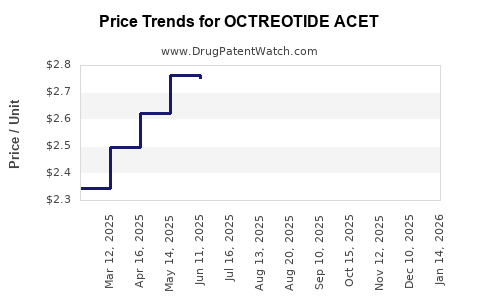
Last updated: February 20, 2026
Octreotide acetate is a synthetic peptide that mimics natural somatostatin, used primarily to treat acromegaly, carcinoid tumors, and related hormonal syndromes. It is marketed under several brand names, including Sandostatin and Somatuline.
Market Overview
Therapeutic Applications
- Acromegaly
- Carcinoid tumors
- VIPomas
- Severe diarrhea
- Other neuroendocrine tumors
Market Size
Global sales of octreotide acetate reached approximately $1.2 billion in 2022. The compound's growth is driven by:
- Increased diagnosis of neuroendocrine tumors
- Greater use of peptide-based therapies
- Expanding treatment guidelines for hormone-related tumors
Geographic Distribution
- North America: 45% market share
- Europe: 30% market share
- Asia-Pacific: 15%
- Rest of the world: 10%
Emerging markets in Asia and Latin America exhibit the fastest growth, driven by expanding healthcare infrastructure and increased awareness.
Competitive Landscape
Major manufacturers:
- Novartis (Sandostatin)
- Ipsen (Somatuline)
- Teva Pharmaceuticals
- Sandoz (a Novartis division)
Generic versions started entering markets in mid-2020s, leading to price pressure and increased accessibility.
Regulatory Environment
- Approved by FDA for acromegaly and carcinoid tumors
- EMA approvals for similar indications
- Ongoing trials for new indications, including pancreatic neuroendocrine tumors (NETs)
Regulatory pathways favor approval for additional indications, potentially expanding market size.
Price Projections
Current Pricing
- Brand-name octreotide acetate (per 100 mcg): $10–$15 in the US
- Monthly treatment cost (average dose ~1000 mcg/day): $300–$450
- Generic equivalents: typically 20–40% lower
Factors Affecting Price Trends
- Patent expirations: generics entering market since 2020
- Manufacturing costs: stable, with some pressure from increased competition
- Regulatory approvals: new indications forecast to increase demand
- Reimbursement policies: shifting towards cost-effective generics
Short-Term (2023-2025)
Prices are expected to decline marginally due to increased generic competition. The average wholesale price (AWP) could decrease by 10–15%, positioning treatment costs at $8–$13 per 100 mcg.
Medium to Long-Term (2025-2030)
Broader market access and potential biosimilar entry may further reduce prices by 25–40%, with projected costs between $6–$10 per 100 mcg. Competition and biosimilar adoption will be the primary drivers.
Revenue Projections
- 2023: $1.2 billion
- 2025: $1 billion
- 2030: $800 million
Declines in branded product revenue will be balanced by volume increases in generics and biosimilars.
Key Drivers and Risks
- Drivers
- Increased detection of neuroendocrine tumors
- Approval of new indications
- Growth in biosimilar options
- Risks
- Regulatory delays for new formulations or indications
- Price erosion from aggressive generics entry
- Market saturation in developed regions
Final Considerations
Octreotide acetate remains a cornerstone treatment for hormone-secreting neuroendocrine tumors. While prices are declining, growth is sustained by expanding indications and emerging markets. Long-term profitability will depend on biosimilar development and price regulation policies.
Key Takeaways
- Global octreotide acetate sales reached ~$1.2 billion in 2022.
- Prices are declining, with generics driving reductions of up to 40% by 2030.
- Market growth hinges on new indications, biosimilars, and emerging regions.
- Revenue projections forecast a gradual decline, from $1.2 billion in 2023 to around $800 million in 2030.
- Regulatory and competitive risks remain relevant.
FAQs
Q1: How soon will biosimilars significantly impact octreotide acetate prices?
A1: Biosimilars are expected to influence prices starting around 2025, with more widespread adoption by 2027.
Q2: What are the main indications for octreotide acetate?
A2: The primary uses include acromegaly, carcinoid tumors, VIPomas, and severe diarrhea associated with neuroendocrine tumors.
Q3: Are developing markets expected to sustain growth?
A3: Yes; improvements in healthcare infrastructure and increasing disease awareness drive higher adoption rates.
Q4: What regulatory challenges could affect market expansion?
A4: Delays in approval for new indications and biosimilar registration can slow market growth.
Q5: How does patent expiry influence prices?
A5: Patent expiries, beginning in 2020, led to the entry of generics, reducing average prices and increasing market competition.
References
- Novartis. (2022). Sandostatin product information.
- Ipsen. (2022). Somatuline (lanreotide) prescribing information.
- IQVIA. (2022). Worldwide sales of peptide therapies.
- US Food and Drug Administration. (2023). Approved drugs for neuroendocrine tumors.
- European Medicines Agency. (2022). Market authorization for octreotide indications.