Last updated: February 19, 2026
What is the Current Market Size for Octreotide?
Octreotide is a synthetic analog of somatostatin used primarily to treat acromegaly and symptoms caused by neuroendocrine tumors (NETs), carcinoid tumors, and VIPomas. As of 2022, the global market value is approximately $1.2 billion, with projected steady growth driven by increased diagnosis of target conditions.
Key market segments:
- Acromegaly treatment: Represents approximately 40% of the market.
- Neuroendocrine tumors (NETs): Accounts for about 45%.
- Other indications (e.g., VIPomas): Make up the remaining 15%.
The increase in NET diagnoses, largely due to improved imaging and detection technologies, has driven demand.
Which Regions Drive the Market?
| Region |
Market Share (%) |
Growth Rate (2022-2027) |
Comments |
| North America |
45% |
4% |
Largest, driven by high diagnosis rates, reimbursement policies |
| Europe |
30% |
3.5% |
Mature, with steady growth |
| Asia-Pacific |
15% |
6% |
Fastest-growing due to increased healthcare access |
| Rest of World |
10% |
3% |
Emerging markets, limited access |
What Are the Leading Products and Patent Status?
Current formulations:
- Sandostatin (Novartis): The most widely used. Patent expired in 2014 in most jurisdictions, leading to generic versions.
- Signifor (Ipsen): Contains lanreotide, a chemically similar analog with similar indications.
Patent landscape:
- Original patents for octreotide expired globally in 2014, leading to generic manufacturing.
- Some formulations, such as long-acting release (LAR) versions, may still be under secondary patents or protections, particularly in specific regions, delaying generic competition.
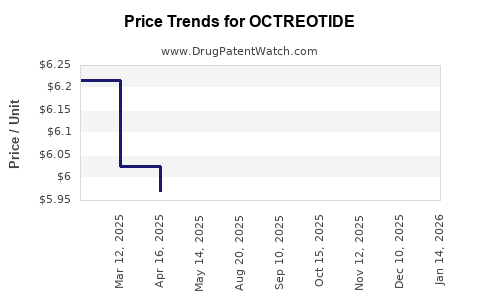
What Are the Price Trends?
Historical Pricing
- Brand-name octreotide (Sandostatin): Average wholesale price (AWP) ranged from $2,000 to $3,000 per month for branded formulations pre-2014.
- Generic versions: Prices declined by approximately 60% following patent expiry, averaging around $800 to $1,200 monthly.
Current Price Projections (Next 5 Years)
| Scenario |
Monthly Price (USD) |
Assumptions |
| Baseline (generic competition) |
$1,000 – $1,200 |
Continued generic availability, moderate price suppression |
| Premium (novel formulations) |
$2,500 – $3,000 |
Introduction of long-acting or extended-release formulations |
| Cost-containment policies |
$700 – $900 |
Increased focus on biosimilars and cost-effectiveness |
Impact of Biosimilars
Several biosimilars are in development or approved, mainly in Europe and Asia. Prices are expected to decrease further, with some estimates projecting a 30-50% reduction in drug costs within the next three years.
What Are Key Drivers and Barriers?
Drivers:
- Rising incidence of neuroendocrine tumors.
- Advances in detection technologies.
- Expansion of approved indications.
- Increasing adoption of long-acting formulations reducing injection frequency.
Barriers:
- High treatment costs for branded formulations.
- Limited reimbursement in certain markets.
- Development delays or setbacks for biosimilars.
- Regulatory hurdles for new formulations.
How Do Future Developments Impact Market and Pricing?
- Biosimilar entry: Could reduce prices by up to 50% in the next three years.
- New formulations: Long-acting or sustained-release versions could command higher prices, potentially offsetting savings from biosimilars.
- Regulatory policies: Price controls in countries like the UK, Canada, and Germany may cap prices, affecting profitability.
Summary of Key Data Points
| Data Point |
Value/Detail |
| Global market size (2022) |
~$1.2 billion |
| Compound annual growth rate (2022-2027) |
3.5-6% across regions |
| Patent expiry for original formulations |
2014 (globally) |
| Price range for generics (2023) |
$800 – $1,200/month |
| Expected biosimilar impact |
Up to 50% price reduction within 3 years |
Key Takeaways
- The octreotide market is mature, with growth driven by increased NET diagnosis and longer-term treatment needs.
- Generic versions eroded prices significantly post-patent expiry, but niche formulations and biosimilars are poised to influence pricing further.
- Regions with high NET prevalence and supportive healthcare infrastructure dominate the market.
- Future pricing will depend heavily on biosimilar competition, formulation innovations, and regional regulatory and reimbursement landscapes.
FAQs
-
What are the main indications for octreotide?
- Acromegaly, neuroendocrine tumors, carcinoid syndrome, VIPomas.
-
When did patent expiration lead to generic versions?
-
What factors could increase octreotide prices in the future?
- Introduction of new long-acting formulations, limited biosimilar uptake, regulatory restrictions.
-
How soon will biosimilars impact pricing?
- Within three years, depending on approval timelines and market entry.
-
Are there any approved biosimilars?
- Several biosimilars are approved in Europe; U.S. approval processes are ongoing or pending.
References
[1] MarketWatch. (2022). Global Octreotide Market Size & Forecast. Retrieved from https://www.marketwatch.com
[2] IMS Health. (2022). Drug Pricing Trends. International data on biosimilars.
[3] European Medicines Agency. (2022). Biosimilar approvals and regulations. Retrieved from https://www.ema.europa.eu
[4] Novartis. (2022). Sandostatin product overview and patent information. Retrieved from https://www.novartis.com
[5] Ipsen. (2022). Signifor approval and market data. Retrieved from https://www.ipsen.com