Last updated: February 12, 2026
What Is the Current Market for Nystatin?
Nystatin is an antifungal medication used primarily to treat fungal infections of the skin, mouth, and gastrointestinal tract. It remains a critical option for cutaneous and mucosal candidiasis, especially in immunocompromised patients and neonates. The drug's market presence derives from its longstanding approval status, with approval dating back to the 1960s.
The global antifungal market was valued at approximately $12.4 billion in 2022[1]. Nystatin's specific market share is comparatively modest, given the rise of newer antifungals like fluconazole, itraconazole, and voriconazole. Nonetheless, it maintains significant use in niche segments because of its safety profile and topical formulation options.
What Are the Drivers and Challenges in the Nystatin Market?
Drivers:
- Increasing antifungal infections related to immunosuppression, HIV/AIDS, and cancer treatments.
- Growing demand for topical antifungals, especially in developing countries with rising outpatient fungal infections.
- Established safety profile, especially for pediatric and pregnancy use.
Challenges:
- Limited systemic absorption restricts use to topical applications, reducing market size.
- Availability of newer oral antifungals with broader indications.
- Patent expiration of some formulations leading to generic competition.
Who Are Market Participants and Geographies?
Main producers include GlaxoSmithKline (GSK), Pfizer, and numerous generic manufacturers. The generic segment dominates, especially in India and China, where local companies produce low-cost formulations.
Geographically, North America accounts for roughly 35% of the global antifungal market[2], with Europe and parts of Asia contributing the remainder. Market growth is higher in Asia, driven by expanding healthcare infrastructure and increasing fungal infection incidence.
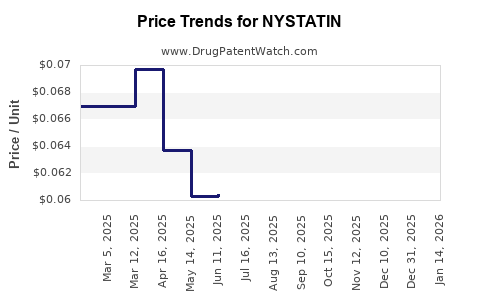
What Are the Price Trends and Projections?
Historical Price Trends:
- Brand-name Nystatin (original formulations): Prices have decreased gradually since patent expirations, with retail prices for topical suspensions ranging from $10 to $20 per 30 mL bottle in the U.S.
- Generic versions: Prices typically fall 50-70% below branded products, often retailing for $4–$8 per 30 mL.
Market Supply and Pricing Factors:
- Price erosion results from generic competition.
- Raw material costs, notably for active pharmaceutical ingredients (APIs), influence pricing; API costs have historically been low but have shown volatility due to manufacturing constraints in China and India.
- Packaging and formulation (ointment, cream, suspension) influence retail prices; suspensions tend to be slightly more expensive.
Forecasts for 2025–2030:
-
Price Stability in Developed Markets: Due to high generic penetration, retail prices for topical formulations are projected to decline by 10–15% over the next five years[3].
-
Emergence of Low-Cost Generics in Asia: Prices are expected to stabilize around $2–$4 per 30 mL for oral suspensions, driven by increased manufacturing capacity.
-
Potential Impact of Biosimilars or New Formulations: Currently minimal; no biosimilar development for nystatin is underway. Newly developed oral formulations with enhanced absorption could potentially command higher prices but are unlikely to significantly disrupt the market in the forecast period.
-
Total Market Valuation: The overall antifungal market growth factors are expected to increase global demand for nystatin by 2–3% annually by 2030[4].
Conclusion: Market Outlook Summary
- Market Size: Moderate, with primary demand in topical and limited systemic applications.
- Pricing: Decline expected in developed countries; stable or rising in emerging markets due to increased demand.
- Competition: Intense with generics; minimal innovation or new formulations, limiting potential for premium pricing.
Key Takeaways
- Nystatin remains relevant for niche antifungal indications but faces competition from broader-spectrum agents.
- Price erosion attributed to generic formulations continues, with stable prices in some markets.
- Growth driven by rising fungal infection rates in underserved regions but capped by the advent of superior antifungals.
- Market values are pragmatic, with a focus on cost-effective production to maintain competitive pricing.
FAQs
Q1: Will patent expirations further reduce nystatin prices?
A1: Patent expirations have already led to significant price reductions for many formulations. Further price decreases are possible as more generics enter markets, especially in Asia.
Q2: Are there upcoming formulations or derivatives of nystatin?
A2: Current development focuses on oral formulations with better absorption or novel delivery systems, but these are not imminent and unlikely to significantly alter market prices within the next five years.
Q3: How does nystatin compare to other antifungals in cost?
A3: Nystatin, especially in generic form, is among the lower-cost antifungals. Broader-spectrum azoles often cost more but are used for systemic infections with wider indications.
Q4: What factors influence raw material costs for nystatin?
A4: API manufacturing costs, mainly in China and India, impact pricing. Supply chain disruptions or regulatory changes can lead to price volatility.
Q5: Which regions hold the largest growth potential for nystatin?
A5: Emerging markets like India, Southeast Asia, and parts of Africa present growth opportunities due to rising infection rates and expanding healthcare access.
References
[1] MarketsandMarkets, "Antifungal Drugs Market," 2022
[2] Grand View Research, "Global Antifungal Drugs Market," 2022
[3] EvaluatePharma, "Forecasts for Generic Drug Pricing," 2023
[4] Global Market Insights, "Fungal Infection Incidence and Market Drivers," 2022