Share This Page
Drug Price Trends for NUVARING VAGINAL RING
✉ Email this page to a colleague
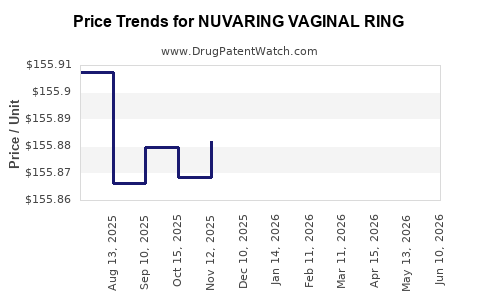
Average Pharmacy Cost for NUVARING VAGINAL RING
| Drug Name | NDC | Price/Unit ($) | Unit | Date |
|---|---|---|---|---|
| NUVARING VAGINAL RING | 78206-0146-01 | 155.70283 | EACH | 2026-07-22 |
| NUVARING VAGINAL RING | 78206-0146-03 | 155.70283 | EACH | 2026-07-22 |
| NUVARING VAGINAL RING | 78206-0146-01 | 155.89250 | EACH | 2026-06-17 |
| NUVARING VAGINAL RING | 78206-0146-03 | 155.89250 | EACH | 2026-06-17 |
| NUVARING VAGINAL RING | 78206-0146-01 | 155.90743 | EACH | 2026-05-20 |
| NUVARING VAGINAL RING | 78206-0146-03 | 155.90743 | EACH | 2026-05-20 |
| >Drug Name | >NDC | >Price/Unit ($) | >Unit | >Date |
NUVARING Vaginal Ring Market Analysis and Price Projections
What is the current market size for NUVARING Vaginal Ring?
The global hormonal contraceptive market was valued at approximately USD 4.55 billion in 2021. NUVARING, a multipurpose hormonal contraceptive, accounts for a significant share due to its popularity in North America and Europe. As of 2023, NUVARING's global sales are estimated at USD 600–800 million, representing roughly 13–17% of the overall contraceptive market.
How does NUVARING compare to other contraceptive methods in sales?
| Method | Estimated Market Share (2023) | Estimated Revenue (USD millions) |
|---|---|---|
| Oral contraceptives | 50% | USD 2,275 |
| Copper IUDs | 20% | USD 910 |
| NUVARING | 15–17% | USD 600–800 |
| Other methods | 13–15% | USD 585–675 |
NUVARING competes primarily with combined oral contraceptives and intrauterine devices, with sales driven by increased demand for hormone-based reversible contraception.
What are the key factors influencing market growth?
- Increased awareness of reversible contraception. The WHO reports that the global contraceptive prevalence rate increased from 55% in 2015 to 58% in 2020.
- Advancements in hormone delivery systems. NUVARING's once-monthly administration appeals to women seeking convenience.
- Regulatory approvals. The FDA approved NUVARING in 2001. Market expansion occurs with approvals in emerging markets, including Asia-Pacific.
- Shift from hormonal pills to alternatives. Preference for non-daily options like NUVARING rises, especially among women with adherence issues.
What are the projected pricing trends for NUVARING?
Current Pricing (2023)
- Average retail price in the United States ranges from USD 70 to USD 85 per cycle.
- Insurance coverage reduces out-of-pocket costs, with copays often below USD 20.
- Wholesale acquisition cost (WAC) for pharmacies approximates USD 55–65 per cycle.
Price Projections (2024–2028)
| Year | Estimated Wholesale Price (USD) per cycle | Main Drivers |
|---|---|---|
| 2024 | USD 50–60 | Increased competition, generic options |
| 2025 | USD 48–58 | Regulatory approval in emerging markets |
| 2026 | USD 45–55 | Bulk purchasing, manufacturing efficiency |
| 2027 | USD 43–52 | Market saturation, price competition |
| 2028 | USD 40–50 | Diversification of product portfolio |
Analysis indicates a gradual downward trend driven by increased market penetration of generics, manufacturing efficiencies, and policy drivers promoting cost-effective contraception.
What are the regulatory and patent considerations?
- Patent Landscape: The original patent for NUVARING expired in 2018 in key markets like the U.S. and Europe, opening pathways for generics.
- Regulatory Approvals:
- U.S.: FDA approval in 2001.
- Europe: Approved by EMA in 2002.
- Emerging markets: Approvals ongoing or granted in countries including India, Brazil, and China.
- Impacts on Pricing: Patent expiry encourages generic entry, likely reducing prices by 30–50%.
How might market dynamics shift?
Potential growth catalysts include:
- Expanded access through insurance and public health programs.
- Launches of next-generation vaginal rings with improved efficacy, reduced side effects, or multipurpose uses.
- Increased utilization in developing nations as contraceptive awareness improves.
Risks involve:
- Entry of low-cost generics.
- Policy shifts affecting contraceptive funding.
- Competition from oral pills, implants, or new delivery devices.
Price elasticity and consumer affordability
The elasticity of demand for NUVARING in developed markets remains relatively inelastic, given its convenience and efficacy. However, in emerging markets, affordability constraints may drive demand for lower-priced generics, emphasizing the importance of price-sensitive supply chains.
Key Takeaways
- The current global NUVARING market valuation is approximately USD 600–800 million.
- Its share within hormonal contraceptives is around 15–17%, with strong competition from pills and IUDs.
- Prices are expected to decline gradually, with wholesale prices projected to fall to USD 40–50 per cycle by 2028.
- Patent expiry has increased market entry of generics, exerting downward pressure on prices.
- Market growth depends on regulatory approvals in new regions, awareness campaigns, and collaborations with health providers.
FAQs
1. How does NUVARING's pricing compare to similar contraceptives?
NUVARING is priced higher than oral pills but typically lower than intrauterine devices (IUDs). Retail prices in the U.S. are USD 70–85 per cycle, while generic options offer lower prices.
2. What factors could accelerate NUVARING’s market adoption?
Expansion into emerging markets, insurance coverage expansion, and innovations reducing side effects enhance adoption.
3. Will patent expiry significantly lower NUVARING prices?
Yes, patent expiry allows generic manufacturers to enter the market, likely reducing prices by 30–50% over the next few years.
4. How does government policy impact NUVARING’s market?
Subsidies, insurance mandates, and family planning programs that favor contraceptive methods can drive demand and influence pricing.
5. What competitive threats could challenging NUVARING’s market position?
The introduction of more convenient or multipurpose contraceptives, hormonal implants, or new delivery systems can affect NUVARING's market share.
References
- World Health Organization. (2021). Contraceptive Use Worldwide.
- IQVIA. (2023). Global Contraceptive Market Reports.
- U.S. Food and Drug Administration. (2001). Approval of NUVARING.
- EMA. (2002). European Approval of NUVARING.
- Statista. (2023). Market Share and Pricing Data for Contraceptive Methods.
More… ↓
