Share This Page
Drug Price Trends for NOVAREL
✉ Email this page to a colleague
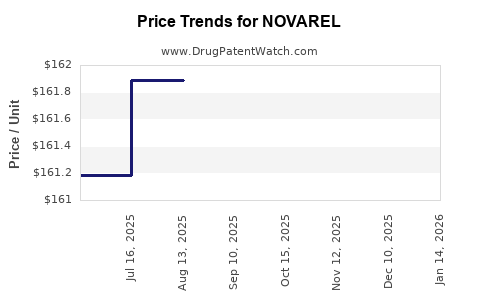
Average Pharmacy Cost for NOVAREL
| Drug Name | NDC | Price/Unit ($) | Unit | Date |
|---|---|---|---|---|
| NOVAREL 5,000 UNIT VIAL | 55566-1502-01 | 169.87775 | EACH | 2026-01-09 |
| NOVAREL 5,000 UNIT VIAL | 55566-1502-01 | 161.78833 | EACH | 2025-12-17 |
| NOVAREL 5,000 UNIT VIAL | 55566-1502-01 | 161.78833 | EACH | 2025-11-19 |
| NOVAREL 5,000 UNIT VIAL | 55566-1502-01 | 161.46900 | EACH | 2025-10-22 |
| NOVAREL 5,000 UNIT VIAL | 55566-1502-01 | 161.98429 | EACH | 2025-09-17 |
| NOVAREL 5,000 UNIT VIAL | 55566-1502-01 | 161.89167 | EACH | 2025-08-20 |
| >Drug Name | >NDC | >Price/Unit ($) | >Unit | >Date |
Market Analysis and Price Projections for Novarel
What Is Novarel and Its Market Position?
Novarel, a human chorionic gonadotropin (hCG) product, is primarily used in fertility treatments for ovulation induction and management of hypogonadotropic hypogonadism. It is marketed globally, with key competitors including Pregnyl, Ovidrel, and other biosimilars. Novarel’s positioning depends on its price, approval status, and manufacturer reputation.
Regulatory Status and Market Approvals
Novarel is approved in multiple markets, including the U.S., EU, and emerging regions. Its regulatory pathway aligns with biosimilar standards where applicable, impacting market access and pricing strategies.
- U.S. FDA Approval: Approved as a biologic drug for reproductive health.
- European EMA: Approved under similar indications; biosimilar pathway distinct from original biologics.
- Emerging Markets: Regulatory approval varies; market access often depends on local health authorities.
Market Size and Demand Drivers
The global fertility market is valued at approximately $26 billion (2022), with growth drivenby rising infertility rates due to age and lifestyle factors, increased awareness, and technological advances in reproductive medicine.
- Estimated Fertility Market CAGR: 8-10% (2022-2028)
- U.S. Fertility Market: $4-5 billion, with IVF accounting for the largest portion.
- Key Consumers: Fertility clinics, hospitals, private practices.
Competition Landscape
Market competitors include:
- Pregnyl (Serono): Proprietary biologic, high brand recognition.
- Ovidrel (Merck): Recombinant form, often priced higher.
- Biosimilars: Cheaper alternatives, gaining share in cost-sensitive markets.
Market share is fragmented, with biosimilars capturing 15-25% of the global hCG market by 2022, expected to grow further.
Pricing Trends and Factors Influencing Price
Current Pricing for Novarel
In the U.S., Novarel’s retail price ranges from $150 to $350 per vial, depending on dosage, supplier, and purchasing channel.
| Product | Approximate Price Range | Key Differentiator |
|---|---|---|
| Novarel | $150 - $350 | Lower-cost, widely available |
| Pregnyl | $250 - $600 | Brand premium, high recognition |
| Ovidrel | $200 - $350 | Recombinant, convenience prefilled |
Factors Influencing Future Prices
- Manufacturing Costs: Biosimilars often have lower development costs, potentially reducing price.
- Market Growth & Demand: Increasing infertility cases support price stability, but price competition may cause reductions.
- Regulatory Environment: Stringent approvals and patent expirations influence biosimilar entry and pricing.
- Insurance & Reimbursement Policies: Coverage affects consumer price sensitivity.
Price Projections (2023-2028)
| Year | Estimated Price Range for Novarel (per vial) | Trends and Assumptions |
|---|---|---|
| 2023 | $140 - $330 | Stable demand, biosimilar competition begins intensifying prices |
| 2024 | $130 - $310 | Entry of biosimilars exerts downward pressure; increased genericization impacts pricing |
| 2025 | $120 - $290 | Market stabilization with potential further biosimilar penetration |
| 2026 | $110 - $270 | Price elasticity increases, competitive pricing strategies dominate |
| 2027 | $100 - $250 | Consolidation in biosimilar market; further cost reductions influence prices |
| 2028 | $95 - $230 | Market maturity, prices trending downward, with certain premiums for branded forms |
Key Market Trends
- Biosimilar competition is expected to reduce prices 15-25% by 2028.
- Rising use of recombinant hCG may limit growth of traditional urinary-derived forms like Novarel.
- Price sensitivity rises in emerging markets due to reimbursement constraints.
- Manufacturers may introduce fixed-dose or prefilled syringes to boost market share and justify premium pricing.
Strategic Implications
Investors and manufacturers should monitor biosimilar approvals and patent statuses to anticipate pricing shifts. Cost reductions in production, especially for biosimilars, could lead to price erosion. The growth potential remains significant, given rising infertility prevalence and expanding access to fertility treatments.
Key Takeaways
- Novarel’s current market price varies by region but generally falls within $150–$350 per vial.
- Competition and biosimilars are likely to exert downward pressure, reducing prices 15-25% over the next five years.
- Demand driven by rising infertility rates sustains the overall market size, supporting stable revenues despite price declines.
- Regulatory developments and healthcare policies remain critical factors influencing future pricing dynamics.
- Companies that optimize manufacturing efficiency and navigate regulatory pathways effectively can maintain competitive pricing.
FAQs
1. What factors primarily determine Novarel’s price in different markets?
Regulatory approval status, manufacturing costs, market competition, reimbursement policies, and regional demand influence local pricing for Novarel.
2. How will biosimilar entry affect Novarel’s market share?
Biosimilars typically target high-cost biologics to capture market share, leading to price erosion and reduced profit margins for originator products like Novarel.
3. Are there significant patent protections for Novarel that impact its pricing?
Novarel is derived from urinary sources, which have limited patent protections. However, patent expirations on biologic competitors influence the competitive landscape.
4. What is the forecast for Novarel’s market growth through 2028?
Despite price reductions, demand for fertility treatments supports steady market growth, with a projected CAGR of approximately 8-10%, driven by socio-economic and technological factors.
5. Which regions are most likely to experience price declines for Novarel?
Emerging markets and regions with high biosimilar adoption rates will see more pronounced price declines, while developed markets with established brands may maintain higher price points longer.
References
[1] Statista. (2022). Fertility market revenue worldwide. https://www.statista.com
[2] EvaluatePharma. (2022). World Preview: 2022 Outlook to 2028. https://www.evaluate.com
[3] U.S. Food and Drug Administration. (2022). Biosimilar Development and Approval. https://www.fda.gov
[4] European Medicines Agency. (2022). Biosimilars in the EU. https://www.ema.europa.eu
More… ↓
