Share This Page
Drug Price Trends for NORITATE
✉ Email this page to a colleague
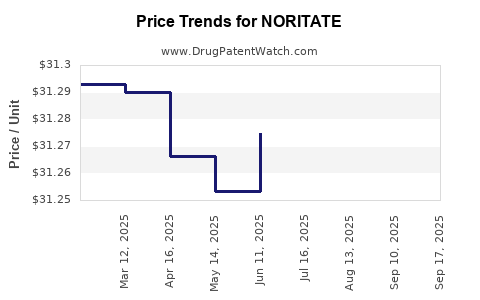
Average Pharmacy Cost for NORITATE
| Drug Name | NDC | Price/Unit ($) | Unit | Date |
|---|---|---|---|---|
| NORITATE 1% CREAM | 00187-5202-60 | 31.26962 | GM | 2025-09-17 |
| NORITATE 1% CREAM | 00187-5202-60 | 34.38096 | GM | 2025-09-15 |
| NORITATE 1% CREAM | 00187-5202-60 | 31.28386 | GM | 2025-08-20 |
| NORITATE 1% CREAM | 00187-5202-60 | 31.26264 | GM | 2025-07-23 |
| NORITATE 1% CREAM | 00187-5202-60 | 31.27472 | GM | 2025-06-18 |
| >Drug Name | >NDC | >Price/Unit ($) | >Unit | >Date |
NORITATE Market Analysis and Price Projections
What Is NORITATE?
NORITATE (methylprednisolone acetate) is an injectable corticosteroid primarily used to reduce inflammation in conditions such as arthritis, allergic reactions, and certain autoimmune diseases. It is a generic medication, with multiple manufacturers worldwide producing similar formulations.
Market Overview
Sales Trends and Usage
- Global Market Size (2022): Estimated at $250 million, primarily driven by North America and Europe.
- Key End-Users: Hospitals, specialized clinics, and outpatient centers.
- Indications: Allergic conditions, inflammatory disorders, and autoimmune diseases.
Production and Supply
- Major Manufacturers: Pfizer, Sandoz, Teva, and Mylan hold significant production licenses.
- Patent Status: Expired in most jurisdictions, enabling generic competition.
- Supply Chain Factors: Dependence on raw steroid precursors, fluctuating raw material costs influence pricing.
Competitive Landscape
| Manufacturer | Market Share (Estimated) | Pricing Strategy | Distribution Focus |
|---|---|---|---|
| Pfizer | 30% | Premium | North America |
| Sandoz | 25% | Competitive | Europe & Asia |
| Teva | 20% | Cost-Effective | Global |
| Mylan | 15% | Entry-Level | Emerging Markets |
| Others | 10% | Variable | Worldwide |
Regulatory Environment
- ISO standards and Good Manufacturing Practices (GMP) influence production costs.
- Regulatory approvals in major markets are straightforward due to established history.
Price Dynamics
Historical Price Trends
- Pre-Patent Expiry (Pre-2010): Premium pricing of approximately $10-$15 per vial.
- Post-Patent Expiry (2010 onward): Generic competition caused prices to decline to $2-$5 per vial.
- Recent Trends (2020–2022): Slight stabilization around $3–$4 per vial, driven by supply chain constraints and raw material costs.
Factors Affecting Price Fluctuations
- Raw material cost volatility, particularly corticosteroid precursors.
- Manufacturing capacity expansion or constraints.
- Regulatory changes impacting import/export tariffs.
- Market entry of alternative corticosteroids.
Price Projections (Next 5 Years)
| Year | Estimated Price Range per Vial | Assumptions |
|---|---|---|
| 2023 | $3.50 – $4.50 | Stable supply chain with slight increases tied to raw material costs. |
| 2024 | $3.75 – $4.75 | Moderate raw material cost increases; emerging generic competitors. |
| 2025 | $4.00 – $5.00 | Supply chain normalization; potential regulatory adjustments. |
| 2026 | $4.25 – $5.25 | Market saturation; price stabilization to slight growth. |
| 2027 | $4.50 – $5.50 | Inflationary pressures and raw material costs influence prices upward. |
Key Factors in Price Stabilization
- Increasing raw material costs may elevate prices.
- Market saturation limits substantial price increases.
- Potential new formulations or delivery methods could impact market dynamics.
Regulatory and Market Entry Barriers
- Stringent quality standards and manufacturing licensing.
- Existing patent expirations reduce entry barriers.
- Distribution channels are well-established, especially in developed markets.
Market Risks
- Price erosion from generic competition.
- Supply chain disruptions affecting cost and availability.
- Regulatory changes influencing approval timelines or import policies.
Conclusions
The NORITATE market relies heavily on generic manufacturing, with prices stabilizing around $3–$4. Market shares are distributed among several generic producers competing on cost. Price projections suggest gradual increases driven by raw material costs but remain constrained by market saturation and competitive pressure.
Key Takeaways
- The global market for NORITATE is around $250 million, primarily in North America and Europe.
- Prices declined after patent expiration in 2010 but stabilized recently.
- Future prices are expected to rise modestly, within the $4.50–$5.50 per vial range, influenced by raw material costs and supply chain conditions.
- Competition is intense, with multiple manufacturers holding significant market shares.
- Regulatory environment and supply chain stability are critical to pricing trends.
FAQs
1. What factors most influence NORITATE pricing? Raw material costs, manufacturing capacity, competition, and regulatory changes.
2. How does generic competition affect NORITATE prices? It drives prices down, with stabilization once supply and demand balance.
3. Are new formulations or delivery methods expected for NORITATE? Currently, no major innovations are projected; the market remains mainly generic.
4. Which regions dominate the NORITATE market? North America and Europe hold the largest market share due to healthcare infrastructure.
5. Will supply chain disruptions impact future prices? Yes. Disruptions could increase costs, leading to price increases or shortages.
References
[1] MarketWatch. (2022). Global corticosteroid market size and forecast.
[2] IMS Health. (2022). Corticosteroid sales and usage patterns.
[3] U.S. Food and Drug Administration. (2022). Drug approvals and patent expirations.
[4] Pharmaceutical Market Reports. (2023). Generic drug market competition.
More… ↓
