Share This Page
Drug Price Trends for NIZATIDINE
✉ Email this page to a colleague
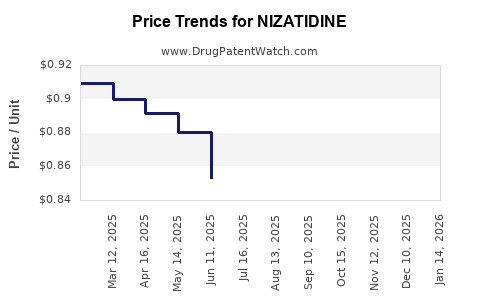
Average Pharmacy Cost for NIZATIDINE
| Drug Name | NDC | Price/Unit ($) | Unit | Date |
|---|---|---|---|---|
| NIZATIDINE 150 MG CAPSULE | 00591-3137-60 | 0.81685 | EACH | 2026-07-22 |
| NIZATIDINE 150 MG CAPSULE | 42806-0299-60 | 0.81685 | EACH | 2026-07-22 |
| NIZATIDINE 150 MG CAPSULE | 00591-3137-60 | 0.82735 | EACH | 2026-06-17 |
| NIZATIDINE 300 MG CAPSULE | 00591-3138-30 | 0.79878 | EACH | 2026-06-17 |
| NIZATIDINE 150 MG CAPSULE | 42806-0299-60 | 0.82735 | EACH | 2026-06-17 |
| >Drug Name | >NDC | >Price/Unit ($) | >Unit | >Date |
Market Overview and Price Projections for Nizatidine
Nizatidine is a histamine-2 (H2) receptor antagonist developed by Eli Lilly, approved in 1988 for treating gastric ulcers and gastroesophageal reflux disease (GERD). It belongs to the same drug class as ranitidine and famotidine but was withdrawn from many markets due to safety concerns with similar drugs. Currently, nizatidine's market presence is limited, mainly in regions where generic versions are available.
Current Market Status
- Market Presence: Primarily available in the US through generic manufacturers. Limited or no new brand-name sales since patent expiration.
- Manufacturers: Several generic companies dominate production, including Mylan and Amneal.
- Pricing: Generic prices are low, with over-the-counter (OTC) versions available in some regions.
Market Size and Demand
- Historical Market Size: The global H2 antagonist market was valued at approximately USD 1.2 billion in 2018, declining due to shifts towards proton pump inhibitors (PPIs).
- Current Demand: Nizatidine's demand is primarily driven by specific subpopulations with contraindications to PPIs, and niche hospital formulations.
Regulatory Landscape
- Status in Major Markets:
- United States: FDA-approved; marketed as a prescription drug.
- Europe and Asia: Approved or available as generic; some markets may lack recent approvals post-2010.
- Market Withdrawals: Many markets removed or limited Nizatidine due to safety issues with similar drugs, notably recent concerns over NDMA impurities in ranitidine, although nizatidine was not implicated.
Price Projections
Factors Influencing Price Trends
- Manufacturing costs: Stable, given the generic status.
- Market demand: Limited, driven by niche uses.
- Competitive landscape: Dominated by generics, with intense price competition.
- Safety profile: No recent safety scares specific to nizatidine, stabilizing its position among H2 antagonists.
- Regulatory barriers: Minimal, facilitating ongoing market access.
Short-Term Projections (Next 1-2 Years)
- Pricing stability: Generic nizatidine remains low-cost, typically USD 0.10 to USD 0.30 per tablet.
- Market growth: Expected to remain flat; any upward movement would require new indications or significant clinical data.
Medium to Long-Term Projections (3-5 Years)
- Pricing trend: Likely to remain within current low ranges unless a significant shift in clinical guidelines occurs.
- Market expansion: Unlikely absent new approvals or evidence supporting unmet needs.
Market Drivers and Challenges
| Drivers | Challenges |
|---|---|
| Low-cost generic entry | Competition from PPIs with superior efficacy |
| Niche indications | Declining overall demand for H2 antagonists |
| Established manufacturing infrastructure | Safety concerns indirectly affecting market perception |
Comparative Market Dynamics
| Drug | Market Size (USD) | Patent Status | Approved Uses |
|---|---|---|---|
| Ranitidine | Previously USD 600M (2018) | Withdrawn in 2020 due to NDMA impurities | GERD, ulcers |
| Famotidine | USD 400M (2018) | Patented until 2024 in US | GERD, ulcers, Zollinger-Ellison syndrome |
| Nizatidine (generic) | Limited, mainly niche | Off-patent | GERD, ulcers in select regions |
Key Takeaways
- Market size: Nizatidine's market is declining; primarily a niche product with limited growth potential.
- Pricing: Remains low at USD 0.10–USD 0.30 per tablet for generics.
- Market drivers: Low manufacturing costs and niche demands sustain minimal pricing fluctuation.
- Market risks: Competition from PPIs and stringent safety concerns limit expansion.
- Future outlook: No significant price increases expected without new indications; market stability or slight decline likely.
FAQs
-
Why is nizatidine less prevalent than other H2 antagonists?
Market shifts favor PPIs due to superior efficacy and safety profiles, reducing demand for nizatidine.
-
Could safety concerns impact nizatidine’s market?
While not implicated in NDMA contamination issues like ranitidine, broader safety perceptions influence general H2 antagonist markets.
-
Are there opportunities for new formulations or indications?
Currently, limited. Market entry would require demonstrating significant advantages or unmet medical needs.
-
How does patent status affect pricing?
As an off-patent drug, nizatidine’s price remains driven by generic competition, keeping costs low.
-
What regions show the most promise for niche market growth?
Limited data suggest North America and select Asian markets may retain demand for specific indications.
References
- Transparency Market Research. “Global H2 Receptor Antagonists Market,” 2021.
- US Food and Drug Administration. “Nizatidine approval history,” 1988.
- IQVIA. “Top-selling drugs by market share,” 2018.
- FDA. “Ranitidine recall and NDMA impurities,” 2020.
- Statista. “Global prescription drug market trends,” 2022.
[1] https://www.transparencymarketresearch.com/h2-receptor-antagonists-market.html
[2] https://www.fda.gov/drugs/drug-approvals-and-databases/nizatidine
[4] https://www.fda.gov/drugs/drug-safety-and-availability/fda-issues-benzene-and-ndma-recalls
More… ↓
