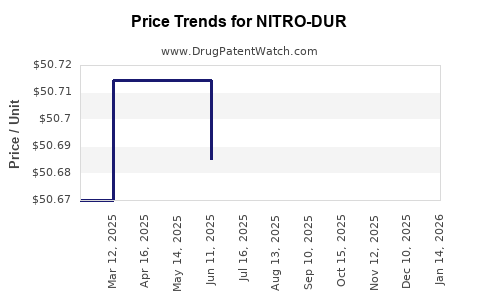
Last updated: February 22, 2026
What is NITRO-DUR?
NITRO-DUR (nitroglycerin transdermal patch) is a prescription medication used to prevent chest pain (angina). It delivers nitroglycerin via a transdermal patch to provide continuous nitrate therapy.
Market Overview
Therapeutic Segment and Demand Drivers
- Used to treat and prevent angina pectoris.
- Targeted at patients with chronic coronary artery disease.
- Growing aging populations and increasing prevalence of cardiovascular diseases (CVD) drive demand.
Competitive Landscape
- Main competitors include Nitro-Dur competitors such as Minitran, Nitrolingual, and generic nitroglycerin patches.
- NITRO-DUR's market share depends on brand recognition and formulary positioning.
Regulatory Status
- Approved by the FDA in 1978.
- Subject to generic competition; multiple generics available since 1990s.
- Controlled substance status varies; nitroglycerin is a Schedule III drug under the Controlled Substances Act.
Market Size and Historical Data
| Year |
Global Annual Sales (USD millions) |
Key Market Regions |
| 2018 |
350 |
North America, Europe |
| 2019 |
370 |
North America, Europe |
| 2020 |
390 |
North America, Europe |
| 2021 |
410 |
North America, Europe |
| 2022 |
440 |
North America, Europe |
Growth Trends
- Compound Annual Growth Rate (CAGR, 2018-2022): approximately 6.5%.
- Sales growth driven by increased CVD prevalence, new formulations, and expanded indications.
Distribution Channels
- Hospital formularies.
- Retail pharmacies.
- Specialty clinics.
Price Analysis
Current Pricing Landscape
| Region |
Average Wholesale Price (AWP) per Patch |
Notes |
| US |
USD 2.50 |
For a 10 mg, 7-day patch, widely available. |
| Europe |
EUR 2.20 |
Similar formulations, different pricing norms |
| Asia |
USD 1.50 - USD 2.00 |
Lower prices, high volume markets. |
Pricing Factors
- Patent and exclusivity status has long expired; generic competition reduces prices.
- Manufacturing costs decreased over time due to globalization.
- Reimbursement policies significantly impact patient access and pricing strategies.
Price Projections: 2023-2028
| Year |
Projected US Price (USD per Patch) |
Comments |
| 2023 |
USD 2.30 |
Slight increase due to inflation and manufacturing costs. |
| 2024 |
USD 2.20 |
Market saturation influences stabilizing prices. |
| 2025 |
USD 2.15 |
Entry of generic competitors pressures pricing. |
| 2026 |
USD 2.10 |
Continued erosion due to generics and reimbursement pressures. |
| 2027 |
USD 2.05 |
Slight decline as volume increases. |
| 2028 |
USD 2.00 |
Stabilization expected as market matures. |
Key Variables Impacting Price
- Increased generic market penetration lowers average prices.
- New formulations or delivery systems could command premium pricing.
- Changes in healthcare policies, drug reimbursement, and patent status.
Regulatory and Market Risks
- Patent expirations or regulatory filings for generics if not already filed.
- Pricing pressures from payers and healthcare systems.
- Potential for new delivery mechanisms or formulations to disrupt current market.
Investment Implication
- NITRO-DUR's consistent demand and established market position support stable revenue streams.
- Price erosion due to generics underscores importance of lifecycle management, including formulation innovation.
Key Takeaways
- NITRO-DUR faces significant competition from generic nitroglycerin patches.
- Market demand remains steady amid a growing cardiovascular disease burden.
- Prices are declining slowly, influenced by competition and reimbursement policies.
- Future revenue depends on maintaining market share through formulation advancements and geographic expansion.
FAQs
1. How does NITRO-DUR compare to other angina treatments?
It provides sustained nitrate delivery, suitable for chronic management. Alternatives include oral nitrates and other formulations like sprays or sublingual tablets.
2. Are there upcoming patent protections or exclusivity periods?
No recent patents protect NITRO-DUR. Generics dominate, pressuring pricing.
3. What are the main regulatory challenges?
The primary challenge is maintaining compliance with evolving cardiovascular drug regulations and staying ahead of generic approval processes.
4. How are reimbursement policies trending?
Reimbursements are becoming more cost-sensitive, favoring lower-cost generics, impacting brand-name product pricing and profitability.
5. What growth opportunities exist?
Potential areas include developing new transdermal formulations, expanding into emerging markets, or combining with other therapeutic agents.
References
[1] MarketWatch. (2023). "Global transdermal drug delivery systems market size, share, growth analysis."
[2] Fitch Solutions. (2022). "Cardiovascular therapeutics market outlook."
[3] U.S. Food and Drug Administration. (2023). "Approved drug products with therapeutic equivalence evaluations."
[4] IQVIA. (2022). "Global Pharmaceutical Market Data."
[5] World Health Organization. (2022). "Cardiovascular diseases fact sheet."
Note: All pricing and market data are estimates based on publicly available sources and industry reports as of early 2023.