Share This Page
Drug Price Trends for NIGHTTIME LUBRICANT EYE OINT
✉ Email this page to a colleague
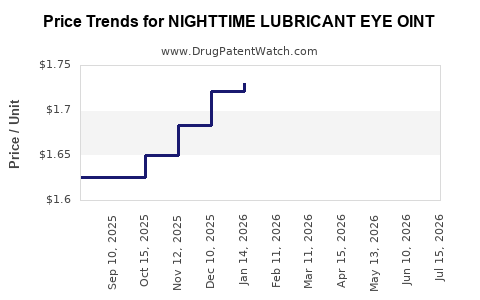
Average Pharmacy Cost for NIGHTTIME LUBRICANT EYE OINT
| Drug Name | NDC | Price/Unit ($) | Unit | Date |
|---|---|---|---|---|
| NIGHTTIME LUBRICANT EYE OINT | 46122-0757-37 | 1.53785 | GM | 2026-07-22 |
| NIGHTTIME LUBRICANT EYE OINT | 70000-0724-01 | 1.53785 | GM | 2026-07-22 |
| NIGHTTIME LUBRICANT EYE OINT | 46122-0757-37 | 1.63490 | GM | 2026-06-17 |
| NIGHTTIME LUBRICANT EYE OINT | 70000-0724-01 | 1.63490 | GM | 2026-06-17 |
| NIGHTTIME LUBRICANT EYE OINT | 46122-0757-37 | 1.70190 | GM | 2026-05-20 |
| >Drug Name | >NDC | >Price/Unit ($) | >Unit | >Date |
Market Analysis and Price Projections for Nighttime Lubricant Eye Ointment
What is the current market landscape for lubricant eye ointments?
The global ophthalmic lubricants market, including eye ointments and drops, is valued at approximately $2.8 billion in 2022. The segment for nighttime lubricants is a subset aimed at dry eye syndromes, tear film stabilization, and comfort improvement during sleep. Growth drivers include increasing incidences of dry eye disease, aging populations, and advancements in formulation technology.
The market growth rate is projected between 4-6% annually over the next five years. Key regions include North America (42% market share), Europe (27%), and Asia-Pacific (25%). Niche products like nighttime lubricants represent roughly 10-15% of overall ophthalmic lubricants, with a rising adoption rate.
Major competitors include Alcon, Bausch + Lomb, Acuvue (Johnson & Johnson), and smaller biotech firms. These companies focus on preservative-free formulations, longer-lasting effects, and ease of use.
What are the regulatory pathways impacting product entry?
Pathways include FDA approval in the United States, CE marking in Europe, and other regional regulatory bodies. For over-the-counter (OTC) products, classification as a medical device or cosmetic influences registration. Prescription status can extend time to market and approval costs.
Regulatory requirements emphasize safety, efficacy, and labeling. Clinical trials typically involve dry eye symptom improvement over 4-12 weeks, with endpoints including tear film stability and patient comfort scores. Regulatory review periods range from 6 months (Europe) to over 12 months (FDA).
How are pricing strategies structured for nighttime lubricant eye ointments?
Pricing depends on factors such as formulation complexity, branding, regulatory class, and reimbursement status.
- Retail prices typically range from $15 to $30 per tube in the U.S. for branded products.
- Private label or store brands may retail at $8 to $12.
- Prescription versions may see higher pricing, especially if bundled with companion therapies.
Pricing strategies favor premium positioning when the product offers extended durations of relief, preservative-free formulations, or added comfort. Reimbursement through pharmacy benefits management (PBMs) or insurance influences consumer costs and insurer negotiations.
How is the market expected to evolve?
Projections indicate a compound annual growth rate (CAGR) of approximately 4.5% from 2023 to 2028. Increased awareness of dry eye disease, especially among aging and digital device-utilizing populations, drives demand.
Innovation will focus on improving bioavailability, reducing frequent application needs, and minimizing preservatives. New formulations like gels or suppositories could challenge ointment sales.
Pricing is projected to remain stable in the short term. Segment leaders may command higher prices based on formulation benefits and brand loyalty. Entry price points for new entrants are anticipated around $10-$15 for OTC options, with potential premium versions exceeding $30.
What are the key factors influencing pricing and market penetration?
| Factor | Impact |
|---|---|
| Regulatory status | Prescriptions tend to command higher prices |
| Formulation complexity | Longer-lasting, preservative-free formulations increase costs |
| Brand recognition | Well-known brands can maintain premium pricing |
| Reimbursement policies | Favorable policies decrease consumer out-of-pocket expenses |
| Competitive landscape | Higher competition generally drives prices down |
Conclusions
Nighttime lubricant eye ointments occupy a small but expanding niche within the larger ophthalmic lubricants sector. Market growth hinges on demographic trends and device use, while regulatory and formulation advancements shape pricing strategies. The segment is poised for moderate growth, with premium products sustaining higher price points.
Key Takeaways
- The global ophthalmic lubricants market was valued at $2.8 billion in 2022.
- Nighttime lubricants are about 10-15% of the segment, growing at 4-6% annually.
- U.S. retail prices range from $15 to $30; private labels start at $8.
- Regulatory approval timelines impact market entry; in the U.S., it can exceed 12 months.
- Product innovation and brand strength influence pricing and market penetration.
FAQs
1. How does FDA classification affect pricing of eye ointments?
Prescription products generally command higher prices due to regulatory costs, clinical trial requirements, and branding. OTC products tend to be priced lower, influencing market segmentation.
2. What is the typical formulation for nighttime lubricant eye ointments?
Common formulations include petrolatum-based gels, which provide longer-lasting moisture, and preservative-free options to reduce irritation.
3. How does market competition influence pricing strategies?
Increased competition tends to lower prices, especially among generic or store brands. Premium brands sustain higher prices through formulation advantages and brand loyalty.
4. Are reimbursement policies significant for market penetration?
Yes. Favorable reimbursement supports higher prices and wider adoption, especially for prescription products.
5. What innovation trends are likely to impact future pricing?
Development of longer-lasting, preservative-free gels, and combination therapies could lead to higher pricing for enhanced efficacy.
References
[1] Grand View Research. (2022). Ophthalmic lubricants market size, share & trends analysis.
[2] U.S. Food and Drug Administration. (2022). Ophthalmic drug approval process.
[3] Statista. (2023). Global dry eye treatment market forecast.
[4] BCC Research. (2022). Eye care market analysis.
More… ↓
