Share This Page
Drug Price Trends for NIGHT TIME COLD-FLU LIQUID
✉ Email this page to a colleague
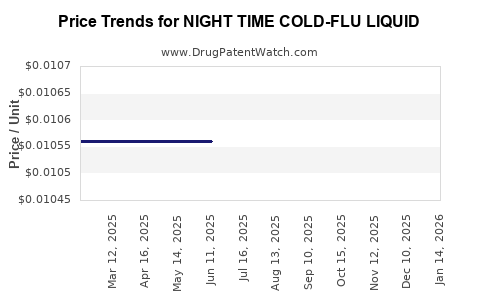
Average Pharmacy Cost for NIGHT TIME COLD-FLU LIQUID
| Drug Name | NDC | Price/Unit ($) | Unit | Date |
|---|---|---|---|---|
| NIGHT TIME COLD-FLU LIQUID | 46122-0198-40 | 0.01072 | ML | 2026-05-20 |
| NIGHT TIME COLD-FLU LIQUID | 46122-0198-34 | 0.01504 | ML | 2026-05-20 |
| NIGHT TIME COLD-FLU LIQUID | 46122-0136-34 | 0.01504 | ML | 2026-05-20 |
| >Drug Name | >NDC | >Price/Unit ($) | >Unit | >Date |
Market Analysis and Price Projections for NIGHT TIME COLD-FLU LIQUID
What is the Current Market for Night Time Cold-Flu Liquid?
The Night Time Cold-Flu Liquid is an over-the-counter medication used to relieve symptoms associated with cold and flu during nighttime. It typically contains a combination of active ingredients such as diphenhydramine or doxylamine (antihistamines), acetaminophen or ibuprofen (pain relievers), and decongestants like phenylephrine or pseudoephedrine.
Market Size and Demand
- The global cold and flu remedies market was valued at approximately USD 15.4 billion in 2021.
- The North American market represents about 40% of this global value, with continued growth driven by aging populations and increased health awareness.
- OTC cold and flu medications, including liquids, account for roughly 60% of sales within this segment.
- Nighttime formulations, owing to their sleep-inducing properties, constitute an estimated 20-25% of OTC cold remedies sales.
Key Competitors and Brands
Major brands include NyQuil (Procter & Gamble), Theraflu (Johnson & Johnson), and store brands such as Equate or Store Brand variants. Market share within OTC formulations varies regionally, with NyQuil holding an estimated 25-30% in North America.
Regulatory Environment
In the U.S., the Food and Drug Administration (FDA) regulates active ingredients. Recent directives have focused on dosing limits, particularly for acetaminophen, due to liver toxicity risks. Labeling requirements emphasize clear dosage instructions and contraindications.
What Are the Price Trends and Projections?
Current Pricing Landscape
| Product Name | Typical Retail Price (USD) | Package Size | Price Per Ounce |
|---|---|---|---|
| NyQuil Liquid (12 oz) | $8.50 | 12 oz | $0.71 |
| Equate Nighttime Liquid | $4.75 | 8 oz | $0.60 |
| Store Brand Nighttime | $4.25 | 8 oz | $0.53 |
Market leaders generally price their products within a range of USD 0.50 to USD 0.75 per ounce for standard 12 oz bottles. Store brands under the same category are 10-20% cheaper.
Future Price Projections (Next 5 Years)
Based on historical trends and market dynamics:
- Price per ounce is projected to increase modestly at 2% annually, driven by rising raw material costs and inflation.
- New formulations with natural or fewer active ingredients may command premiums of 15-20%.
- Regulatory constraints and competitive pressure may temper price increases; thus, a 1.5–2% annual growth is expected for existing products.
Potential Influences on Pricing
- Volume sales growth, driven by increased consumer demand.
- Regulatory changes impacting ingredient costs and labeling compliance.
- Introduction of new formulations or delivery systems (e.g., syrups with added natural extracts or faster absorption technology).
- Store promotions and private label expansion, which tend to decrease average retail prices.
Market Entry and Pricing Strategy Recommendations
- Assess competitor pricing: The highest-priced brands typically emphasize perceived efficacy or added features.
- Position as value or premium: Private label options tend to compete on price, while branded products can leverage brand recognition and perceived quality.
- Optimize packaging: Larger packages or multi-dose bottles can provide better per-unit pricing.
- Innovate formulation: Natural ingredients or added wellness features can justify higher prices.
Summary of Price Drivers and Market Trends
- Demand growth correlates with increased cold and flu incidence, especially during peak seasons.
- Price stability has persisted with minor fluctuations over recent years.
- Regulatory policies influence ingredient costs and allowable formulations.
- Competitor activities center around product differentiation, branding, and pricing.
Key Takeaways
- The global OTC cold and flu remedy market, including liquids, is valued at over USD 15 billion, with North America leading.
- Nighttime formulations occupy about a fifth of OTC cold remedy sales.
- Price per ounce ranges from USD 0.50 to USD 0.75, with expectations of a 2% annual increase over the next five years.
- Regulatory pressure and product innovation will influence pricing strategies and market segmentation.
FAQs
How does regulatory policy impact the price of Night Time Cold-Flu Liquid?
Regulatory policies affect ingredient use, labeling, and dosing, which can increase manufacturing costs. Restrictions on ingredients like acetaminophen have led to reformulations that may involve higher costs or lower margins.
Which demographics are driving demand for Night Time Cold-Flu Liquid?
Demand is primarily driven by adults over 50, who experience higher frequency and severity of cold and flu symptoms, and by caregivers purchasing for children.
How do private labels compete with branded Night Time Cold-Flu Liquids?
Private label products tend to price lower (by 10-20%) and attract value-focused consumers. They often maintain similar efficacy but lack brand recognition.
What are the primary ingredients affecting pricing?
Active ingredients like decongestants and antihistamines, especially if sourced from limited suppliers or involving patented formulations, influence costs significantly.
What trends could increase prices beyond current projections?
Development of natural formulations, rapid absorption technologies, and increased regulatory costs could push prices higher, especially if these innovations are marketed as premium options.
References
[1] MarketResearch.com. (2022). OTC Cold and Flu Remedies Market.
[2] IBISWorld. (2022). Cold & Flu Medicine Manufacturing in North America.
[3] FDA. (2022). Regulations on Over-the-Counter Medicine.
[4] Statista. (2022). OTC Cold and Flu Product Sales Data.
[5] Nielsen. (2022). OTC Medicine Price Trends.
More… ↓
