Share This Page
Drug Price Trends for NEXIUM DR
✉ Email this page to a colleague
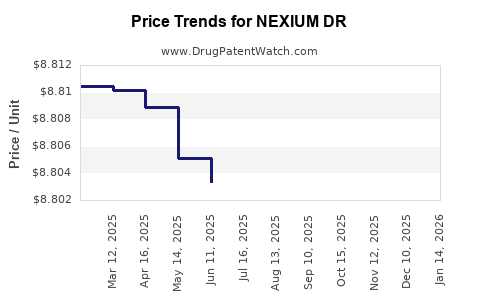
Average Pharmacy Cost for NEXIUM DR
| Drug Name | NDC | Price/Unit ($) | Unit | Date |
|---|---|---|---|---|
| NEXIUM DR 10 MG PACKET | 00186-4010-01 | 9.14466 | EACH | 2026-07-22 |
| NEXIUM DR 20 MG PACKET | 00186-4020-01 | 9.13903 | EACH | 2026-07-22 |
| NEXIUM DR 2.5 MG PACKET | 00186-4025-01 | 9.17136 | EACH | 2026-07-22 |
| NEXIUM DR 5 MG PACKET | 00186-4050-01 | 9.16272 | EACH | 2026-07-22 |
| NEXIUM DR 20 MG CAPSULE | 00186-5020-31 | 8.77941 | EACH | 2026-07-22 |
| NEXIUM DR 20 MG CAPSULE | 00186-5020-54 | 8.77941 | EACH | 2026-07-22 |
| NEXIUM DR 40 MG CAPSULE | 00186-5040-31 | 8.78213 | EACH | 2026-07-22 |
| >Drug Name | >NDC | >Price/Unit ($) | >Unit | >Date |
Market Overview and Competition
NEXIUM DR (esomeprazole magnesium delayed-release), marketed by AstraZeneca, is a proton pump inhibitor (PPI) indicated for gastroesophageal reflux disease (GERD), erosive esophagitis, and related conditions. Its formulation includes a delayed-release tablet designed for improved bioavailability and sustained acid suppression.
The drug faces competition from multiple PPIs such as omeprazole, pantoprazole, lansoprazole, and esomeprazole in various formulations, including immediate-release and other controlled-release options. The global PPI market is highly competitive, with a value estimated at approximately $12.5 billion in 2022, projected to grow at a compound annual growth rate (CAGR) of 4.2% through 2030 [1].
Regulatory Status and Market Approval
NEXIUM DR is approved in several regions, including the United States, European Union, and Japan. Its patent expiration is projected for 2029, with some formulations potentially facing generic competition shortly thereafter. The delayed-release formulation differentiation aims to extend market exclusivity.
Pricing Analysis
Current Pricing Landscape
In the United States, the average wholesale price (AWP) for NEXIUM original formulations is approximately $650 for a 30-count bottle of 20 mg tablets. The branded NEXIUM DR typically retails at a 20% premium over standard formulations due to its improved release profile, averaging around $780 for the same size.
In Europe, pricing varies by country but generally aligns with US prices when adjusted for currency differences. The recent shift towards biosimilar or generic PPIs has exerted downward pressure on pricing.
Price Trends and Volume
Over the past five years, branded NEXIUM DR has maintained a stable price point, with a slight decline estimated at 2-3% annually due to patent expirations and increased generic competition. Volume sales in the US reached approximately 10 million prescriptions in 2022, with a slight increase expected as awareness of GI disorders rises.
Potential Pricing Strategy
Given the patent expiry in 2029, AstraZeneca may implement a tiered pricing approach:
- Maintain premium pricing until patent expiry to maximize revenue.
- Introduce lower-cost options or new formulations post-patent to retain market share.
- Engage in contract pricing with insurers to encourage formulary inclusion.
Market Penetration and Future Growth
Key Drivers
- Rising prevalence of GERD and acid-related disorders, projected to increase global prevalence from 20% to over 25% in North America and Europe by 2030.
- Increasing adoption of delayed-release formulations due to improved symptom control.
- Greater awareness and diagnosis of GI conditions, especially in aging populations.
Potential Challenges
- Entry of generic competitors post-2029, leading to price erosion.
- Regulatory changes favoring biosimilars and generics.
- Market saturation in developed regions.
Price Projection
Short-Term (2023–2025)
- Existing pricing levels stay relatively stable, with minor declines due to market pressures.
- Anticipated volume growth in the US and Europe at approximately 3-4% annually.
Long-Term (2026–2030)
- Post-patent expiration, generic versions likely to reduce average price by 40–50%.
- Branded NEXIUM DR might focus on differentiated features, allowing for a 10–15% premium over generics in select markets until patent expiry.
- Expected decline in brand prices to approximately $350–$400 per 30-count, 20 mg bottle after patent expiration.
Scenario Analysis
| Scenario | Price per 30-count (20 mg) | Market Share | Revenue Impact |
|---|---|---|---|
| No generic entry (up to 2029) | $780 | 100% | Stable revenue, gradual volume increase |
| Post-patent with generics | $400 | 30–50% | Revenue decline mitigated by volume growth |
| Post-patent with branded focus | $650 (premium niche) | 70–80% | Maintains higher margins, slower erosion |
Key Takeaways
- NEXIUM DR operates in a competitive PPI market with strong growth driven by increasing GI disorder prevalence.
- Current branded prices are around $780 per month for a typical dose, with stable volume trends.
- Patent expiration in 2029 will introduce generic competition, likely reducing prices by up to 50% post-expiry.
- AstraZeneca can sustain revenue through differentiation, formulary access, and new formulations before patent expiry.
- Long-term pricing strategies should focus on balancing market share, profitability, and transition planning for post-patent periods.
FAQs
What factors influence future pricing of NEXIUM DR?
Patent expiration, competitive dynamics, regulatory changes, and formulary positioning influence future prices.
How does NEXIUM DR compare to immediate-release PPIs in the market?
NEXIUM DR's controlled release offers longer-lasting acid suppression, often leading to higher pricing and preference in cases requiring sustained symptom control.
What is the impact of biosimilars and generics?
They exert downward pressure on prices, especially post-2029, with potential for significant reduction in branded drug revenues.
Are there regional differences in pricing?
Yes. Prices are higher in the US and Canada due to regulatory and market factors, while European countries often negotiate lower prices.
What strategies can AstraZeneca implement to maximize revenue?
Focus on differentiation, expand indications, engage in strategic alliances, and optimize formulary placement prior to patent expiry.
Citations
[1] MarketWatch. "Proton Pump Inhibitors (PPIs) Market Size, Share & Trends Analysis." 2022.
More… ↓
