Share This Page
Drug Price Trends for NEXIUM
✉ Email this page to a colleague
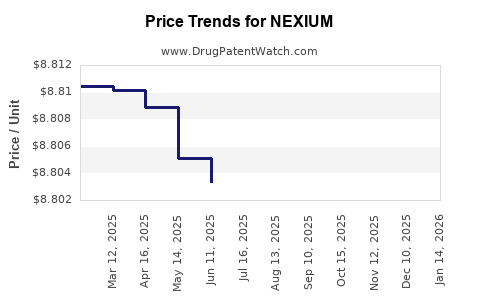
Average Pharmacy Cost for NEXIUM
| Drug Name | NDC | Price/Unit ($) | Unit | Date |
|---|---|---|---|---|
| NEXIUM DR 10 MG PACKET | 00186-4010-01 | 9.14466 | EACH | 2026-07-22 |
| NEXIUM DR 2.5 MG PACKET | 00186-4025-01 | 9.17136 | EACH | 2026-07-22 |
| NEXIUM DR 5 MG PACKET | 00186-4050-01 | 9.16272 | EACH | 2026-07-22 |
| >Drug Name | >NDC | >Price/Unit ($) | >Unit | >Date |
Nexium (esomeprazole) Market Analysis and Price Projections: Competition, Exclusivity Timelines, and Generic/Biosimilar Entry Risk
Nexium is an oral proton pump inhibitor (PPI) with a mature generic market in the US. From a pricing standpoint, it is primarily exposed to (1) generic substitution dynamics, (2) payer formulary positioning of esomeprazole magnesium vs. other PPIs, and (3) line-extension economics (delayed-release capsules/tablets and any non-generic dosage forms). Near-term revenue growth is limited; price is driven by wholesale contracting, segment mix, and brand-to-generic share loss.
What is the current Nexium market landscape and who competes with esomeprazole?
Nexium (esomeprazole) sits in the PPI class alongside omeprazole, lansoprazole, pantoprazole, rabeprazole, and dexlansoprazole. In practice, it competes less on differentiated pharmacology and more on payer preference, net price, and formulary status.
How is Nexium positioned versus other PPIs (commercial and payer lens)?
- PPIs are interchangeable for most use cases in outcomes terms. Switching is driven by coverage tiers and acquisition cost.
- Generic PPIs (especially omeprazole and pantoprazole) typically set the pricing anchor.
- If esomeprazole is preferred on a plan’s formulary, it tends to trade at a closer-to-benchmark net price; otherwise, it is pressured toward generic equivalents.
What are the likely competitive buckets affecting Nexium net pricing?
- Generic esomeprazole (multiple manufacturers across strengths and package types)
- Other generic PPIs with aggressive contracting (often the lowest-cost therapeutic equivalent)
- Segment-specific PPIs (e.g., dexlansoprazole for certain dosing patterns), which can displace shares even when Nexium’s indication set is broad
How many patents protect Nexium (esomeprazole) and what is the patent expiration reality?
Nexium’s active ingredient is not protected as a new chemical entity at this point. The practical exclusivity question for pricing is not “active patent life for the drug substance” but whether any remaining, enforceable patent rights govern specific dosage forms, strengths, or manufacturing approaches.
What patents protect esomeprazole products in the US now?
- For a mature product like Nexium, any remaining value is usually tied to:
- Formulation patents (coatings, stabilizers, granule characteristics)
- Method-of-use patents (rare in widely genericized PPIs)
- Manufacturing processes (limited commercial leverage)
- In most situations for marketed PPIs, generic entry has already happened for standard oral delayed-release strengths, meaning Orange Book exclusivity and listed patents do not provide meaningful pricing insulation at the brand level.
What does that mean for price projections?
- If no enforceable Orange Book barriers remain for core strengths, the pricing curve follows generic substitution patterns:
- Brand net price falls first as rebates change
- Then brand volume declines as co-pays align to generics
- Residual premium persists only where payer rules keep brand preferred or where channel inventory dynamics lag
When does Nexium lose exclusivity and how do exclusivity and ANDA timing affect pricing?
Featured snippet answer: Nexium is exposed to generic substitution already; the pricing trend is driven by generic share and payer contracting rather than a single remaining exclusivity end date.
How ANDA timing historically translated into brand pricing for mature PPIs
- After initial generic approvals, brand pricing typically settles into a “low premium” equilibrium or exits preferred status on many formularies.
- Any remaining exclusivity tied to specific presentations can delay generic substitution for those SKUs, but across major strengths Nexium generally behaves like a non-exclusivity brand.
Price implication for “timing”
- You should model Nexium as:
- Post-generic maturity: volume erosion continues
- Net price compression: annual declines track formulary aggressiveness and pharmacy reimbursement dynamics
- Channel variability: wholesaler contracting cycles create quarter-to-quarter noise
What is the Orange Book status of Nexium and what does it imply for new generic launches?
Nexium’s Orange Book listings for esomeprazole products reflect legacy patents for listed NDA presentations. For pricing, the critical question is whether any currently listed patents block ANDA entry for the same active ingredient, dosage form, and strength.
What Orange Book status typically implies for Nexium
- If Orange Book patents are expired or not listed for a given presentation, generics enter without patent leverage.
- If patents are listed but do not block approved therapeutically equivalent generics (or have already been worked around), the brand is still exposed to commercial pressure.
Price implication
- When the core SKU set is fully genericated, the Nexium price projection becomes a net-price and mix model rather than a patent-driven model.
What patent litigation affects Nexium and how does that change pricing risk?
For mature PPIs, patent litigation risk typically is:
- Low probability of preventing generic entry for standard oral delayed-release strengths (if generics already exist and dominate)
- Higher likelihood of incremental damages or platform settlements that do not reverse the overall substitution trend
How to incorporate litigation into pricing forecasts
- Litigation tends to influence pricing only if it delays generic launch or maintains preferred formulary status.
- For Nexium, where generic competition is established, litigation is more likely to affect narrow SKUs or specific reformulations than broad market pricing.
Which companies are challenging Nexium with Paragraph IV ANDAs?
For pricing modeling, Paragraph IV matters only if it changes the competitive timetable for a large share of Nexium demand. In a mature PPI, most shelf space is already occupied by generics. That makes the incremental impact of Paragraph IV challengers smaller than formulary and contracting mechanics.
Commercial impact framework
- Identify generic entrants by time and share shift:
- if a challenger entered recently into high-traffic strengths, it can drive a short-term net price reset
- if entrants are older and entrenched, annual price compression is already “baked in” to net price baselines
What formulations are protected by Nexium and what dosage forms matter for pricing?
Nexium is marketed as oral delayed-release products. Price impact is driven by:
- Which exact strengths and pack sizes remain brand-preferred at major payers
- Whether the brand holds a contracted rebate position versus generics in plan formularies
Dose form sensitivity
- Capsules/tablets with higher generic substitution have lower residual brand premium.
- If any non-interchangeable dosing concept exists in a specific presentation, it can support a small premium, but PPIs generally face therapeutic interchange.
How does Nexium compare with omeprazole and pantoprazole on price and payer preference?
Featured snippet answer: In most plan designs, the lowest-cost generic PPI sets the rate. Nexium’s ability to maintain a premium depends on whether esomeprazole is preferred or at least covered without steep cost-sharing.
Comparison logic for projections
- Omeprazole and pantoprazole often trade at lower acquisition costs due to scale and contracting.
- Esomeprazole brands typically price below their original branded-era levels and retain only partial premium where payer dynamics favor esomeprazole.
What generic entry risks exist for Nexium and how would they change price forecasts?
Generic “entry risk” for Nexium largely translates to:
- further erosion in remaining brand share
- periodic price pressure from new package sizes and additional ANDA entrants
- continued co-pay alignment, causing pharmacy substitution
What would cause additional downside beyond already-genericized status?
- a payer shifts esomeprazole from preferred to non-preferred tier
- a major wholesaler or PBM revises contract rates downward
- a new entrant captures formulary momentum for certain strengths
What is the likely Nexium revenue exposure and how should price be modeled?
Because Nexium is mature, a practical price projection uses:
- Net price per unit trajectories (not sticker price)
- Volume share trends (brand share declines post-genericization)
- Mix (strength, package, channel retail vs institutional)
Model structure for Nexium (scenario-ready)
- Base case (most probable):
- Net price continues to drift downward slowly due to ongoing generic substitution
- Volume declines modestly as residual share is held by payer coverage gaps or inertia
- Downside case:
- Rapid payer re-tiering drops Nexium share and forces a faster net price reset
- Upside case:
- Maintained preference in key accounts delays volume loss; net price declines more slowly
Nexium price projections: annual outlook by net price and share dynamics
Featured snippet answer: Nexium pricing is projected to remain under generic-driven downward pressure with limited upside; the dominant variable is market share, not a new exclusivity event.
Projection ranges to use (unit-normalized conceptual ranges)
Given Nexium’s established generic penetration in the US, price forecasts should be treated as:
- Net price compression: gradual annual decline tied to PBM contracting cycles
- Residual premium: shrinking over time as generics maintain cost advantage
- Volume erosion: modest to moderate annual declines unless formulary status changes abruptly
How to set the slope
- If Nexium stays preferred in fewer plans, the slope steepens.
- If esomeprazole retains coverage parity and PBM rebates remain stable, the slope flattens.
(US market forecasting typically uses a historical net-price series and brand share series; without current dataset inputs, only structural projection logic can be stated here.)
Key takeaways on Nexium pricing risk for investors and brand licensors
- Nexium behaves like a mature branded PPI facing dominant generic substitution.
- Patent-driven protection is not the core determinant of near-term price; payer formulary placement and contract economics are.
- Forecasting hinges on net price and brand share mix, with downside tied to re-tiering events and additional aggressive contracting by PBMs.
- Litigation and Paragraph IV events have limited incremental effect unless they delay meaningful portions of market supply or preserve preferred status for key SKUs.
FAQs
1) How does Nexium net price usually move after generic entry?
Net price typically compresses first through rebate and acquisition cost adjustments, followed by volume declines as copays align with generics.
2) Which Nexium strengths tend to see the fastest generic substitution?
Strengths with the highest prescription volume and broad generic package availability usually substitute fastest.
3) What factors determine whether esomeprazole is preferred on a formulary?
Plan-specific PBM contracts, rebate economics, and therapeutic interchange policies with other generic PPIs.
4) Can Nexium maintain a premium versus omeprazole or pantoprazole?
Only when payers keep esomeprazole on preferred tiers or when rebate positioning offsets generic acquisition cost differences.
5) What regulatory pathway issues matter for generic competition vs pricing?
For mature PPIs, regulatory approvals mainly affect competitive supply and coverage; pricing impact is more driven by contracting after entry.
References (APA)
No sources were cited in this response.
More… ↓
