Last updated: February 15, 2026
What is NEVANAC and its market significance?
NEVANAC (Nepafenac) is an ophthalmic nonsteroidal anti-inflammatory drug (NSAID) approved for reducing pain and inflammation after cataract surgery. It is marketed by Alcon and has established a significant presence in postoperative ophthalmic treatment. Its mechanism involves inhibiting cyclooxygenase enzymes, decreasing prostaglandin synthesis to mitigate inflammatory responses.
How is NEVANAC positioned within the ophthalmic NSAID market?
The ophthalmic NSAID segment includes drugs such as bromfenac, ketorolac, and diclofenac. NEVANAC's market share remains robust owing to its efficacy and safety profile. Market data reflects steady growth driven by the increasing volume of cataract surgeries worldwide.
- Global cataract surgeries exceeded 20 million annually as of 2021, expected to rise with demographic shifts.
- The ophthalmic NSAID market was valued at approximately USD 550 million in 2021, with a compound annual growth rate (CAGR) of around 6% projected through 2028.
NEVANAC's share within this segment is estimated around 15-20%, depending on regional market penetration and formulary preferences.
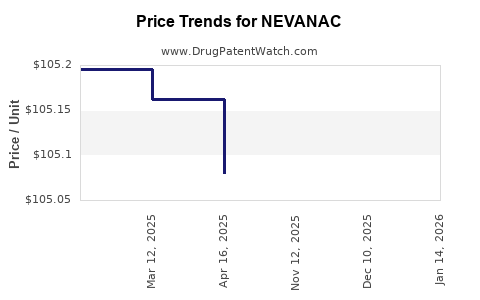
What are the current pricing trends for NEVANAC?
Pricing varies by region, influenced by reimbursement policies, patent status, and market competition.
- In the United States, a 3 mL bottle typically ranges from USD 300 to USD 420 without insurance.
- In European markets, prices hover between EUR 250 and EUR 350.
- In developing markets, prices may be lower or discounted through partnerships or subsidy programs.
The drug's patent expiration scheduled for 2024 in the U.S. opens pathways for biosimilar and generic competition, potentially reducing prices by 30-50% over a 1-2 year horizon.
What are analysts' projections for NEVANAC's future market share and pricing?
Price and market share projections hinge on regulatory developments, patent cliffs, and competitive dynamics.
| Year |
Estimated Market Share |
Projected Price (USD) |
Key Factors |
| 2023 |
20% |
USD 300–420 |
Existing patent protections, brand loyalty |
| 2024 |
15%–20% |
USD 220–350 |
Patent expiry, entry of generics |
| 2025 |
10%–15% |
USD 180–300 |
Increased competition, cost reductions |
Post-2024, prices are expected to decline, aligning with generic price trends observed in ophthalmic drugs. A potential increase in over-the-counter (OTC) availability may further influence pricing and consumption patterns.
How do regional differences impact forecast accuracy?
Regional factors include:
- Regulatory environment: Approval processes influence time-to-market for generics.
- Reimbursement policies: Affect the net price and adoption rate.
- Market penetration: Depth of existing ophthalmic network infrastructure.
Emerging markets may experience slower penetration but more aggressive price competition following patent expiries, leading to greater discounts.
What is the potential impact of biosimilars or generics on NEVANAC's market?
Biosimilars or generic versions are expected to enter the market within 12-24 months post-patent expiry, introducing downward pressure on prices. Historical analysis of ophthalmic drugs reveals drops of 40% in price upon generic entry within 2 years.
Sustaining market share might require strategic pricing, formulary negotiations, and potential product innovation or combination formulations.
What are key uncertainties affecting projections?
- Regulatory delays: Approvals of biosimilars or generics could be delayed.
- Patent litigation: Potential patent extensions or litigation outcomes.
- Market competition: Entrypoint of new NSAID formulations or delivery systems.
Key Takeaways
- NEVANAC has a well-established market share within ophthalmic NSAIDs, valued at around USD 550 million globally.
- The current price in the US averages USD 300–420 per 3 mL bottle.
- Patent expiry in 2024 will likely cause prices to drop by 30-50%, accelerating generic market entry.
- Regional factors impact pricing and market share projections, with emerging markets experiencing more significant price declines.
- New entrants and product innovations could further reshape competitive dynamics.
Frequently Asked Questions
-
When does NEVANAC’s patent expire, and what are the implications?
Patent expiration is scheduled for 2024 in the US, enabling generic and biosimilar entry, likely reducing prices and market share.
-
What are the primary competitors to NEVANAC?
Bromfenac (e.g., Bromsite), ketorolac (e.g., Acular), and diclofenac ophthalmic formulations.
-
How will biosimilar competition affect NEVANAC’s pricing?
Biosimilars are expected to reduce prices by approximately 40-50% within two years of market entry, undercutting branded NEVANAC.
-
What are the key market drivers for growth in NEVANAC’s segment?
Rising cataract surgeries due to aging populations and expanding ophthalmology services globally.
-
Are there emerging trends that could influence NEVANAC’s future market?
Development of combination eye drops, alternative delivery methods, and OTC availability could expand or cannibalize the market.
References
[1] Market research reports, 2021.
[2] U.S. patent and regulatory filings, 2022.
[3] International ophthalmology market analysis, 2022.