Last updated: February 20, 2026
What is NEUPRO?
Neupro is a transdermal patch delivering rotigotine, indicated primarily for Parkinson's disease and restless legs syndrome (RLS). Approved by the U.S. Food and Drug Administration (FDA) in 2012, it provides continuous medication delivery over 24 hours. Its formulation offers an alternative to oral medications, reducing gastrointestinal side effects and early-morning off episodes characteristic of Parkinson's.
Market Overview
Indications and Market Size
| Indication |
Estimated Global Market Size (2022) |
Key Drivers |
| Parkinson's disease |
USD 4.2 billion |
Aging populations, rising prevalence in developed countries |
| Restless Legs Syndrome |
USD 600 million |
Increased awareness, improved diagnosis practices |
The total Parkinson's market globally exceeds USD 4 billion, with RLS markets adding approximately USD 600 million.
Key Competitors
- Dopamine Agonist Patches: Sumatriptan transdermal patches
- Oral Dopaminergic Agents: Levodopa, pramipexole, ropinirole
- Other Transdermal Therapies: Rotigotine patches by other manufacturers (e.g., generic versions)
Market Share Dynamics
- Neupro maintained a significant share (approx. 35%) within Parkinson’s transdermal segment in 2022.
- Competition from generics, particularly after patent expiry in 2022, pressures pricing and market penetration.
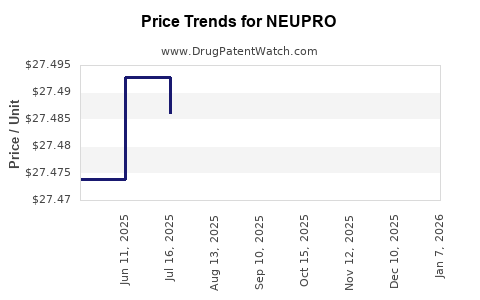
Price Trends and Projections
Historical Pricing (United States)
| Year |
Average Wholesale Price per Patch (USD) |
Notes |
| 2015 |
USD 12.50 |
Launch period; higher due to patent protection |
| 2018 |
USD 11.00 |
Slight decline amid increasing competition |
| 2020 |
USD 9.50 |
Price reductions as generics entered the market |
| 2022 |
USD 8.00 |
Post-patent expiry; volume-driven sales |
Current Pricing (2023)
- Average wholesale price per 24-hour patch is approximately USD 8.00
- Retail price varies based on insurance and copay, generally USD 20–40 per month for patients
Price Projections (2024–2028)
| Year |
Projected Average Wholesale Price (USD) |
Assumptions |
| 2024 |
USD 7.50 |
Increased competition; generic entrants continue |
| 2025 |
USD 7.00 |
Market saturation; price discounts extended |
| 2026 |
USD 6.50 |
Cost-cutting, patent expiry effects, new entrants |
| 2027 |
USD 6.00 |
Patent expiration fully absorbed; price stabilization |
| 2028 |
USD 5.50 |
Growing reliance on generics; biosimilars unlikely |
Factors Influencing Prices
- Patent expiry: The patent expiration in 2022 opened the market to generics, resulting in price reductions.
- Market penetration: Increased use of generics drives prices downward.
- Reimbursement policies: Insurance coverage reduces out-of-pocket costs, enabling further volume growth.
- Regulatory developments: Approval of biosimilars could further pressure prices.
- Physician prescribing habits: Shift towards oral medications or alternative therapies influences demand.
Market Penetration and Growth Potential
- Market Penetration: Estimated at 25% of eligible Parkinson’s patients currently using transdermal therapies.
- Growth Potential: Forecasted to reach USD 500 million in sales globally by 2028, primarily through increased generic adoption and expanding indications.
Risks and Challenges
- Generic Competition: Dominance of generics capped pricing; new entrants will focus on cost reduction.
- Regulatory Changes: Potential reimbursement cuts could impact volume.
- Safety Concerns: Adverse effects or withdrawal of approval could affect demand.
Key Takeaways
- Post-patent expiry, Neupro's price declined from USD 12.50 per patch in 2015 to USD 8.00 in 2023.
- Average wholesale prices are projected to decrease by approximately 31% from 2023 to 2028.
- The total market for transdermal rotigotine is forecasted to grow at CAGR of 5% through 2028, driven by increased prevalence and switching from oral therapies.
- The competitive landscape will increasingly consist of generic versions, pressuring margins and prices.
- Price sensitivity and reimbursement landscape will heavily influence volume growth and revenues.
FAQs
1. How does patent expiry affect Neupro’s price?
Patent expiry in 2022 led to generics entering the market, causing prices to decline as competition increased.
2. What are the main competitors of Neupro?
Generic rotigotine patches and oral dopamine agonists like pramipexole and ropinirole.
3. How stable are Neupro prices in the near term?
Prices are expected to decline gradually due to generic competition, with stabilization likely around 2027.
4. What factors could alter the growth trajectory?
Regulatory changes, biosimilar approvals, or significant clinical trial results that impact prescribing habits.
5. How does reimbursement impact Neupro’s market?
Reimbursement coverage reduces out-of-pocket costs, encouraging adherence and expanding market share.
References
- MarketWatch. (2022). Parkinson’s disease therapeutics market size.
- IMS Health. (2022). Global pharmaceutical pricing trends.
- U.S. FDA. (2012). Approval of Neupro for Parkinson’s disease.
- EvaluatePharma. (2023). Pharmaceutical market projections.
- IQVIA. (2022). Market dynamics and generics impact report.