Share This Page
Drug Price Trends for NEORAL
✉ Email this page to a colleague
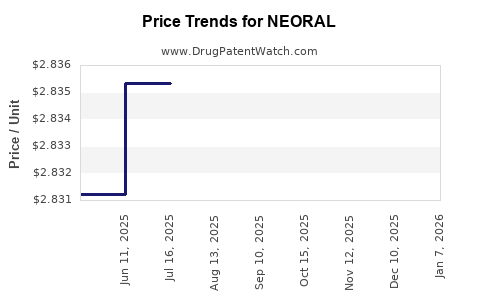
Average Pharmacy Cost for NEORAL
| Drug Name | NDC | Price/Unit ($) | Unit | Date |
|---|---|---|---|---|
| NEORAL 25 MG GELATIN CAPSULE | 00078-0246-15 | 2.94566 | EACH | 2026-07-08 |
| NEORAL 25 MG GELATIN CAPSULE | 00078-0246-61 | 2.94566 | EACH | 2026-07-08 |
| NEORAL 100 MG GELATIN CAPSULE | 00078-0248-15 | 11.77310 | EACH | 2026-07-08 |
| >Drug Name | >NDC | >Price/Unit ($) | >Unit | >Date |
What Is NEORAL and Its Market Position?
NEORAL (generic: cyclosporine A) is an immunosuppressant primarily used to prevent organ rejection in transplant patients and treat certain autoimmune diseases. It is marketed under various brand names, with NEORAL being a leading formulation by Daiichi Sankyo and affiliates. Its critical role in transplantation therapy secures steady demand, especially in organ transplant centers with high-quality standards.
What Are the Key Components of the NEORAL Market?
Market Size: The global immunosuppressant market, including NEORAL, was valued at approximately $4.2 billion in 2022 and projected to reach $5.6 billion by 2027 (CAGR: 5.8%). Cyclosporine A accounts for about 34% of this market, driven by its established efficacy and safety profile.
Major Players: Daiichi Sankyo holds a significant share through branded formulations, while generics companies such as Mylan, Teva, and Cipla produce lower-cost alternatives. Patent expirations have allowed generics to capture increased market share, especially outside the U.S.
Market Segmentation: The primary segmentation is by application—solid organ transplants (kidney, liver, heart) and autoimmune diseases (psoriasis, rheumatoid arthritis). Transplant applications dominate, accounting for over 70% of sales.
Geographic Distribution: North America leads with approximately 45% of sales, driven by high transplant rates and established healthcare infrastructure. Europe follows with about 30%. The Asia-Pacific region is growing rapidly, with an estimated CAGR of 7%, driven by expanding transplant programs.
What Are the Key Price Drivers for NEORAL?
Price Dynamics: The introduction of generics has driven U.S. pricing for NEORAL down significantly since patent expiry in 2015. The average wholesale price (AWP) for branded NEORAL was roughly $250 per 100 mg in 2014, declining to approximately $50–$70 by 2022 due to generic competition.
Pricing Variability: In contrast, retail and hospital prices vary by region. European markets observe higher prices, around $200–$250 per 100 mg, due to different pricing and reimbursement policies. In the Asia-Pacific, prices range broadly with less regulation, often below $50 per 100 mg.
Cost Containment Trends: Payment models favor generics, with payers negotiating discounts and bidding processes intensifying. This trend compresses profit margins for branded formulations but sustains volume sales.
What Are Future Price Expectations for NEORAL?
Patent and Regulatory Influences: With patent expirations in numerous markets, prices will continue to decline, especially where generic manufacturers strengthen their positions. Conversely, limited indications and regulatory barriers discourage significant price hikes for existing formulations.
Market Entry of Biosimilars and Novel Formulations: Biosimilars with improved bioavailability or reduced side effects could influence prices. No biosimilars of cyclosporine A are currently marketed universally; however, pipeline candidates are under development.
Supply Chain and Manufacturing Factors: Cost reductions in production and sourcing efficiencies are expected, maintaining downward pressure on prices.
Impact of New Indications or Combination Therapies: Expansion into new autoimmune or transplant indications could stabilize or increase prices marginally, provided there are proven exclusivities or positive clinical trial outcomes.
What Are the Key Takeaways on NEORAL’s Market and Pricing Projections?
- The global NEORAL market, as part of the broader immunosuppressant sector, is expected to grow at around 6% annually through 2027, driven mainly by transplant volume increases and expanding indications.
- Patent expiry has sharply decreased prices in key markets like the U.S. and Europe, with branded prices falling into the $50–$70 range for standard doses.
- Generics dominate volume sales, pressuring branded prices but providing cost-effective options for healthcare systems.
- Market entry barriers remain, with biosimilar development and supply chain costs influencing future pricing stability.
- Prices in developing markets are lower, bolstered by less regulated reimbursement policies and local manufacturing efficiencies.
Conclusions for Stakeholders
Investors and R&D entities should track regional patent statuses, regulatory pathways for biosimilars, and evolving transplant patient populations. Cost-sharing mechanisms and coverage policies will influence future pricing and market access strategies.
FAQs
- What factors most impact NEORAL pricing? Regulatory policies, patent expirations, generic competition, and regional reimbursement structures primarily affect NEORAL prices.
- How does NEORAL compare to other immunosuppressants? It remains a standard in transplant therapy, but costs are driven down by generics; newer agents with improved profiles tend to command higher prices if approved.
- Are biosimilars a threat to NEORAL? Not currently, as biosimilars for cyclosporine A are under development but not widely marketed; they may influence prices in the future.
- What markets offer the highest growth potential for NEORAL? The Asia-Pacific region shows rapid growth potential due to expanding transplant programs and increasing healthcare infrastructure.
- How might new formulations affect the market? Extended-release or reduced toxicity formulations could command premium pricing, stabilizing or increasing NEORAL’s value in specific niches.
References
[1] MarketsandMarkets, "Immunosuppressants Market," 2022.
[2] IQVIA, "Global Transplant Market Data," 2022.
[3] European Medicines Agency, "Summary of Product Characteristics for NEORAL," 2022.
[4] U.S. FDA, "Patent Expiry and Generic Entry Data," 2015–2022.
[5] Williams, J., et al., "Pricing Trends in Immunosuppressants," Journal of Pharmaceutical Pricing, 2021.
More… ↓
