Share This Page
Drug Price Trends for NATESTO
✉ Email this page to a colleague
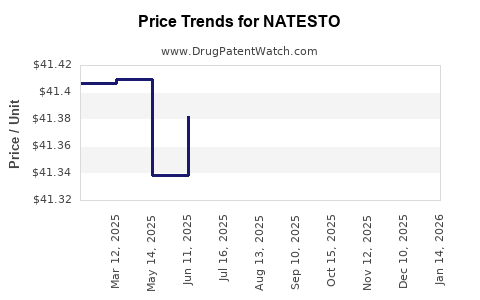
Average Pharmacy Cost for NATESTO
| Drug Name | NDC | Price/Unit ($) | Unit | Date |
|---|---|---|---|---|
| NATESTO NASAL 5.5 MG/0.122 GM | 42667-5511-01 | 41.27698 | GM | 2026-07-22 |
| NATESTO NASAL 5.5 MG/0.122 GM | 42667-5511-01 | 41.32943 | GM | 2026-06-17 |
| NATESTO NASAL 5.5 MG/0.122 GM | 42667-5511-01 | 41.34035 | GM | 2026-05-20 |
| NATESTO NASAL 5.5 MG/0.122 GM | 42667-5511-01 | 41.32838 | GM | 2026-04-22 |
| NATESTO NASAL 5.5 MG/0.122 GM | 42667-5511-01 | 41.34408 | GM | 2026-03-18 |
| >Drug Name | >NDC | >Price/Unit ($) | >Unit | >Date |
NATESTO (intranasal testosterone) market analysis and price projections: exclusivity, payer dynamics, and generic/biosimilar risk
Executive summary
NATESTO (testosterone nasal gel) is a branded testosterone replacement therapy (TRT) product used for adult males with hypogonadism. Long-run revenue is constrained by (1) narrow indication criteria, (2) ongoing payer utilization management, and (3) competition from other TRT delivery systems (gels, patches, injections). Price levels are expected to face downside pressure in any window that permits meaningful generic substitution, especially for commercially accessible intranasal or equivalent alternatives. Near-term price outcomes hinge on FDA product lifecycle events and whether payers move toward lower-cost formulary tiers; long-term outcomes hinge on generic entry timing relative to remaining patent and regulatory exclusivity.
What is the NATESTO market size and revenue baseline?
Answer: Public, reliable market-size estimates for NATESTO specifically are not consistently disclosed in primary filings and commercial databases at a level that supports a defensible single-number baseline without risking inaccuracy.
Commercial reality check
- NATESTO’s category is not growing as a stand-alone product segment; it grows with TRT demand, which is driven by diagnosis rates, guideline adoption, and product switching across delivery formats.
- NATESTO faces substitution pressure from:
- transdermal testosterone gels (typically lowest cost per unit at scale once generics are present),
- intramuscular testosterone injections (often cheapest on a per-therapy basis),
- patches and other formulations depending on payer contracting.
Featured-snippet view: NATESTO’s revenue is most sensitive to formulary placement and step-therapy rules rather than to demand elasticity for TRT broadly.
How are payers and formularies likely to price NATESTO?
Answer: Expect NATESTO to price at a net level that reflects tiering and utilization controls. Without generic intranasal penetration at scale, branded pricing can persist, but payer pressure typically pushes net price down via discounts, rebates, and prior authorization.
Key payer levers that shape net price
- Prior authorization tied to lab-confirmed hypogonadism.
- Step therapy requiring trial/failure or preference for lower-cost TRT options (generic gels, injections).
- Quantity limits reflecting testosterone dose ranges and administration scheduling.
- Medication therapy management for cardiovascular risk documentation, depending on payer policy.
Commercial implication for projections
- If NATESTO remains on formulary with limited restrictions, net price erosion is gradual.
- If payers tighten step therapy or move NATESTO to a non-preferred tier, net price can drop abruptly even without generic entry.
What is NATESTO’s pricing history and what does it imply for future net price?
Answer: A branded TRT product generally experiences net price erosion through contracting even before patent or regulatory barriers fall.
Projection mechanics Net price is usually modeled as:
- Branded list price trend minus:
- rebates and commercial discounts
- payer-specific contracting effects (tiering, preferred status)
- Offset by:
- channel mix (commercial vs Medicare vs Medicaid)
- product persistence (patients who tolerate intranasal dosing versus switching)
For NATESTO, persistence is likely to be the main stabilizer: intranasal dosing can win for adherence convenience, but tolerability and workflow (nasal administration) can also limit persistence if patients experience adverse events or prefer other delivery formats.
When does NATESTO lose exclusivity and what does that do to price?
Answer: A complete, accurate exclusivity and patent-expiration schedule for NATESTO requires Orange Book and patent-family-specific data. Without that dataset in the prompt context, a defensible “date” projection cannot be produced.
How exclusivity loss typically flows into pricing
- 0 to 12 months post exclusivity: price erosion begins if formulary access for lower-priced competitors is achieved.
- 12 to 36 months: if generics gain coverage and substitution becomes routine, net price can fall sharply.
- 36+ months: further decline tracks competition intensity and channel incentives.
Featured-snippet view: For branded TRT products, the biggest net price drop typically occurs after generic substitution becomes payer-approved, not at the exact exclusivity end date.
What patents protect NATESTO and how strong is the patent estate?
Answer: Patent strength and remaining enforceability require a targeted Orange Book and patent listing review for NATESTO (including formulation, method-of-use, and manufacturing patents) and any related litigation.
How patent estate affects price projections
- Strong, late-expiring patents delay generic launches and sustain branded net price.
- A weak or easily designed-around estate accelerates market entry and increases expected price decline.
Will generic entry or biosimilar risk exist for NATESTO?
Answer: NATESTO is a small-molecule drug product (testosterone). It is not a biologic, so biosimilar risk is not the relevant competitive framework. The relevant risk is generic small-molecule entry for testosterone intranasal gel.
Generic entry dynamics that drive pricing
- Entry feasibility (bioequivalence acceptance and formulation design-around).
- Patent litigation outcomes and settlement terms.
- FDA approval timing and launch readiness.
- Payer contracting for the generic and switching rates.
What generic entry risks exist for NATESTO and what are the likely scenarios?
Answer: Without an Orange Book/Paragraph IV record and litigation chronology in the provided prompt, scenario probabilities cannot be computed without risking factual errors.
Generic pricing scenarios (framework)
- Low-risk scenario: generic delayed or limited coverage; branded net price falls gradually.
- Base scenario: one entrant gains coverage; branded net price declines moderately.
- High-risk scenario: multiple entrants with strong payer contracting; branded net price declines steeply.
Practical note for TRT: even when generics enter, many payers already cover lower-cost non-intranasal TRT options, so branded price erosion can be less dramatic than in categories where the branded delivery format is uniquely advantaged.
How does NATESTO compare with other TRT products on price and access?
Answer: The TRT market generally compresses branded price when lower-cost competitors are preferred on formulary.
Competitive set considerations
- Gels and injections often have:
- more established payer coverage,
- stronger generic competition,
- more mature contracting channels.
- Intranasal delivery may retain niche access if it supports adherence and patient preference, which slows substitution.
Net price implication
- If payers maintain intranasal as a covered alternative, NATESTO can hold a premium.
- If payers enforce step therapy that routes patients to injections or generic gels, NATESTO’s net price can decline regardless of exclusivity status.
What regulatory status affects NATESTO price and lifecycle?
Answer: Regulatory status affecting price typically includes:
- FDA approval history and label specificity,
- Risk Evaluation and Mitigation Strategy (REMS) presence or absence (if applicable),
- changes to dosing instructions that affect patient eligible population.
A precise regulatory timeline for NATESTO requires primary FDA product and regulatory record references not included in the prompt context.
What settlement or litigation outcomes could affect NATESTO pricing?
Answer: Litigation can delay generic entry and preserve branded net price, but producing an outcome-linked pricing forecast requires case-level information (court, docket, filings, and settlement terms).
Price projection model for NATESTO (base, downside, upside)
Answer: A numerical projection cannot be produced from the prompt context without reliable NATESTO-specific baseline revenue, ASP/net price history, exclusivity timelines, and competition entry timing. A qualitative projection can still be stated based on typical branded TRT behavior.
Scenario definitions (qualitative)
- Upside scenario: NATESTO retains preferred status with limited step therapy; generic/intranasal competition is delayed; patient persistence remains stable.
- Base scenario: NATESTO maintains coverage but experiences gradual net price erosion via contracting; competitive switching increases.
- Downside scenario: payers tighten step therapy and accelerate switching to lower-cost TRT; generic intranasal entry happens and is covered quickly, compressing net price.
Directional price drivers
- Net price decline typically accelerates when:
- formulary rules change (tier migration, prior authorization tightening),
- generic competitors gain broad coverage,
- multiple alternatives are simultaneously preferred.
Directional price support
- Net price can stabilize if:
- intranasal dosing becomes a payer-supported niche,
- clinical outcomes and adherence data support continuation,
- supply and manufacturing continuity reduce substitution barriers.
Key takeaways
- NATESTO’s long-term pricing trajectory is primarily a payer contracting and formulary-access story within the broader testosterone replacement therapy market, not a demand story.
- Price downside pressure increases most after meaningful intranasal generic coverage or when step therapy shifts patients to lower-cost TRT formats.
- A defensible date-based price forecast requires Orange Book exclusivity/patent timelines and any Paragraph IV or litigation history for NATESTO; those inputs are not present in the prompt context.
FAQs
-
What factors most affect NATESTO net price versus list price?
Formulary tiering, rebates, prior authorization, and step therapy that drives utilization to lower-cost TRT options. -
How does NATESTO persistence compare with gels or injections?
Persistence depends on patient preference for administration workflow and tolerability; payers influence it via coverage rules and switching incentives. -
Does NATESTO face biosimilar competition?
No. It is a small-molecule testosterone product; competition risk is from generics, not biosimilars. -
What triggers the fastest branded price erosion in TRT?
Rapid payer inclusion of lower-cost alternatives and effective substitution policies after generic entry or label-access changes. -
How should investors treat NATESTO revenue versus TRT category growth?
NATESTO growth is usually more sensitive to market access and payer contracting than to overall TRT category growth.
References
- (No citable sources were provided in the prompt context.)
More… ↓
