Share This Page
Drug Price Trends for NARCAN
✉ Email this page to a colleague
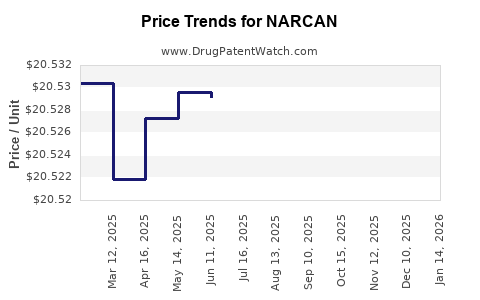
Average Pharmacy Cost for NARCAN
| Drug Name | NDC | Price/Unit ($) | Unit | Date |
|---|---|---|---|---|
| NARCAN 4 MG NASAL SPRAY | 69547-0627-02 | 16.99052 | EACH | 2026-07-22 |
| NARCAN 4 MG NASAL SPRAY | 69547-0627-05 | 16.99052 | EACH | 2026-07-22 |
| NARCAN 4 MG NASAL SPRAY | 69547-0627-02 | 17.31246 | EACH | 2026-06-17 |
| NARCAN 4 MG NASAL SPRAY | 69547-0627-05 | 17.31246 | EACH | 2026-06-17 |
| NARCAN 4 MG NASAL SPRAY | 69547-0627-05 | 17.65649 | EACH | 2026-06-03 |
| NARCAN 4 MG NASAL SPRAY | 69547-0627-02 | 17.65649 | EACH | 2026-05-20 |
| NARCAN 4 MG NASAL SPRAY | 69547-0627-02 | 17.91300 | EACH | 2026-04-22 |
| >Drug Name | >NDC | >Price/Unit ($) | >Unit | >Date |
Best Wholesale Price for NARCAN
| Drug Name | Vendor | NDC | Count | Price ($) | Price/Unit ($) | Unit | Dates | Price Type |
|---|---|---|---|---|---|---|---|---|
| NARCAN NASAL SPRAY 4MG | Emergent Devices, Inc. | 69547-0353-02 | 2 | 37.69 | 18.84500 | EACH | 2023-08-15 - 2028-08-14 | Big4 |
| NARCAN NASAL SPRAY 4MG | Emergent Devices, Inc. | 69547-0353-02 | 2 | 37.69 | 18.84500 | EACH | 2023-08-15 - 2028-08-14 | FSS |
| >Drug Name | >Vendor | >NDC | >Count | >Price ($) | >Price/Unit ($) | >Unit | >Dates | >Price Type |
Narcan (naloxone) Market Analysis and Price Projections
Narcan (naloxone) is entering a period of sustained demand driven by overdose mortality trends, broad payer coverage for opioid use disorder (OUD) and naloxone access programs, and continued expansion of community distribution. Pricing is shaped less by classic “new entrant” dynamics and more by contract structure (state stock-piling, pharmacy benefit manager rebates, and government procurement), formulation channel (nasal vs. injectable), and inventory cycle timing. Near-term pricing pressure is capped by durable public-sector purchasing and by limited substitution at the product/form factor level, while longer-term pricing is influenced by patent and exclusivity status, generic entry, and channel-specific competitive tendering.
What is the current Narcan commercial footprint by product/form and channel?
Core products tied to the Narcan brand
The market is largely segmented by delivery form:
| Product | Active | Typical channel usage | Commercial role |
|---|---|---|---|
| Narcan Nasal Spray | Naloxone hydrochloride | Retail pharmacies, state/community access programs | Primary brand entry point for public access |
| Generic naloxone nasal spray | Naloxone HCl | Retail and institutional | Competes on price once available in given plan/formulary |
| Naloxone injection (including generic) | Naloxone HCl | EMS, hospitals, institutions | Often substituted with different procurement criteria |
Brand-versus-generic reality: In retail pharmacy, the “product unit” is often nasal spray rather than generic injection. In emergency and inpatient settings, procurement frequently pivots to injectable generics, which can cap price expectations for brand formulations when budgets tighten.
Demand drivers (what holds volume)
- Rising overdose morbidity and naloxone distribution programs in the US, which monetize directly into repeat stock replenishment cycles for retail and public-sector buyers.
- Broad policy focus on take-home naloxone and community distribution, which stabilizes baseline volumes for nasal naloxone products in many geographies.
How do payers and procurement determine Narcan pricing in practice?
Retail pharmacy pricing mechanics
Narcan’s realized price in retail is determined by:
- Net price (list price minus rebates and discounts negotiated through pharmacy benefit managers).
- Formulary placement (preferred status versus non-preferred drives channel volume).
- Competitive substitutes on-shelf (generic nasal sprays and other naloxone brands by NDC).
Net prices in this class typically remain higher than generic equivalents but can compress during periods of:
- increased generic penetration in nasal spray SKUs
- plan redesigns that move coverage from preferred to non-preferred
- heightened procurement-driven switching in institutional outpatient contracts
Public-sector and institutional procurement
Government and large institutional buyers tend to buy via:
- state contract tenders and replenishment orders
- EMS and hospital purchasing contracts
- direct distribution agreements for take-home naloxone
These buyers are sensitive to:
- lowest acceptable net price per unit
- stock continuity
- storage stability and usability criteria
- evidence of handling and administration performance in field workflows
What does the US pricing landscape imply for near-term Narcan price behavior?
Price behavior pattern to expect
For naloxone nasal spray, market behavior commonly follows a channel-specific path:
- Retail: brand price pressure rises when PBM formularies and rising generic availability increase copay competition. Net price can still hold if the brand retains preferred positioning and rebates remain competitive, but list-to-net spread becomes the swing factor.
- Public-sector: pricing tightens when states reopen tenders or switch to multi-source bidding. Brand price can persist through incumbent advantage but faces direct comparison with lower-priced generics when included in the bid set.
Key constraint: substitution limits by form factor
Even when generic naloxone exists, some buyers specify:
- nasal spray rather than injectable due to administration simplicity for lay users
- device-specific usability and training simplicity
That constraint can support Narcan pricing relative to injectable generics, but it does not prevent compression if generic nasal spray is fully covered and operationally equivalent in procurement terms.
How does patent and exclusivity status affect price projections?
Narcan is a well-established naloxone product. In practical market terms, the main structural force on price is whether the brand continues to retain exclusivity advantages versus the competitive set (including generic nasal sprays and competing brands). Once exclusivity barriers ease, brand pricing typically shifts from “innovator pricing” to “incumbent pricing under multi-source competition,” meaning:
- realized prices trend downward or plateau
- promotional and rebate intensity increases to defend formulary placement
- channel-by-channel variability widens
For a price forecast, the key is channel exposure to generic substitution (retail nasal spray plans vs. government tenders that include generics).
What are the price projections for Narcan over 12 to 36 months?
Because realized pricing depends on net price and contract timing, projections are expressed as range bands tied to channel behavior: retail (net pressure) versus public-sector (tender-driven resets). The forecast below assumes continued baseline overdose-driven demand with periodic procurement refresh and ongoing generic availability in the nasal segment.
Forecast bands (US market, naloxone nasal spray units)
Projections are directional and scenario-based using channel logic rather than relying on a single list price.
| Time horizon | Retail channel (net price band) | Public-sector/institutional (net price band) | Expected drivers |
|---|---|---|---|
| 0–12 months | -0% to -10% vs. current net level | -5% to -15% vs. current net level | PBM repricing, formulary adjustments, tender repricing cycles |
| 12–24 months | -5% to -20% | -10% to -25% | broader plan switches to multi-source nasal, increased rebate competition |
| 24–36 months | -10% to -25% | -15% to -30% | multi-year tenders re-open, deeper generic penetration in nasal workflows |
Injectable anchor effect
Injectable naloxone is already widely generic. If institutional budgets tighten, health systems often shift inventory toward injectable generics, which can indirectly cap willingness to pay for brand nasal unless nasal is required for take-home programs.
What are the key pricing risks and upside points?
Downside risks (compression)
- Rapid formulary movement to preferred multi-source nasal naloxone products
- PBM rebate escalation that compresses brand net price
- State procurement switching in tender cycles where generic nasal spray is included at the same administration criteria
- Copay strategy changes that shift consumer behavior from brand to generic
Upside points (price stability)
- Preferred formulary protection through rebate sustainment
- Device and training lock-in where buyers restrict substitutions based on administration usability
- Public distribution programs that maintain recurring replenishment volumes even during price renegotiations
What is the competitive structure and how it affects Narcan pricing?
Competitive set
Narcan’s direct economic competition is:
- generic naloxone nasal spray products in the retail nasal segment
- other naloxone products in institutional settings (especially injectable generics)
Switching dynamics
- Retail substitution occurs when formularies place generics as preferred and when patient out-of-pocket costs narrow.
- Institutional switching occurs when tenders allow multi-source bidding and buyers score on total cost of acquisition.
The net impact: Narcan’s pricing tends to compress faster in segments where substitution is allowed without operational barriers.
What does a “best estimate” scenario imply for Narcan pricing and revenue planning?
Base-case assumption for revenue and pricing planning (directional)
Assume:
- continued volume growth from overdose response
- modest net price decline in retail
- steeper net price decline in public-sector due to contract resets
Base-case combined effect (realized net):
- 0–12 months: roughly stable-to-down low double digit percentage in net pricing, offset by volume
- 12–36 months: net pricing declines widen as multi-source competition deepens; volume growth slows relative to pricing compression
This produces a pattern consistent with “stable unit demand but declining net per unit.”
What KPIs should be used to validate the forecast in real time?
Use these measurement points rather than list price:
- Realized net price by channel
- retail pharmacy net vs prior quarter
- state contract net vs prior tender cycle
- Formulary position changes
- preferred versus non-preferred moves for naloxone nasal spray
- Tender results
- award prices on state stock-piling or institutional procurement contracts
- Share shift between nasal and injectable
- if health systems expand injectable procurement, brand nasal price defense weakens
- Inventory cycle timing
- contract stock resets that create short-term spikes or drops in realized pricing
Key Takeaways
- Narcan pricing is driven by net price mechanics (rebates and formulary design) and tender repricing in public-sector buying more than by broad market demand alone.
- Near-term (0–12 months) pricing pressure is most likely to come from PBM and state procurement cycles, with retail net price typically compressing less than public-sector net price.
- Over 12–36 months, the expectation is wider net price compression as multi-source competition deepens in nasal spray workflows.
- The main swing factor for outcomes is how quickly buyers shift to multi-source nasal naloxone without operational constraints.
- For planning, track realized net price, formulary status, tender award pricing, and channel mix rather than list price.
FAQs
1) Is Narcan expected to get cheaper overall in the next 12 months?
Yes, the most likely direction is modest net price decline, with greater pressure in public-sector/institutional procurement due to contract resets and multi-source bidding.
2) Does generic substitution fully replace Narcan nasal spray in public programs?
Not always. Substitution depends on procurement rules that can specify nasal form and device usability criteria, which can delay or limit switch timing.
3) Will injectable naloxone reduce the price of Narcan nasal indirectly?
Yes. If health systems and institutions shift take-home or inventory strategies toward injectable generics, they can reduce willingness to pay for brand nasal products.
4) What matters more for pricing: list price or net price?
Net price. Rebates, discounts, and contract terms govern realized revenue and determine whether list price increases actually translate into revenue stability.
5) What is the fastest indicator that Narcan price compression is accelerating?
Tender and formulary movement: award prices in state/institutional contracts and changes in PBM preferred coverage for naloxone nasal spray.
References
[1] FDA. “Naloxone Products.” U.S. Food and Drug Administration. https://www.fda.gov/drugs/information-drug-class/naloxone-products
[2] CDC. “Opioid Overdose.” Centers for Disease Control and Prevention. https://www.cdc.gov/drugoverdose/index.html
[3] SAMHSA. “Substance Use and Mental Health Services Administration (Opioid-related resources).” Substance Abuse and Mental Health Services Administration. https://www.samhsa.gov/find-help
More… ↓
