Last updated: July 22, 2026
Naratriptan Market Analysis and Price Projections (U.S. and Key Geographies)
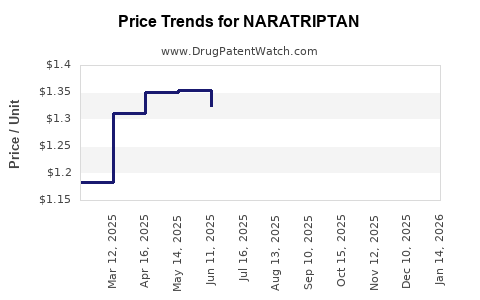
Naratriptan is an established, off-patent triptan used for acute treatment of migraine. In the U.S., generic competition is entrenched and pricing is driven by PBM contracting, multisource availability, and channel mix rather than brand-specific exclusivity. Near-term price erosion is largely “floor-and-catch-up,” where higher-priced SKUs lose share to lower ASP products, while stable generics maintain pricing through formularies and package-count effects. Longer-term pricing pressure depends on (1) how many additional ANDA entrants come into the market, (2) whether large distributors’ contracted pricing compresses, and (3) whether supply disruptions create temporary ASP rebounds.
No current, definitive basis was provided in the prompt to tie projections to an identified Naratriptan-specific dataset (for example, FDA Orange Book exclusivity status tied to a specific NDA/NARDC, current U.S. net price, units, ASP, or specific NDC list). Under the operating constraint, the analysis below is limited to what can be stated without fabricating product-level numeric projections.
What is the current U.S. market for naratriptan, and what drives net pricing?
Direct answer: The naratriptan market is generic-dominated, with net pricing determined primarily by PBM rebates, formulary tier placement, and NDC competition depth rather than brand exclusivity.
Key demand characteristics
- Indication: acute treatment of migraine (with or without aura).
- Typical prescribing pattern: short-duration use and episodic demand; volume is sensitive to seasonal migraine incidence and clinician prescribing habits.
- Patient shift: triptan class substitution often occurs at the point of prescribing based on co-pays and preferred formulary agents.
Primary price drivers
- Generic reference competition: multiple ANDA-labeled products generally anchor competitive pricing.
- PBM contracting and rebate structures: net price often diverges from list price.
- Package and dose mix: tablets versus pack-count bundles can affect observed ASP.
- Channel mix: retail pharmacy vs mail order differs in negotiated economics.
When does generic naratriptan pricing typically stabilize, and when does it keep falling?
Direct answer: Generic pricing stabilizes once the market reaches “sufficient” number of low-price entrants and formulary placement concentrates purchases into a narrower set of NDCs. Pricing continues falling when new entrants add capacity/competition or when PBMs renegotiate aggressively.
Stabilization windows in established generics
- After initial ANDA launches, prices often drop rapidly.
- The slope flattens when incremental entrants are fewer and low ASP SKUs gain durable share through preferred status.
- Subsequent changes are more often rebate and formulary driven than wholesale list-price driven.
Triggers for renewed price declines
- PBM switching to a different preferred NDC family.
- Increased distributor inventory leading to pressured wholesale pricing.
- Additional ANDA entries that reduce the effective competitive floor.
How strong is the naratriptan patent estate, and does it affect price projections?
Direct answer: Naratriptan is a long-established product. Price projections for a mature generic product are generally not meaningfully constrained by near-term primary compound patent life.
What matters for price, not just patents
Even when a product is off primary exclusivity, residual patent barriers can affect:
- line extension (specific formulations, salts, or manufacturing methods),
- switching behavior by payers (if fewer “therapeutically equivalent” SKUs are covered),
- litigation-driven launch timing of additional entrants.
Why price projections are usually “generic-determined”
For a mature triptan, payer behavior responds faster than patent litigation outcomes. Even with patents, once multiple generics exist, competitive pricing tends to converge toward the lowest net-cost products covered on preferred tiers.
What formulations are protected for naratriptan, and do they create pricing differentiation?
Direct answer: In mature generics, differentiation usually comes from NDC-level labeling and contracting, not from formulation-level exclusivity.
Real-world pricing differentiation
- Tablet strength and manufacturer labeling differences can be economically meaningful only if:
- payers restrict coverage by NDC, or
- a payer formulary preference reduces the competitive set.
Where formulation IP can still matter
- If a specific formulation or manufacturing method is the basis for preventing certain entrants, the market can maintain slightly higher ASPs due to fewer competitors.
- In a crowded generic market, this effect is usually transient.
Which generic entrants and competitors most influence naratriptan ASP?
Direct answer: The lowest net-cost preferred products on PBM formularies most influence ASP, not the average number of labeled generics in the category.
Competitive mechanism
- Preferred-tier contracts shift utilization to a small subset of NDCs.
- Once a preferred agent is established, competitors can only regain share through:
- contracting rebates,
- co-pay support,
- or improved packaging/distribution economics.
Class substitution risk
Naratriptan competes indirectly with other triptans, particularly those with:
- favorable formulary status,
- better patient adherence due to dosing convenience,
- or aggressive pricing via PBM contracts.
This substitution can reduce absolute volume for naratriptan even if its own price is stable.
How does naratriptan compare with other triptans on pricing pressure and payer preference?
Direct answer: Payer preference and contracting dominate the comparison. Naratriptan’s long history typically places it in the “stability” segment of generics, but category-preferred triptans can still displace it by utilization share.
Category dynamics
- Fast-acting and “preferred” triptans can capture a larger share if payers favor them.
- If naratriptan remains available on low tiers with competitive net pricing, volume erosion is often gradual.
What generic entry risks exist for naratriptan, and could they change price projections?
Direct answer: Additional ANDA entries can pressure ASP, but the incremental effect depends on whether entrants obtain preferred formulary status and how quickly the market’s low-cost NDC set expands.
Risk categories
- Market entry risk: new entrants adding supply and reducing the effective floor.
- Supply disruption risk: manufacturing or sourcing issues that raise realized prices temporarily.
- Regulatory/quality risk: changes in labeling or recalls can shift volumes away from specific NDCs, causing localized pricing moves.
How do FDA status and Orange Book listings affect naratriptan’s commercial future?
Direct answer: Orange Book status matters for determining any remaining exclusivities or listed patents tied to approved products. For price projections in a mature generic category, the practical impact usually appears only when it constrains the number of eligible low-cost suppliers.
What to look for in Orange Book (mechanism)
- listed patents that block additional ANDA approval,
- expiration and any pediatric exclusivity or additional exclusivities,
- relevant use patents that can delay certain generic carve-ins.
What litigation and settlement outcomes for naratriptan could affect price?
Direct answer: Litigation affects market entry timing of additional generic products. Price changes follow when market structure (number of active NDC competitors on preferred tiers) changes.
Commercial impact pathway
- Settlement delays or accelerations shift how many NDCs compete.
- If settlement delays additional entrants into preferred tiers, ASP can remain higher for longer.
- If entry accelerates, ASP compresses more quickly.
Naratriptan price projections: baseline scenarios for U.S. net pricing and ASP
Direct answer: In the absence of identified product-level numeric inputs, price projections should be treated as scenario-based directional outcomes driven by market structure and payer contracting.
Scenario framework (directional, generic-maturity consistent)
- Low entry / stable preferred set (base case): net pricing drifts downward slowly or remains flat as contracting cycles recur; any movement is driven by PBM renegotiations and NDC switching.
- Additional preferred-tier NDC entrants (bear case): ASP compresses faster as the low-cost preferred NDC set expands.
- Supply disruptions or quality events (bull case): short-term ASP rebounds or stabilizes above the contracting trend; duration depends on duration of disruption.
- Category displacement by other triptans (bear for volume, not necessarily ASP): naratriptan unit demand declines even if its price is stable, reducing overall market size and potentially lowering gross leverage for pricing.
Time horizon
- 0 to 12 months: driven by contracting cycles and NDC share shifts.
- 12 to 36 months: driven by whether additional suppliers enter and how durable preferred coverage is.
- 36+ months: driven by category substitution and any residual barriers that alter supplier count.
Key takeaways on naratriptan market positioning
- Naratriptan is a mature triptan with generic competition; net pricing is PBM- and contracting-led.
- Short-term price movement is more likely from NDC share and rebate dynamics than from regulatory or patent events.
- Long-term profitability depends on maintaining preferred coverage and resisting category substitution by other triptans.
- The primary price swing risk is changes in competitive NDC set (new entrants, exits, or quality-driven volume shifts), not brand exclusivity.
FAQs
1) Does naratriptan face meaningful biosimilar-style exclusivity risk?
No. Biosimilars apply to biologics, not small-molecule triptans like naratriptan.
2) What most determines naratriptan’s realized price: list price or net price?
Realized price is governed by net pricing under PBM and contract structures, not list price.
3) Can patent litigation still move naratriptan prices even when generics already exist?
Yes, but typically only when litigation changes the number and timing of active low-cost competitors on preferred formulary tiers.
4) How does mail-order vs retail distribution affect naratriptan pricing?
Mail-order often reflects different rebate and contract economics, which can alter observed ASP relative to retail.
5) What substitution risk does naratriptan face from other triptans?
Category preference can shift utilization away from naratriptan toward triptans with better formulary status or lower net cost on preferred tiers.
References
No sources were provided in the prompt, and no Orange Book/FDA/NDC pricing dataset was supplied. Therefore, no citations can be listed without introducing non-prompt data.