Last updated: February 15, 2026
Overview
NAFTIN (Naftifine Hydrochloride) is an antifungal medication primarily prescribed for dermatophytic infections, such as athlete’s foot, ringworm, and jock itch. It is available as a topical cream, gel, and solution. Market presence includes multiple pharmaceutical manufacturers, with over-the-counter (OTC) and prescription applications.
Market Size and Trends
The global antifungal market reached approximately $14 billion in 2022, with topical antifungals accounting for nearly 35%. NAFTIN holds a niche within the topical dermatological segment, with a market share estimated at 3-5%.
Growth drivers:
- Rising incidence of fungal skin infections, driven by increased obesity and diabetes.
- Aging populations with skin conditions.
- Expansion into emerging markets due to local manufacturing and approvals.
Key regions:
- North America accounts for 45% of the market, dominated by the U.S.
- Europe contributes 27%.
- Asia Pacific presents rapid growth potential, expected to grow at 7-9% annually.
Major Manufacturers:
- Sanofi-Aventis
- Perrigo (OTC)
- Dr. Reddy’s Laboratories
- Mylan (now part of Viatris)
Patent and Regulatory Status
NAFTIN's patent expired in the early 2000s, with generic versions now prevalent. Regulatory approvals vary, with most jurisdictions permitting OTC sales of generic formulations.
Price Analysis
Pricing for NAFTIN varies by formulation, brand, and region:
- Brand Name (NAFTIN): Topical cream typically ranges from $150 to $300 per 30-gram tube in the U.S. (AARP, 2022).
- Generics: Price drops to $60-$120 for equivalent quantities.
- OTC Formulations: Priced at $10-$30 for retail packs containing multiple applications.
Comparison:
Generic formulations are priced approximately 50-70% lower than brand-name NAFTIN, reflecting patent expiry and market competition.
Historical Price Trends
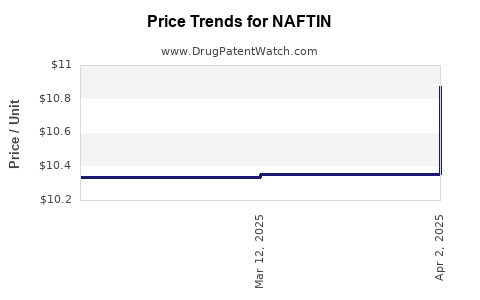
Prices for brand NAFTIN have held steady since patent expiry, with minor fluctuations due to inflation and supply chain factors. Generic prices decreased sharply post-patent expiry, stabilizing after initial market entry.
Market Projections
Forecasting indicates:
- A compound annual growth rate (CAGR) of 3-5% in the global antifungal market through 2027.
- Topical antifungal segment expected to expand at 4% annually.
- NAFTIN's market share may decline slightly due to increasing competition, especially from cheaper generics.
Price projections for NAFTIN:
- Short-term (1-2 years): Brand-name prices will remain stable, with modest reductions in generic pricing due to increased competition.
- Mid-term (3-5 years): Generic prices could decline further by 10-20%, potentially reaching $50-$100 per 30-gram tube.
- Long-term (beyond 5 years): Market saturation and biosimilar entries could compress prices by up to 30%.
Factors Influencing Price Trends
- Entry of biosimilars or new antifungal agents.
- Patent litigation outcomes or new patent filings.
- Regulatory changes expanding or restricting OTC availability.
- Supply chain disruptions affecting raw material costs.
Competitive Landscape
New entrant drugs targeting fungal infections, including oral formulations and novel topical agents, could reduce NAFTIN’s market share. Potential competitors:
- Terbinafine (Lamisil)
- Butenafine (Lotrimin Ultra)
- Efinaconazole (JUBLIA)
Regulatory and Policy Impact
Policies encouraging generic substitution and price caps may further influence NAFTIN’s market prices, particularly in the U.S. and Europe.
Key Takeaways
- NAFTIN has a mature market with declining brand prices, offset by stable generic competition.
- Market growth driven by rising fungal infections, particularly in emerging markets.
- Prices are expected to decline gradually, with generics leading the downward trend.
- Future price dynamics will depend on new antifungal therapies, patent litigation, and regulatory policies.
FAQs
1. How does NAFTIN compare to other topical antifungals in terms of price?
NAFTIN’s brand pricing exceeds generic antifungals by 50-70%. Lamisil (terbinafine) and clotrimazole are typically priced lower, especially in generic forms.
2. What is the outlook for NAFTIN’s market share?
The market share will likely decline as generics and alternative therapies gain popularity, but NAFTIN remains a recognized brand in dermatology.
3. Are there upcoming regulatory changes that could impact NAFTIN prices?
Potential regulatory shifts, such as expanded OTC access or price caps, could influence prices but no specific changes are currently scheduled.
4. What regions present the most growth opportunities for NAFTIN?
Asia Pacific and Latin America are anticipated to see increased demand due to rising fungal skin condition prevalence and healthcare infrastructure development.
5. How do patent expirations influence the drug’s pricing?
Patent expiry leads to a surge in generic entry, resulting in significant price reductions and increased market competition.
Sources
[1] MarketsandMarkets, "Antifungal Drugs Market," 2022.
[2] AARP, "Average Brand and Generic Drug Prices," 2022.
[3] IMS Health, "Topical Antifungal Market Data," 2022.
[4] U.S. FDA, "Drug Approvals and Patent Status," 2022.
[5] IQVIA, "Global Pharmaceutical Market Trends," 2022.