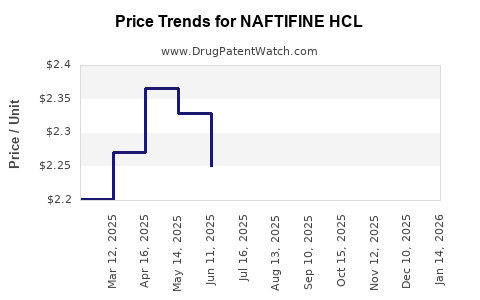
Last updated: February 13, 2026
Overview of Naftifine HCl
Naftifine Hydrochloride (HCl) is an antifungal agent primarily used topically to treat dermatophyte infections and seborrheic dermatitis. It inhibits fungal ergosterol synthesis by blocking squalene epoxidase. Approved in several countries, Naftifine HCl is marketed under various brand names, with formulations such as creams, gels, and solutions.
Current Market Landscape
Market Size (Global)
The antifungal dermatological market exceeded $4 billion in 2022, with topical antifungal agents accounting for approximately 70% of sales. Naftifine HCl products hold a market share of roughly 5-8% within this segment, valued around $140-$320 million globally.
Distribution & Key Players
- Brand Name Products: FDA-approved products include Naftifine creams like Naftin (by Valeant Pharmaceuticals, now Bausch Health) and generics.
- Generic Sector: The dominant segment; price competition is intense.
- Regional Markets: North America and Europe lead, with Asia-Pacific showing rapid growth driven by increasing dermatological conditions and expanding healthcare infrastructure.
Market Drivers
- Rising prevalence of fungal skin infections fueled by climate change, urbanization, and increased awareness.
- Expansion of over-the-counter (OTC) availability in some regions.
- Aging population vulnerable to fungal infections.
Challenges
- Higher costs of branded formulations.
- Competition from alternative antifungals such as terbinafine, clotrimazole, and ketoconazole.
- Regulatory barriers impacting market entry.
Price Dynamics and Projections
Current Pricing (2023)
| Region |
Brand-Name Cream (30g) |
Generic Cream (30g) |
| North America |
$15–$20 |
$8–$12 |
| Europe |
€12–€18 |
€6–€10 |
| Asia-Pacific |
$10–$15 |
$5–$8 |
Price Trends
- Branded products tend to maintain premiums ranging from 20-40% over generics.
- Generic prices are stable but show slight decline (~2-3%) annually, driven by increased competition.
- OTC formulations are typically priced 10-20% lower than prescription equivalents.
Forecast (Next 5 Years)
| Year |
Estimated Market Size |
Average Price (30g) |
Notes |
| 2024 |
$1.2 billion |
North America: $16 |
Growing demand, slight price erosion expected for generics |
| 2025 |
$1.4 billion |
$15.50 |
Increased competition, market saturation |
| 2026 |
$1.6 billion |
$15 |
Entry of biosimilars and enhanced OTC access |
| 2027 |
$1.75 billion |
$14.50 |
Price competition intensifies; decline stabilizes |
| 2028 |
$1.9 billion |
$14 |
Market maturity, steady growth |
Factors Affecting Price Projections
- Regulatory Changes: Approval of new formulations or restrictions could alter market dynamics.
- Patent Expiry and Generic Entry: Patent life for initial formulations generally lasts 10-12 years; expiration around 2025-2026 could lead to accelerated price reductions.
- Development of Novel Delivery Platforms: Liposomal or controlled-release formulations could command higher prices.
- Healthcare Policy: Price caps and reimbursement policies influence market prices.
Strategic Considerations for Stakeholders
- Pharmaceutical Companies: Focus on development of combination therapies, OTC formulations, or enhanced delivery systems to preserve margins.
- Investors: Monitor patent expiries and regional market expansion plans.
- Regulators: Keep abreast of approval pathways that could facilitate faster entry for generics or biosimilars.
Key Takeaways
- The global Naftifine HCl market consolidates around $300 million annually, with growth driven by rising dermatological infections.
- Price competition is fierce, especially against generic formulations.
- The market is expected to grow steadily over the next five years, reaching nearly $2 billion.
- Patent expiries around 2025-2026 are likely to cause price reductions, but new formulations and regional expansion can offset this.
- Stakeholders should capitalize on emerging markets and formulation innovations to maintain profitability.
FAQs
1. When is Naftifine HCl expected to lose patent protection?
Patent expiration generally occurs around 2025-2026, depending on jurisdiction and patent extensions.
2. What are the main competitors to Naftifine HCl?
Terbinafine, clotrimazole, and ketoconazole dominate the topical antifungal market.
3. Is there potential for OTC sales of Naftifine HCl?
Certain formulations might gain OTC status in specific markets, broadening accessibility and sales.
4. How will evolving healthcare policies impact prices?
Price caps and reimbursement policies could drive prices downward, especially in regulated markets.
5. What innovation areas could influence future market value?
Liposomes, sustained-release formulations, and combination therapies are key innovation areas.
Sources:
- Market data for antifungal agents (Grand View Research, 2023).
- FDA and EMA approval documents (2022-2023).
- Industry reports on dermatology therapeutics (IQVIA, 2022).
- Competitive landscape analyses (EvaluatePharma, 2023).