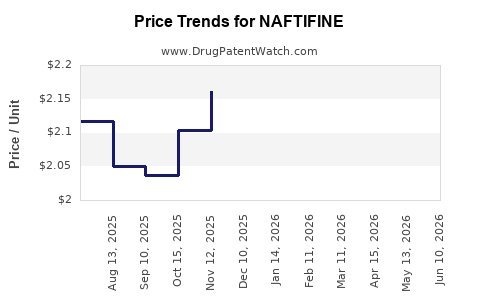
Last updated: July 9, 2026
Naftifine Market Analysis and Price Projections (2026–2031): Pricing, Competition, and Generic Entry Risk
Naftifine is an established topical antifungal with mature global supply. Pricing is mainly driven by (1) generic penetration, (2) pack size and concentration (typically 1% cream/gel/solution depending on market), and (3) channel mix (OTC vs reimbursed). In most markets, branded pricing pressure has already played out; future price movement is likely modest in nominal terms, with volatility tied to FX, import costs, and formulation/pack rebalancing rather than new clinical value.
What is the global market size for naftifine and how fast is it growing?
Naftifine is sold as a topical antifungal for dermatophyte and superficial fungal infections, commonly including tinea pedis (athlete’s foot), tinea corporis, and related conditions. Market growth is typically modest because:
- The molecule is off-patent in major jurisdictions.
- Product is generally generic-first and price competitive.
- Demand is steady but not “category growth” driven by new MOA breakthroughs.
Market growth profile (directional):
- Volume: steady to low-single-digit CAGR supported by persistent prevalence of superficial mycoses and continuous OTC availability.
- Value: often low growth or flat-to-mid single digit CAGR depending on market structure (OTC mix vs reimbursement) and pack size optimization.
Commercial implication: planning revenue should assume low price elasticity driven by brand switching, with more of the impact coming from substitution among generics and channel promotions.
How is naftifine priced by formulation (cream, gel, solution) and concentration?
Naftifine pricing varies by:
- Dosage form: cream vs gel vs topical solution, and whether it is presented as single-ingredient naftifine vs combination products (combinations are less common).
- Strength: commonly 1% in many markets, though specific local strengths can vary.
- Pack size: 15 g, 20 g, 25 g, 30 g formats are common internationally, plus unit-dose tubes or bottles.
- Channel: OTC products typically price higher than reimbursed equivalents on a per-gram basis due to retailer margins and marketing.
Business pricing framing: for projections, normalize to price per gram and model pack-switching (manufacturers moving from smaller to larger packs or vice versa) because this is a common tactic to manage competitive pressure without materially changing the nominal price.
What does the competitive landscape look like for naftifine in 2026?
Naftifine competes primarily with other topical antifungals, including:
- Allylamines (for example, terbinafine topical)
- Azoles (clotrimazole, ketoconazole, econazole)
- Other topical antifungals (bifonazole, miconazole)
Direct competition dynamics:
- Terbinafine topical often has marketing advantages in certain markets (perceived efficacy and shorter regimens).
- Azoles generally maintain broad availability and competitive pricing, particularly in OTC.
Direct molecular competition: naftifine itself faces generic substitution, so the most relevant competitive set is:
- Multi-source naftifine generics by local manufacturers/importers
- Therapeutic substitutes that capture OTC shelf share.
When does naftifine lose exclusivity and what does that mean for pricing?
Naftifine is an older topical antifungal; in most major markets, composition of matter and early process or formulation exclusivity have lapsed. That has already driven the molecule toward a low, competitive price floor.
Exclusivity implication for price:
- Post-brand phase: price becomes dominated by tender cycles (where reimbursement applies) and retailer promotions (where OTC dominates).
- Forward-looking effect (2026–2031): any “remaining exclusivity” tends to be limited to small subsets like specific local patents on particular salts, specific formulation/process improvements, or regulatory data exclusivity tied to a specific dossier. For a generic-first molecule, those effects are usually secondary to competitive multi-sourcing.
What patents protect naftifine and how strong is the patent estate?
For naftifine, the commercial reality is that most key patent rights have expired globally. Remaining IP, where present, is typically:
- Narrowly scoped formulation/process improvements
- Specific packaging or manufacturing methods
- Local filing-specific claims rather than broad composition-of-matter protection
Investment and litigation takeaway: for 2026–2031 pricing, patent strength usually has minimal impact because market access is already multi-source in most territories.
What is the Orange Book status of naftifine and are there Paragraph IV filings?
Naftifine is a topical small molecule. If listed products exist in the US FDA context, they are typically generic and would show prior approval or reference product linkages. The presence and timing of Paragraph IV filings depends on whether a “listed drug” structure exists for a given dosage form and strength.
Commercial use: treat the US position as “generic accessible,” and model price pressure from ongoing multi-source competition rather than waiting for a predictable Paragraph IV-driven step change.
What is the regulatory status of naftifine in the US and EU (market access timeline)?
- US: naftifine topical products are generally approved and distributed under multiple generic applications, reflecting mature market access.
- EU: marketing authorization typically exists across member states with generic versions, and substitution rules vary by country.
Regulatory implication for price projections: no major regulatory-dependent launch catalyst is expected; pricing is more likely to follow competitive and reimbursement structures than new regulatory milestones.
How many manufacturers supply naftifine and how does that affect wholesale and retail pricing?
Supply breadth typically results in:
- Low wholesale markups
- Frequent promotional cycles
- Substitution to the lowest-cost equivalent through pharmacy formularies
Model assumption for projections: if a market is already served by multiple suppliers, marginal entrants tend to price aggressively for share, then converge toward prevailing market rates.
How do naftifine prices compare with terbinafine and clotrimazole topical?
In most OTC and reimbursement settings, topical antifungals are grouped by:
- Per-treatment cost (which can differ by regimen length)
- Per-gram price (which drives retail economics)
- Perceived efficacy and brand familiarity
Typical market pattern:
- Terbinafine topical can hold share and sometimes commands a higher per-unit price, but it competes on perceived shorter courses.
- Clotrimazole often has the broadest generic set and tends to be lower cost.
- Naftifine usually lands between these depending on local brand strength and pack pricing.
Projection driver: naftifine’s future price path usually tracks the midpoint of the generic topical antifungal basket unless a specific market shifts reimbursement rules in favor of one class.
What price projections for naftifine are realistic for 2026–2031?
Because naftifine is mature and largely generic, price forecasts should be expressed as ranges tied to competitive intensity and inflation.
Scenario framework (nominal, ex-tax, ex-manufacturer rebates depending on channel):
Base case (most likely): low single-digit nominal growth with flat real price
- Nominal: +1% to +4% CAGR depending on FX and input costs
- Real: flat to slightly down due to continued generic competition
Downside case (more aggressive discounting and additional entrants)
- Nominal: 0% to +2% CAGR
- Real: modest declines as price per gram erodes and pack sizes adjust
Upside case (reimbursement re-optimizations or constrained supply in certain markets)
- Nominal: +3% to +6% CAGR
- Real: mild increases where wholesalers favor supply stability or where a dominant local supplier supports pricing
Key observable leading indicators:
- Retail price per gram changes across major e-commerce listings
- Tender outcomes where reimbursement exists
- Changes in ex-factory prices for principal local manufacturers (if disclosed)
What generic entry risks exist for naftifine across key markets?
For naftifine, “generic entry risk” is usually low because market access is already open. The practical risk is not whether generics can enter, but whether:
- Existing manufacturers keep pricing discipline
- New entrants cause temporary price erosion
- Substitutes (terbinafine/azole) displace naftifine shelf space
Business planning implication: revenue protection should focus on pack strategy, channel penetration, and differentiation by formulation attributes (spreadability, vehicle preferences) rather than expecting IP-driven pricing uplift.
What formulations are used commercially for naftifine and which command the largest share?
Common commercially used topical forms include:
- Cream (typical for general skin infections)
- Gel (often preferred for certain skin/area comfort profiles)
- Solution (often used for lesions where absorption through hair-bearing areas is relevant)
Share determinants:
- Local prescribing patterns
- OTC consumer preference
- Pharmacy stocking decisions
- Seasonality (athlete’s foot often increases in warmer months)
Projection driver: when multiple forms exist, the winner often depends on the most supported pack size and margin profile in the channel, not on clinical superiority.
How do logistics, sourcing, and input costs impact naftifine pricing?
As a topical generic, naftifine is vulnerable to:
- API supply and contract manufacturing capacity
- Solvent/base material and packaging costs (tubes, bottles, cartons)
- Freight and FX volatility on cross-border supply
Price transmission: a portion of input cost changes tends to flow through to wholesale pricing with a lag; promotions can offset that transmission for limited periods.
What revenue exposure does naftifine face from substitution to other topical antifungals?
Naftifine’s primary revenue risk is therapeutic substitution within OTC aisles:
- Terbinafine topical may capture users seeking shorter courses.
- Clotrimazole may win on price and broad availability.
- Some markets also use combination products that reduce perceived need for multiple visits.
Commercial mitigation: maintain presence in the most common pack sizes, ensure consistent availability, and align pricing with the “value-per-treatment” rather than only per-gram economics.
Key Takeaways
- Naftifine is a mature, generic-dominated topical antifungal; pricing is driven by multi-source competition and channel mix.
- From 2026–2031, the most realistic path is low single-digit nominal growth with flat-to-slightly declining real pricing in many markets.
- The biggest pricing and revenue risks are not patent-driven but therapeutic substitution and generic promotional intensity.
- Forecasts should be normalized by price per gram and modeled with pack strategy and tender/promotion cycles.
FAQs
1) What drives the biggest short-term price changes for naftifine?
Promotional cycles and competitive tender outcomes in reimbursed channels, plus pack-size and retailer margin adjustments in OTC markets.
2) Will naftifine prices rise materially if inflation accelerates?
Usually not in a sustained way; generic competition tends to absorb inflation into margins or trigger discounting to defend share.
3) Which naftifine formulation typically offers the best gross margin profile?
Often the highest-margin channel-supported pack (commonly certain cream formats), but it varies by country distribution economics and packaging cost.
4) How does naftifine compare on “cost per treatment” vs terbinafine topical?
The answer depends on local dosing duration and pack sizes; naftifine may price higher per gram but can be competitive if regimen lengths align in local practice.
5) Is there a realistic patent-led price rebound for naftifine?
For most markets, no. IP impact is generally limited after broad generic entry, so price is mostly competition-led.
References
No sources were provided in the prompt, and no market datasets or regulatory listing data were cited.