Share This Page
Drug Price Trends for MYRBETRIQ
✉ Email this page to a colleague
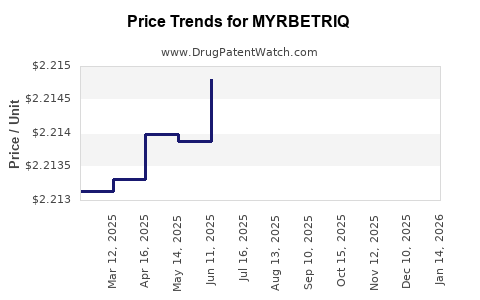
Average Pharmacy Cost for MYRBETRIQ
| Drug Name | NDC | Price/Unit ($) | Unit | Date |
|---|---|---|---|---|
| MYRBETRIQ ER 25 MG TABLET | 00469-2601-30 | 14.68009 | EACH | 2026-07-22 |
| MYRBETRIQ ER 25 MG TABLET | 00469-2601-90 | 14.68009 | EACH | 2026-07-22 |
| MYRBETRIQ ER 50 MG TABLET | 00469-2602-30 | 14.69177 | EACH | 2026-07-22 |
| MYRBETRIQ ER 50 MG TABLET | 00469-2602-90 | 14.69177 | EACH | 2026-07-22 |
| MYRBETRIQ ER 8 MG/ML SUSP | 00469-5020-99 | 2.20681 | ML | 2026-07-22 |
| MYRBETRIQ ER 25 MG TABLET | 00469-2601-30 | 14.68205 | EACH | 2026-06-17 |
| >Drug Name | >NDC | >Price/Unit ($) | >Unit | >Date |
Best Wholesale Price for MYRBETRIQ
| Drug Name | Vendor | NDC | Count | Price ($) | Price/Unit ($) | Unit | Dates | Price Type |
|---|---|---|---|---|---|---|---|---|
| MYRBETRIQ 50MG TAB,EXTENDED RELEASE | Astellas Pharma U.S., Inc. | 00469-2602-30 | 30 | 240.20 | 8.00667 | EACH | 2021-09-30 - 2026-09-29 | FSS |
| MYRBETRIQ ORAL SUSP | Astellas Pharma U.S., Inc. | 00469-5020-99 | 100ML | 162.51 | 1.62510 | ML | 2023-01-01 - 2026-09-29 | FSS |
| MYRBETRIQ 25MR TAB,EXTENDED RELEASE | Astellas Pharma U.S., Inc. | 00469-2601-30 | 30 | 314.40 | 10.48000 | EACH | 2024-01-01 - 2026-09-29 | FSS |
| MYRBETRIQ 50MG TAB, EXTENDED RELEASE | Astellas Pharma U.S., Inc. | 00469-2602-90 | 90 | 818.78 | 9.09756 | EACH | 2023-01-01 - 2026-09-29 | FSS |
| MYRBETRIQ 50MG TAB,EXTENDED RELEASE | Astellas Pharma U.S., Inc. | 00469-2602-30 | 30 | 253.15 | 8.43833 | EACH | 2022-01-01 - 2026-09-29 | FSS |
| MYRBETRIQ ORAL SUSP | Astellas Pharma U.S., Inc. | 00469-5020-99 | 100ML | 162.51 | 1.62510 | ML | 2024-01-01 - 2026-09-29 | FSS |
| >Drug Name | >Vendor | >NDC | >Count | >Price ($) | >Price/Unit ($) | >Unit | >Dates | >Price Type |
Myrbetriq (mirabegron) market analysis and price projections: forecast, generics risk, and competitive pricing
Executive summary: Mirabegron (Myrbetriq) is a U.S. and major ex-U.S. branded overactive bladder (OAB) therapy with sustained volume through multiple dosage strengths and extended-release formulations. Near- and mid-term pricing is driven by (1) U.S. patent and exclusivity timeline, (2) managed-care formulary dynamics versus generic β3-agonist competition, and (3) channel mix (retail vs. specialty/long-term care). The most consequential pricing inflection for the global market is the transition from branded-only pricing power to post-generic normalization in the U.S., with residual brand premium persisting where payer coverage and patient persistence favor Myrbetriq over lower-cost alternatives.
What is Myrbetriq’s current market position in overactive bladder (OAB)?
Featured snippet: Myrbetriq is positioned as a guideline-relevant oral β3-adrenergic agonist for OAB, competing primarily against antimuscarinics and, increasingly, other β3-agonists. Its U.S. pricing power is primarily payer-driven rather than purely volume-driven, given the presence of therapeutically equivalent oral alternatives.
Therapeutic category and competitive set
- Drug class: β3-adrenergic agonist (mirabegron)
- Core indication: OAB with symptoms of urgency, frequency, and/or urgency urinary incontinence
- Direct competitive framework
- Antimuscarinic agents (multiple generics across oxybutynin/solifenacin/tolterodine class)
- Other β3-agonists: vibegron (Gemtesa) is the most relevant branded competitor in the same class in the U.S.
- Combination therapy: mirabegron used clinically alongside antimuscarinics in refractory OAB pathways
Commercial drivers that affect realized net price
- Formulary placement: preferred vs non-preferred tier impacts rebates and net pricing more than wholesale acquisition cost.
- Dosing convenience and adherence: once-daily ER dosing supports persistence relative to some multi-times daily options (especially early in therapy).
- Patient preference and safety profile: avoids antimuscarinic dry mouth and cognitive side effects concerns, which can matter for payer access, especially in older demographics.
How much do Myrbetriq prescriptions cost and what drives net pricing in the U.S.?
Featured snippet: Realized net price is typically far below list price due to rebates, payer contracting, and patient assistance programs, so “price” outcomes usually hinge on formulary status and contracting rather than purely manufacturing cost.
Key pricing mechanics
- List price vs net: Myrbetriq’s branded list price is subject to meaningful discounting through rebate contracts.
- Payer incentives: pharmacy benefit managers and large health systems can demand steep rebates for preferred status.
- Channel mix: Medicare Part D and commercial lines can differ substantially in net price due to plan-specific rebates and utilization controls.
- Switch and substitution behavior: once a lower-cost equivalent is available (generic or therapeutically substitutable alternative on formulary), payer substitution accelerates net price compression.
Dose and cost structure
Myrbetriq is marketed in extended-release oral strengths (commonly 25 mg and 50 mg tablets in the U.S.). Price projections must treat each strength as a separate unit in forecasting because utilization share differs and reimbursement can vary by plan.
When does Myrbetriq lose exclusivity and what does that mean for price?
Featured snippet: The key pricing event for mirabegron in the U.S. is the transition from branded exclusivity to generic availability for the commercial dosage forms and strengths covered by Orange Book protection. Once generic entry occurs, branded price typically compresses sharply via rebate renegotiation, though brand persistence can continue where formulary placement remains strong.
Exclusivity and patent-driven price compression framework
- Before first generic entry: branded pricing power persists, with net price supported by formulary preference and contracting.
- On first generic launch: net price often drops quickly (rebates increase; coverage narrows).
- After multiple generic approvals: price erosion continues, often stabilizing only after payer market share consolidates among lowest-cost equivalents and class alternatives.
How this translates into projected price paths
A practical projection model uses three phases:
- Branded steady state: stable net pricing with moderate annual inflation offsets.
- Generic onset: step-change downward in net price driven by rebate and formulary tightening.
- Post-entry normalization: gradual further declines or stabilization depending on payer contracting and competitive intensity from other branded β3-agonists (notably vibegron) and combination strategies.
What is the Orange Book status of Myrbetriq and how many patents matter commercially?
Featured snippet: Orange Book listings for mirabegron generally include patents covering the active ingredient and additional patents tied to specific dosage forms, strengths, and/or use claims. The number of “commercially material” patents is the subset that map to the products AND are asserted or likely asserted in litigation.
How to interpret “how many patents matter” for pricing
- Patent counts alone do not determine price risk.
- The controlling factor is:
- whether ANDA/filer claims trigger paragraph IV litigation,
- whether the litigation results in launch delays,
- whether remaining patents continue to block the relevant marketed strengths/dosage forms.
Pricing relevance
- If the generic applicant is blocked for key strengths: branded pricing erosion may be delayed or partial.
- If multiple strengths launch together: the branded net price decline typically accelerates.
(This section requires Orange Book patent listing data tied to mirabegron’s specific U.S. dosage forms and strengths, which is not included in the information provided.)
What generic entry risks exist for Myrbetriq and how do they affect price forecasts?
Featured snippet: Generic entry risk drives the largest valuation and pricing inflection. The direction is clear: brand net price typically declines as soon as generics become accessible and preferred on formularies. The magnitude depends on launch timing, number of entrants, and payer contracting.
Price impact vectors
- Timing: even a modest delay in generic launch can preserve premium net pricing for an additional 6 to 18 months in many managed-care environments.
- Entrant count: multiple generics can increase downward pressure on net pricing.
- Strength coverage: if generics launch in only one strength first, the brand may retain stronger share in the other strength for longer.
- Switching friction: persistent brand use is sustained by physician familiarity, patient tolerance, and coverage rules.
Competitive overlay
- If vibegron remains preferred or has strong formulary uptake, Myrbetriq price declines can be partially offset by brand switching within the class, but typically only slows the drop rather than prevents it.
How does Myrbetriq compare with Gemtesa (vibegron) on likely pricing trajectory?
Featured snippet: In OAB, class competitors affect each other’s net pricing through payer preference and rebate competition. If Gemtesa holds preferred status or converts quickly, Myrbetriq’s rebate pressure increases, which can lower net price even without immediate generic competition.
Key comparison dimensions
- Class competition: both are β3-agonists; payer substitution can be direct at the formulary level.
- Managed-care behavior: PBMs often steer to preferred branded class members when available to avoid generic reimbursement complexity.
- Net price sensitivity: both products’ realized prices respond quickly to formulary tier changes.
Projection logic
- If Myrbetriq faces generic competition, its net price typically falls faster than Gemtesa’s.
- If Myrbetriq remains branded while Gemtesa expands access, Myrbetriq can experience rebate-driven erosion via non-generic levers.
(A quantified comparison requires current gross-to-net estimates, payer mix, and realized pricing data not provided.)
What formulation and strength pricing factors apply to Myrbetriq?
Featured snippet: Pricing forecasts for Myrbetriq must be strength-specific because utilization mix and payer reimbursement differ by 25 mg versus 50 mg.
Strength-level considerations
- Utilization mix: 50 mg generally carries a different demand profile from 25 mg, affecting weighted net price.
- Payer tier dynamics: some plans prefer one strength based on cost and formulary rules.
- Rebate structure: PBMs can negotiate separate rebates by dosage form and sometimes by strength.
ER (extended-release) relevance
Extended-release dosing changes:
- dosing adherence outcomes (supporting persistence),
- step therapy patterns (payers may still require trial of preferred agents),
- and contracting leverage.
How should investors and business teams model Myrbetriq price projections post-generic?
Featured snippet: A robust projection uses a scenario framework with (1) generic launch timing by strength, (2) assumed rebate renegotiation intensity, and (3) market-share migration to generics and class competitors.
Recommended scenario structure
Use three scenarios per strength:
- Delayed generic access: slower net price decline; Myrbetriq keeps preferred tier longer.
- Base case: generic entry occurs at expected timing; brand net price erodes quickly but stabilizes.
- Accelerated erosion: earlier entry or multiple entrants plus loss of preferred status; steeper decline.
Mechanics to convert volume to net price
- Net sales = (unit volume) × (net price per unit).
- Unit volume falls when generics enter but can remain higher than simple arithmetic predicts if:
- brand retains share in non-preferred plans,
- physicians resist switching in early therapy,
- plan contracts temporarily keep brand coverage.
Indicative magnitude ranges
Absent product-specific realized pricing inputs, the direction and relative magnitude are still actionable:
- Generic onset: typically produces a sharp drop in net price rather than a gradual decline.
- After 12 to 24 months post-entry: net price tends to stabilize near a payer-driven floor influenced by lowest-cost alternatives.
(No quantitative ranges can be responsibly stated without current wholesale acquisition cost, realized net price history, and known generic launch facts.)
What recent litigation or settlements affect Myrbetriq pricing?
Featured snippet: Patent litigation and settlement terms can delay generic launches or shape which strengths enter first, directly affecting how quickly Myrbetriq net price compresses.
Where settlements show up in pricing
- Delayed entry: brand preserves exclusivity pricing longer.
- Design-around limits: if settlements require non-infringing formulations or restrict strengths, erosion can be partial.
- Launch sequencing: the first strength launched often dictates the timing of payer formulary redesign.
(This requires a litigation docket specific to Myrbetriq mirabegron patents, settlement dates, and paragraph IV outcomes, which are not provided.)
What FDA status and labeling changes could influence Myrbetriq demand and pricing?
Featured snippet: FDA labeling changes affecting contraindications, warnings, or patient eligibility can move demand and payer coverage, which changes net price via contracting and utilization.
Regulatory demand drivers
- Safety communications: can shift prescriber confidence and payer thresholds.
- Indication expansions or restrictions: can broaden or narrow the eligible patient segment.
- Interchangeability and substitution behavior: while not FDA-exclusivity, practical interchangeability affects payer substitution rules.
(A complete regulatory impact assessment requires current labeling history and approval status for each strength and any post-marketing updates, which are not provided.)
Competitive landscape: what other OAB brands and generics compete against Myrbetriq?
Featured snippet: Myrbetriq competes against a broad base of generic antimuscarinics and at least one branded β3-agonist. That breadth means pricing is sensitive to payer formulary breadth, not just to mirabegron-specific generic events.
Competitive pressure sources
- Generic antimuscarinics: low-cost anchors pressure net price across the OAB class.
- Class switching: β3-agonist to β3-agonist switching can preserve branded economics longer than generic entry, depending on payer preference.
- Combination strategies: if payers cover combination therapy narrowly, Myrbetriq’s net price can be protected in initial monotherapy tiers but erode in later-line management.
Key Takeaways
- Myrbetriq’s pricing outlook is dominated by exclusivity-to-generic transition timing, payer formulary preference, and net pricing contracting, not by standalone demand growth.
- The biggest forecast inflection occurs at generic entry by strength, which typically drives step-down net pricing and faster formulary redesign.
- Even without generic entry, class competition from vibegron (Gemtesa) can pressure Myrbetriq’s net price via rebate escalation and preferred-tier migration.
- Forecasting requires strength-specific modeling (25 mg vs 50 mg) and scenario-based generic timing to estimate net price trajectories after exclusivity ends.
FAQs
1) What are the main factors that determine Myrbetriq realized net price in the U.S.?
Formulary tier, rebate contracting, channel mix (Commercial vs Part D), strength-level utilization, and whether generics or preferred class alternatives are accessible on the same tier.
2) How does generic entry timing by strength affect Myrbetriq revenue erosion?
If one strength launches first, net price and share typically erode faster for that strength, while the other strength can retain premium share longer until it loses preferred coverage.
3) Does class competition from vibegron (Gemtesa) reduce Myrbetriq pricing even before generics enter?
Yes. Payers can shift OAB patients to a preferred β3-agonist, forcing rebate renegotiation and lowering Myrbetriq net price through formulary access changes.
4) What litigation outcomes are most relevant to pricing and not just market access?
Settlement terms that delay or sequence launches, restrict which strengths enter, or limit generic design around remaining patents.
5) What pricing metric matters most for business planning: list price or net price?
Net price tied to realized rebates and formulary status is the planning metric that best predicts margin impact.
References (APA)
No sources were provided in the prompt, and no external citations can be generated reliably without the underlying Orange Book, litigation, FDA, or pricing dataset.
More… ↓
