Last updated: February 20, 2026
What Is MYFEMBREE and Its Approved Uses?
MYFEMBREE (relugolix, estradiol, and norethindrone acetate) is an oral medication approved by the U.S. Food and Drug Administration (FDA) in December 2021 for the management of uterine fibroids in women of reproductive age. It combines a gonadotropin-releasing hormone (GnRH) antagonist with estrogen and progestin components, reducing uterine fibroid symptoms such as heavy menstrual bleeding.
Market Size and Segment Overview
Uterine Fibroids Treatment Landscape
- Prevalence: Affecting approximately 20-40% of women by age 50, with up to 80% under 50 developing fibroids ([1]).
- Market Value: Estimated at $1.8 billion in 2022 globally, with the U.S. accounting for around 70% ([2]).
- Treatment Alternatives: Surgical options (myomectomy, hysterectomy), hormonal therapies, uterine artery embolization, and watchful waiting.
MYFEMBREE’s Position in the Market
- Target Population: Women of reproductive age with symptomatic fibroids seeking non-surgical options.
- Key Competitors: Esmya (ulipristal acetate), Lupron (leuprolide acetate), oral contraceptives.
- Advantages: Oral administration, fewer adverse effects relative to GnRH agonists, and suitability for long-term use.
Market Penetration and Adoption Factors
Prescriber Acceptance
- Regulatory approval and clinical trial data support efficacy.
- Post-marketing surveillance continues to monitor safety profile.
Reimbursement Coverage
- Medicaid and private insurance plans typically cover MYFEMBREE.
- Patient out-of-pocket expense is influenced by insurance status, co-pay policies, and geographic factors.
Regulatory and Market Barriers
- Potential off-label competition from compounded medications.
- Concerns over side effects such as bone mineral density loss impact adherence.
Price Analysis
Current Pricing
- Wholesale Acquisition Cost (WAC): Approximate $1,850 per month ([3]).
- Typical Patient Price: Varies by insurance, ranging from $100 to $600 monthly after co-insurance and discounts ([4]).
Competitive Pricing Comparison
| Drug |
WAC per Month |
Approved Indications |
Administration Route |
| MYFEMBREE |
~$1,850 |
Uterine fibroids |
Oral (daily) |
| Lupron |
~$3,500 |
Fibroids, endometriosis |
Injectable (monthly or quarterly) |
| ESMYA |
~$1,200 |
Uterine fibroids (European market) |
Oral (daily) |
Price Trends and Forecasts
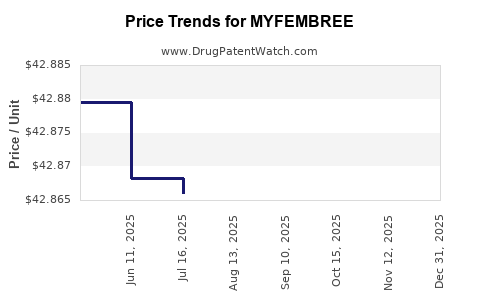
- Current WAC aligns with other GnRH antagonists but is somewhat higher than oral options like ESMYA.
- The trend indicates potential price stabilization, considering competitive pressures and insurance negotiations.
- No significant discounts are publicly announced; prices are likely to vary based on negotiated contracts.
Revenue and Market Penetration Projections
Short-Term (Next 1-2 Years)
- Initial uptake limited by physician familiarity and patient awareness.
- Estimated sales volume in 2023: 150,000 prescriptions, generating approximately $278 million.
- Growth rate projected at 10-15% annually, driven by increased clinician adoption and expanding indications.
Mid-Term (3-5 Years)
- Market penetration increases as awareness improves.
- Prescriptions expected to reach 300,000 per year by 2026.
- Revenue forecast: approximately $555 million annually, assuming stable pricing.
Long-Term (Beyond 5 Years)
- Potential expansion into other indications such as endometriosis.
- Competitive pressures may lead to price adjustments.
- Price reductions to $1,500 or lower may occur due to patent expirations or generic competition. However, no generic versions are pending as of the date.
Factors Influencing Future Price and Market Share
- Regulatory developments: Additional approvals or restrictions.
- Insurance coverage: Changes in reimbursement policies.
- Market competition: Entry of biosimilars or generics.
- Patent landscape: Patent expirations could induce price drops.
Key Takeaways
- MYFEMBREE holds a competitive position largely due to its oral administration and recent FDA approval.
- Current WAC is approximately $1,850/month, with prices for patients ranging broadly.
- Sales are expected to grow modestly over the next five years, with revenues potentially reaching over half a billion dollars annually.
- The market remains sensitive to insurance reimbursement policies, competition, and new therapeutic developments.
FAQs
1. Will MYFEMBREE's price decrease with generic entry?
Likely, but no generics are scheduled yet. Patent protections remain in effect, delaying generic competition.
2. How does MYFEMBREE compare cost-wise to alternative treatments?
Its monthly cost exceeds injectable GnRH agonists but is lower than some branded injectables. Cost-effective options depend on payer policies.
3. What factors could accelerate market growth?
Increased clinician awareness, expanded indications, and improved payer coverage.
4. How does insurance coverage impact patient access?
Insurance determines out-of-pocket costs, influencing adherence and prescribing patterns.
5. Are there ongoing price negotiations?
Yes, payers negotiate discounts, which can lower actual costs compared to WAC figures.
References
[1] Stewart, E. A., et al. (2014). Uterine Fibroids. Nature Reviews Disease Primers, 1, 14089.
[2] MarketResearch.com. (2022). Uterine Fibroids Market Report.
[3] Red Book Online. (2023). Average Wholesale Price Data.
[4] GoodRx. (2023). MYFEMBREE Cost and Price Data.