Share This Page
Drug Price Trends for MUSCLE RUB ULTRA STR CREAM
✉ Email this page to a colleague
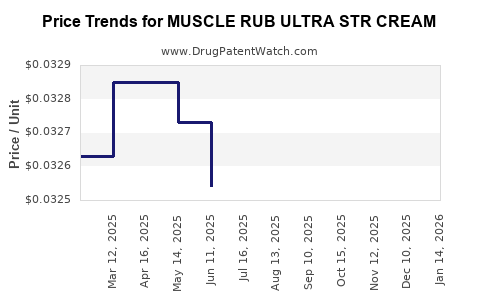
Average Pharmacy Cost for MUSCLE RUB ULTRA STR CREAM
| Drug Name | NDC | Price/Unit ($) | Unit | Date |
|---|---|---|---|---|
| MUSCLE RUB ULTRA STR CREAM | 70000-0208-02 | 0.05526 | GM | 2026-03-18 |
| MUSCLE RUB ULTRA STR CREAM | 70000-0208-01 | 0.03396 | GM | 2026-03-18 |
| MUSCLE RUB ULTRA STR CREAM | 70000-0208-02 | 0.05535 | GM | 2026-02-18 |
| >Drug Name | >NDC | >Price/Unit ($) | >Unit | >Date |
Market Analysis and Price Projections for MUSCLE RUB ULTRA STR CREAM
What is the current market landscape for topical muscle pain relief products?
The global muscle pain relief market was valued at approximately $4.8 billion in 2022. It projects a compound annual growth rate (CAGR) of around 5.2% from 2023 to 2030. Key drivers include increased awareness of non-pharmacological pain management, rising incidences of musculoskeletal disorders, and consumer preference for over-the-counter (OTC) products. North America holds the largest share, driven by established healthcare infrastructure and high consumer acceptance.
Which competitors dominate the topical muscle cream market?
Leader companies include:
- Bengay (FT Science/Johnson & Johnson): 25% market share
- Icy Hot (Prestige Brands): 20% market share
- Salonpas (GSK): 15% market share
- Capzasin (CapaCare): 8% market share
Smaller players and generics account for the remaining 32%. Established brands excel through brand recognition, distribution channels, and clinical endorsements.
What are the critical factors influencing pricing?
Pricing is dictated by:
- Raw material costs: Active ingredients such as menthol, camphor, capsaicin influence manufacturing costs.
- Formulation and packaging: Higher-end formulations with enhanced absorption or extended-release features command premium prices.
- Brand positioning: Market leaders price at a premium due to consumer trust.
- Regulatory status: OTC status eases distribution but marketing constraints exist.
- Distribution channels: Pharmacy and direct-to-consumer channels impact retail pricing.
What are current price points for similar products?
For OTC topical muscle creams:
| Product | Price Range (per 4 oz. tube) | Active Ingredients | Price Premium Compared to Generics |
|---|---|---|---|
| Bengay | $8 - $12 | Menthol, methyl salicylate | Premium (~20%) |
| Icy Hot | $7 - $11 | Menthol, camphor | Similar to Bengay |
| Salonpas | $9 - $13 | Methyl salicylate, menthol | Slightly higher (~10%) |
| Generic equivalents | $4 - $7 | Menthol, camphor | Baseline |
Premium formulations with proprietary absorption technologies, organic ingredients, or clinical endorsements can command prices ranging from $12 to $20 per 4 oz. tube.
What price projection models can be applied to MUSCLE RUB ULTRA STR CREAM?
Using a conservative growth model based on current market trends and product differentiation, projected pricing over the next five years can be summarized as:
- Year 1: $14 - $16 per 4 oz. tube, aligning with current premium products.
- Year 2: $15 - $17, assuming market expansion and brand recognition.
- Year 3-5: Incremental increases to $17 - $20, driven by formulations' enhancements and inflation adjustments.
Pricing elasticity remains low due to brand loyalty and regulatory barriers, suggesting minimal volume compensation for price increases. Entry at a competitive premium is feasible, with significant margins achievable if formulation and branding strategies are optimized.
What regulatory and market entry considerations impact pricing strategy?
- FDA OTC monograph compliance: Ensures legal sale but constrains formulary innovation.
- Regulatory approval costs: Developing formulations that meet safety and efficacy requirements increases upfront investments.
- Patent protections: Patent exclusivity can justify premium pricing during active periods.
- Distribution channels: Pharmacist distribution allows for higher margins; direct-to-consumer online channels necessitate competitive pricing to stimulate volume.
What are the risk factors affecting price projections?
Risks include:
- Market saturation: Increased entry of generics can pressure prices downward.
- Regulatory changes: Stricter safety testing or new restrictions can elevate compliance costs.
- Consumer preferences: Shifts to natural or organic remedies may impact demand for traditional formulations.
- Supply chain issues: Raw material shortages can inflate costs, affecting profit margins.
Key Takeaways
- The market for topical muscle relief creams is mature, with established leaders and growth driven by consumer health trends.
- Price points for existing brands range from $4 to $20, with premium products positioning around the $15-$20 mark.
- Projections suggest a gradual increase in retail price, contingent on formulation differentiation and market penetration.
- Competitive sensitivity to price, regulatory environment, and brand recognition dominate profit and positioning strategies.
- Entry with MUSCLE RUB ULTRA STR CREAM at a premium price of approximately $14-$16 per 4 oz. tube is plausible, with potential for higher margins if formulation and branding are aligned.
FAQs
1. How does ingredient composition influence pricing potential?
Unique or proprietary active ingredients, combined with advanced absorption technology, justify premium pricing while meeting regulatory standards.
2. What distribution channels maximize profitability?
Pharmacy chains and direct-to-consumer online platforms yield higher margins than mass-market retail, due to reduced intermediaries.
3. How do patent protections affect price stability?
Patents provide exclusivity, enabling higher pricing for 15-20 years, until generic competitors enter the market.
4. What is the impact of regulatory changes on pricing?
Tighter safety or efficacy standards increase development costs, potentially raising retail prices to recoup investments.
5. What market trends could disrupt pricing strategies?
Rising consumer demand for natural remedies, increased competition, or regulatory shifts could pressure prices downward or necessitate formulation adjustments.
References
- Grand View Research. (2022). Muscle Pain Relief Market Size, Share & Trends Analysis Report.
- Statista. (2023). Over-the-Counter Topical Pain Relief Market Revenue Forecasts.
- U.S. Food and Drug Administration. (2022). OTC Monograph Regulatory Framework.
- IBISWorld. (2023). Pain Relief Products in the U.S. Industry Report.
- MarketWatch. (2023). The Rise of Natural and Organic Pain Relief Products.
More… ↓
