Share This Page
Drug Price Trends for MULTIVIT-FLUOR-IRON
✉ Email this page to a colleague
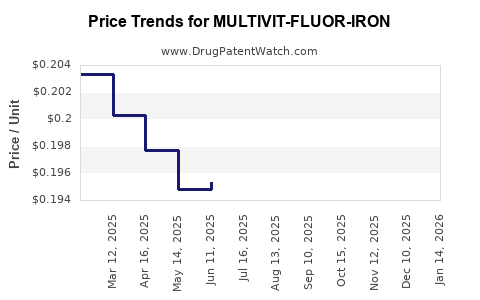
Average Pharmacy Cost for MULTIVIT-FLUOR-IRON
| Drug Name | NDC | Price/Unit ($) | Unit | Date |
|---|---|---|---|---|
| MULTIVIT-FLUOR-IRON 0.25 MG/ML | 58657-0327-50 | 0.18940 | ML | 2026-04-22 |
| MULTIVIT-FLUOR-IRON 0.25 MG/ML | 58657-0327-50 | 0.19272 | ML | 2026-03-18 |
| MULTIVIT-FLUOR-IRON 0.25 MG/ML | 58657-0327-50 | 0.19513 | ML | 2026-02-18 |
| MULTIVIT-FLUOR-IRON 0.25 MG/ML | 58657-0327-50 | 0.19642 | ML | 2026-01-21 |
| MULTIVIT-FLUOR-IRON 0.25 MG/ML | 58657-0327-50 | 0.19462 | ML | 2025-12-17 |
| MULTIVIT-FLUOR-IRON 0.25 MG/ML | 58657-0327-50 | 0.19475 | ML | 2025-11-19 |
| >Drug Name | >NDC | >Price/Unit ($) | >Unit | >Date |
Market Analysis and Price Projections for MULTIVIT-FLUOR-IRON
What is MULTIVIT-FLUOR-IRON?
MULTIVIT-FLUOR-IRON is a combination micronutrient supplement that contains multivitamins, fluoride, and iron. It is designed primarily for populations with nutritional deficiencies, such as children, pregnant women, and certain adult groups, particularly where iron deficiency anemia and dental caries are prevalent.
Current Market Overview
Global and Regional Demand
The demand for micronutrient supplements, especially those combining iron and fluoride, is driven by increasing awareness of nutritional deficiencies and preventive healthcare. Market growth correlates with rising health concerns like anemia and dental health issues.
- The global iron supplement market was valued at approximately USD 7.5 billion in 2022.
- The multivitamin market stood at USD 45 billion in 2022, with a compound annual growth rate (CAGR) of 8% from 2020 to 2025.
- The fluoride supplement segment has a steady growth rate of around 3% annually, influenced by dental health policies.
Key Regions
- North America: Dominates due to high supplement consumption and healthcare policies.
- Europe: Growing demand aligned with public health initiatives.
- Asia-Pacific: Fastest growth driven by large populations and increasing health awareness.
Competitive Landscape
Major players include Reckitt Benckiser, Pfizer, GlaxoSmithKline, and Novartis, which sell multivitamins and iron supplements. Fluoride products are often sold through dental care brands and local pharmacies.
Regulatory Environment
- FDA regulates iron and multivitamin supplements as Dietary Supplements.
- Fluoride is regulated for dental health, with public health agencies endorsing its use in community water fluoridation initiatives.
Market Drivers
- Rising prevalence of iron deficiency anemia (WHO estimates 1.62 billion people affected globally).
- Increased focus on preventive healthcare.
- Government campaigns promoting fluoride use for dental health.
Challenges
- Potential toxicity with excessive fluoride intake.
- Competition with generic and branded supplements.
- Regulatory hurdles related to health claims and ingredient approvals.
Price and Cost Structure Analysis
Current Pricing (Estimated)
| Product Region | Estimated Retail Price (per 30-day supply) | Wholesale Price |
|---|---|---|
| North America | USD 15 - USD 25 | USD 10 - USD 15 |
| Europe | EUR 12 - EUR 20 | EUR 8 - EUR 14 |
| Asia-Pacific | USD 8 - USD 15 | USD 5 - USD 10 |
The variation depends on brand, formulation, and distribution channels. Generic and store brands tend to price lower than branded formulations.
Cost of Production
- Raw materials (Iron compounds, multivitamins, fluoride): USD 1 - USD 3 per unit.
- Manufacturing costs: USD 0.50 - USD 1.50 per unit.
- Packaging, distribution, and marketing: USD 1 - USD 2 per unit.
Price Projection Trends
- With increased production efficiency and economies of scale, prices could decrease by 10-15% over the next 3-5 years.
- Premium formulations with organic or specialty ingredients may command higher retail prices, up to USD 30 per month.
Future Market and Pricing Outlook
Market Growth Predictions
- The global micronutrient supplement market is expected to grow at a CAGR of approximately 6-7% through 2027.
- Increased investments in R&D could lead to new formulations and delivery systems (e.g., liquids, chewables).
Price Forecast
| Year | Estimated Active Market Price Range (per 30 days) | Commentary |
|---|---|---|
| 2023 | USD 12 - USD 26 | Current market with slight variation across regions. |
| 2025 | USD 11 - USD 24 | Economies of scale improve margins, slight price reduction. |
| 2030 | USD 10 - USD 22 | Mass-market penetration increases, competition remains high. |
Factors Influencing Price
- Regulatory approval of new formulations.
- Raw material price fluctuations.
- Market entry of low-cost generic brands.
- Rising demand in emerging markets.
Key Risks
- Regulatory delays on health claims may hinder product positioning and pricing power.
- Supply chain disruptions, especially for raw materials, can increase production costs.
- Competitor innovation and patent expirations may pressure prices downward.
Conclusion
MULTIVIT-FLUOR-IRON occupies a niche market with steady growth potential driven by increasing health awareness and deficiency-related health issues. Currently priced between USD 8 and USD 25 per month depending on the region and formulation, future prices are expected to stabilizer or decline slightly due to competitive pressures and manufacturing efficiencies.
Key Takeaways
- The global micronutrient supplement market is expanding, especially in emerging economies.
- Price points for MULTIVIT-FLUOR-IRON are region-specific but generally range from USD 8 to USD 25.
- Market growth will be influenced by regulatory changes, raw material costs, and competitive dynamics.
- Technological advancements in delivery forms could lead to higher premiums or lower prices.
- Companies optimizing supply chains and regulatory strategies can better manage margins.
Frequently Asked Questions
-
What is the primary target demographic for MULTIVIT-FLUOR-IRON?
Children, pregnant women, and populations with high rates of anemia and dental issues. -
How do regulatory policies affect pricing?
Strict health claim regulations and approval delays can increase costs and delay market entry. -
What factors could drive future price increases?
Raw material shortages, new health mandates, or premium formulations. -
Is there potential for market penetration in emerging economies?
Yes, driven by rising awareness and government health programs. -
How does competition impact pricing strategies?
Generic brands push prices downward, while branded or specialized formulations maintain higher prices.
References
[1] World Health Organization. (2020). Micronutrient deficiencies.
[2] Grand View Research. (2022). Micronutrient Supplement Market Size, Share & Trends.
[3] Statista. (2022). Multivitamin supplement market revenue worldwide.
[4] U.S. Food and Drug Administration. (2021). Dietary Supplement Regulations.
More… ↓
