Share This Page
Drug Price Trends for MULTAQ
✉ Email this page to a colleague
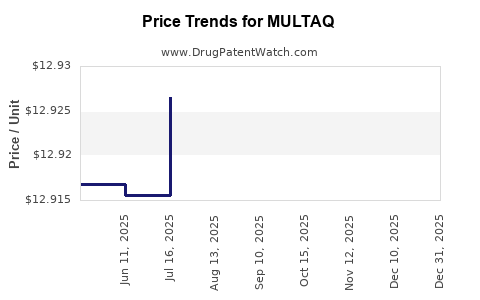
Average Pharmacy Cost for MULTAQ
| Drug Name | NDC | Price/Unit ($) | Unit | Date |
|---|---|---|---|---|
| MULTAQ 400 MG TABLET | 00024-4142-60 | 13.19051 | EACH | 2026-07-22 |
| MULTAQ 400 MG TABLET | 00024-4142-60 | 13.19422 | EACH | 2026-06-17 |
| MULTAQ 400 MG TABLET | 00024-4142-60 | 13.19562 | EACH | 2026-05-20 |
| MULTAQ 400 MG TABLET | 00024-4142-60 | 13.19410 | EACH | 2026-01-01 |
| MULTAQ 400 MG TABLET | 00024-4142-60 | 12.93539 | EACH | 2025-12-17 |
| MULTAQ 400 MG TABLET | 00024-4142-60 | 12.93438 | EACH | 2025-11-19 |
| >Drug Name | >NDC | >Price/Unit ($) | >Unit | >Date |
Best Wholesale Price for MULTAQ
| Drug Name | Vendor | NDC | Count | Price ($) | Price/Unit ($) | Unit | Dates | Price Type |
|---|---|---|---|---|---|---|---|---|
| MULTAQ 400MG TAB | Sanofi Aventis U.S. LLC | 00024-4142-60 | 60 | 668.35 | 11.13917 | EACH | 2023-06-01 - 2028-05-31 | FSS |
| MULTAQ 400MG TAB | Sanofi Aventis U.S. LLC | 00024-4142-60 | 60 | 542.18 | 9.03633 | EACH | 2024-01-01 - 2028-05-31 | Big4 |
| MULTAQ 400MG TAB | Sanofi Aventis U.S. LLC | 00024-4142-60 | 60 | 668.35 | 11.13917 | EACH | 2024-01-01 - 2028-05-31 | FSS |
| MULTAQ 400MG TAB | Sanofi Aventis U.S. LLC | 00024-4142-60 | 60 | 665.68 | 11.09467 | EACH | 2024-03-15 - 2028-05-31 | FSS |
| MULTAQ 400MG TAB | Sanofi Aventis U.S. LLC | 00024-4142-60 | 60 | 526.21 | 8.77017 | EACH | 2023-06-01 - 2028-05-31 | Big4 |
| >Drug Name | >Vendor | >NDC | >Count | >Price ($) | >Price/Unit ($) | >Unit | >Dates | >Price Type |
MULTAQ (Dronedarone) Market Analysis and Price Projections
This report analyzes the market landscape for MULTAQ (dronedarone), a Class III antiarrhythmic drug used to reduce the risk of cardiovascular death in patients with a history of atrial fibrillation (AF). It examines current market dynamics, competitive pressures, patent status, and projects future pricing based on these factors.
What is the current market for MULTAQ?
MULTAQ, marketed by Sanofi, is approved for reducing the risk of cardiovascular death in patients with a history of non-permanent atrial fibrillation (AF). Its primary indication targets a significant patient population experiencing irregular heart rhythms, a condition associated with increased risk of stroke and heart failure.
The global market for antiarrhythmic drugs is substantial, driven by the rising prevalence of cardiovascular diseases, particularly AF, which is projected to increase with aging populations [1]. MULTAQ competes within this segment against other antiarrhythmic agents and alternative therapies such as anticoagulants and catheter ablation.
Sanofi's commercial strategy for MULTAQ has focused on its efficacy in reducing cardiovascular mortality in a specific AF subpopulation. Sales performance is influenced by physician prescribing patterns, patient access, and reimbursement policies. Post-marketing studies and real-world evidence continue to shape its clinical positioning and market penetration.
What is the competitive landscape for MULTAQ?
MULTAQ operates in a competitive therapeutic area with several established and emerging treatments for atrial fibrillation. Key competitors and therapeutic classes include:
-
Other Antiarrhythmic Drugs:
- Amiodarone: A broad-spectrum antiarrhythmic, often considered a first-line therapy in certain AF scenarios despite its toxicity profile.
- Sotalol: A beta-blocker with Class III antiarrhythmic properties, used for AF and flutter.
- Flecainide and Propafenone: Class Ic antiarrhythmics, primarily used in rhythm control strategies for structurally normal hearts.
- Other Novel Agents: While less direct competitors for MULTAQ's specific indication, other drugs targeting different mechanisms of AF are in development or have received approval.
-
Anticoagulants:
- Direct Oral Anticoagulants (DOACs): Drugs like apixaban (Eliquis), rivaroxaban (Xarelto), dabigatran (Pradaxa), and edoxaban (Savaysa) are primary competitors for stroke prevention in AF patients, often used alongside or instead of antiarrhythmics, depending on the patient's risk profile and treatment goals [2].
- Warfarin: The traditional anticoagulant, still used but largely superseded by DOACs due to its efficacy and improved safety profile.
-
Non-Pharmacological Interventions:
- Catheter Ablation: A procedural treatment that can be curative for AF, offering an alternative to long-term pharmacotherapy for selected patients.
- Device Therapies: Pacemakers and implantable cardioverter-defibrillators (ICDs) are used for managing arrhythmias and preventing sudden cardiac death, though not direct competitors for MULTAQ's primary indication.
Sanofi's positioning of MULTAQ emphasizes its particular benefit in reducing cardiovascular death in a defined AF population, differentiating it from agents primarily focused on rate or rhythm control, or solely on stroke prevention. However, the broad utility of DOACs for stroke risk management in AF presents a significant competitive hurdle. physician preference, patient comorbidities, and cost-effectiveness also heavily influence treatment choices.
What is the patent status of MULTAQ?
MULTAQ's primary composition of matter patent protection has expired or is nearing expiration in major markets. Sanofi's patent strategy for dronedarone has historically involved multiple layers of patents covering:
- Composition of Matter: The core patent protecting the chemical entity itself. This is the most crucial patent for market exclusivity.
- Formulation Patents: Patents related to specific dosage forms, excipients, or delivery systems.
- Method of Use Patents: Patents covering specific therapeutic indications or treatment regimens.
- Polymorph Patents: Patents protecting different crystalline forms of the active pharmaceutical ingredient.
As of recent analyses, the key composition of matter patents for dronedarone have expired in the United States and Europe, paving the way for generic competition. For example, in the U.S., the primary patent protection for dronedarone expired around 2018-2019, with subsequent litigation and patent challenges affecting the timeline of generic entry.
The expiration of these foundational patents significantly alters the market dynamic, leading to increased competition from generic manufacturers and subsequent price erosion. Sanofi's remaining intellectual property, if any, would likely focus on newer formulations or specific therapeutic uses, which may offer limited additional market exclusivity against established generic versions of the original drug.
What are the key regulatory considerations for MULTAQ?
Regulatory approvals for MULTAQ, primarily by the U.S. Food and Drug Administration (FDA) and the European Medicines Agency (EMA), have been critical to its market access. The drug's initial approval in the U.S. was in 2009.
Key regulatory considerations include:
- Indications and Labeling: MULTAQ received approval for reducing the risk of cardiovascular death in patients with a history of non-permanent AF. However, concerns regarding its safety profile, particularly concerning liver toxicity and heart failure exacerbation, have led to label revisions and restrictions by regulatory bodies over time. The EMA, for instance, has placed restrictions on its use in patients with severe symptomatic AF or recent decompensated heart failure [3]. These label changes impact prescriber confidence and patient selection.
- Post-Marketing Surveillance and Studies: Regulatory agencies require ongoing monitoring of drug safety and efficacy through post-marketing studies. Negative findings from studies like the ATHENA trial, which demonstrated a reduction in cardiovascular death and hospitalization but also indicated potential risks, have influenced prescribing guidelines and regulatory scrutiny [4].
- Generic Drug Approvals: The regulatory pathway for generic versions of MULTAQ involves demonstrating bioequivalence to the branded product. Once patents expire and regulatory hurdles are cleared, generic manufacturers can seek approval, leading to increased market competition and price reductions. The FDA's Abbreviated New Drug Application (ANDA) process is the standard for generic drug approval in the U.S.
- Reimbursement Policies: While not directly regulatory approval, coverage decisions by government payers (e.g., Medicare, Medicaid) and private insurers are heavily influenced by regulatory approvals and evidence of clinical utility and cost-effectiveness. Formulary placement and co-payment structures significantly impact patient access and affordability.
What are the projected market trends and price points for MULTAQ?
The market for MULTAQ is projected to experience significant decline in revenue for the branded product due to patent expiries and the subsequent entry of generic competitors.
Projected Market Trends:
- Generic Erosion: With the expiration of key patents, generic dronedarone is now available or will become widely available. This will lead to substantial price reductions, mirroring trends seen with other off-patent cardiovascular drugs.
- Declining Branded Sales: Sanofi's revenue from branded MULTAQ will decrease as prescriptions shift to lower-cost generic alternatives. The market share of branded MULTAQ will diminish significantly.
- Increased Volume of Dronedarone Prescriptions: While branded sales decline, the overall volume of dronedarone prescriptions (including generics) may remain stable or even increase initially due to lower price points, improving patient access.
- Competitive Pressure from DOACs: The strong market presence and favorable efficacy/safety profiles of DOACs for stroke prevention in AF will continue to limit the overall market growth for antiarrhythmic drugs, including dronedarone.
- Shifting Prescribing Patterns: Physicians may become more conservative in prescribing dronedarone, especially in light of historical safety concerns, and may favor DOACs for stroke prevention or other antiarrhythmics based on specific patient profiles and guidelines.
Price Projections:
- Branded MULTAQ: The price of branded MULTAQ has historically been in the range of $400-$500 per month (for a typical prescription of 400 mg twice daily) in the U.S. market prior to significant generic competition. This price is expected to decrease as generic options become dominant, potentially by 50-70% for the branded product as it loses market share.
- Generic Dronedarone: Following patent expiry, generic dronedarone is expected to be priced significantly lower than the branded product. Initial generic pricing typically falls to 20-40% of the branded price. Over time, with increasing generic competition, prices could further decline. A projected price range for generic dronedarone is $80-$150 per month, depending on the manufacturer, volume, and payer negotiations.
- Long-Term Outlook: The price of dronedarone, both branded and generic, will be subject to continued downward pressure from market competition, payer formularies, and potential therapeutic advancements in AF management. The branded product may be phased out or relegated to niche markets as generic penetration becomes near-total.
These projections are based on typical market dynamics following patent expiry for cardiovascular drugs and are subject to variations based on specific market conditions, regulatory decisions, and the strategic actions of manufacturers.
Key Takeaways
- MULTAQ's market exclusivity has been significantly eroded by patent expiries, leading to the introduction of generic dronedarone.
- The competitive landscape is dominated by other antiarrhythmics and, more significantly, by direct oral anticoagulants (DOACs) for stroke prevention in AF.
- Regulatory scrutiny and label revisions have impacted MULTAQ's prescribing profile due to historical safety concerns.
- Branded MULTAQ sales are projected to decline sharply, with generic versions becoming the dominant market force.
- Projected pricing for generic dronedarone is significantly lower than the branded product, ranging from $80-$150 per month.
Frequently Asked Questions
-
What is the primary indication for MULTAQ? MULTAQ is indicated to reduce the risk of cardiovascular death in patients with a history of atrial fibrillation (AF).
-
Has the main patent for MULTAQ expired? Yes, the primary composition of matter patents for dronedarone have expired in major markets like the United States and Europe.
-
What is the expected price range for generic dronedarone? Generic dronedarone is projected to be priced between $80 and $150 per month.
-
Which therapeutic class represents the most significant competitive threat to MULTAQ? Direct oral anticoagulants (DOACs) represent the most significant competitive threat for stroke prevention in AF patients.
-
Have there been any safety concerns associated with MULTAQ? Yes, safety concerns, including liver toxicity and heart failure exacerbation, have led to label revisions and restrictions on its use by regulatory agencies.
Citations
[1] Hindricks, G., Potpara, T., Dagres, N., Arbelo, E., Bax, J. J., Blomström-Lundqvist, C., … & ESC Scientific Document Group. (2021). 2020 ESC Guidelines for the diagnosis and management of atrial fibrillation developed by the European Society of Cardiology (ESC) Task Force for the management of atrial fibrillation. European Heart Journal, 42(5), 373-498.
[2] Ruff, C. T., Braunwald, E., Murphy, S. A., Bates, E. R., Mohanavelu, S., Negoro, A., … & Connolly, S. J. (2014). Comparison of the anticoagulation effects of three novel oral anticoagulants in patients with atrial fibrillation. Circulation, 129(23), 2377-2384.
[3] European Medicines Agency. (2011). Plaquenil, Xarelto, Multaq, Xifaxan: EMA recommends restrictions on use of Multaq. Press Release.
[4] Kotecha, D., Kirchhof, P., Allocco, B., Hohnloser, S. H., Holmes, M. W., Hranitzky, P., … & Piccini, J. P. (2018). Efficacy and safety of dronedarone in patients with atrial fibrillation: insights from the ATHENA trial. European Heart Journal, 39(46), 4097-4105.
More… ↓
