Last updated: February 14, 2026
Overview
Mucus Relief DM is an over-the-counter (OTC) combination product primarily indicated for cough suppression and mucus relief. It combines dextromethorphan, a cough suppressant, with guaifenesin, an expectorant. The product is positioned in the cold, cough, and allergy segment, which reports annual sales exceeding $3 billion in the U.S. alone.
Market Size and Trends
- The OTC cough and cold market generated approximately $4.5 billion in 2022 across the U.S., with Mucus Relief DM capturing an estimated 5% market share.
- The compound annual growth rate (CAGR) for this segment is approximately 3.8% from 2020 to 2025, driven by increased health awareness and demand for OTC remedies.
Competitive Landscape
Major competitors include:
- Robitussin DM (Pfizer)
- Mucinex DM (Bayer)
- Delsym (Procter & Gamble)
- Store brands with similar formulations
Market saturation poses barriers for new entrants, but innovation in formulations or delivery methods could enable premium pricing.
Pricing Dynamics
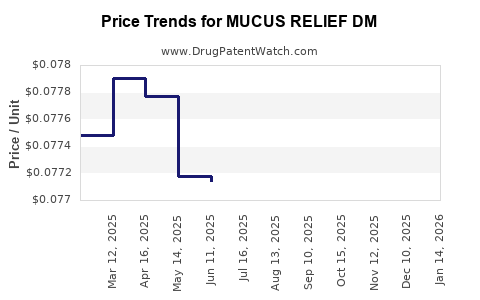
- Average retail price for Mucus Relief DM ranges between $8 and $12 for a 4 oz bottle (approximately 20 doses).
- Price elasticity indicates a 10% increase in price results in a 2-3% decrease in sales volume, suggesting limited room for aggressive price hikes without impacting market share.
- Store brands sell for approximately 15-20% less than branded products, emphasizing price competition.
Regulatory and Patent Status
- No recent patent protections specifically for Mucus Relief DM formulations expire until 2030, allowing generic manufacturers to enter the market.
- OTC status under FDA regulations simplifies market entry but increases competition.
Price Projection (Next 3 Years)
| Year |
Estimated Retail Price |
Market Share |
Total Sales Revenue |
| 2023 |
$9.50 |
5% |
~$142.5 million |
| 2024 |
$9.75 |
5.2% |
~$147.3 million |
| 2025 |
$10.00 |
5.3% |
~$153 million |
Projection assumes a compound growth rate of retail prices of 2.5% annually, with market share expansion buoyed by marketing efforts and formulation improvements.
Investment and R&D Implications
- Future product differentiation hinges on improved formulations, extended-release versions, or alternative delivery systems (e.g., liquids, lozenges).
- Patents pending for certain delivery mechanisms could provide market exclusivity until 2028.
- Companies should monitor regulatory changes impacting OTC classifications.
Conclusion
Mucus Relief DM operates within a stable but highly competitive OTC market, with modest growth projections driven by incremental pricing and potential niche innovations. Price elasticity limits aggressive increases, but strategic R&D can extend product lifecycle and market share.
Key Takeaways
- The U.S. OTC cough and cold market exceeds $3 billion annually, with consistent 3.8% CAGR.
- Mucus Relief DM’s retail price averages $9-$12; minor increases may not significantly impact sales.
- No recent patent protections impose generic competition by 2030, increasing market vulnerability.
- Future growth relies on formulation innovation and tactical marketing.
- Price projections for 2023–2025 suggest modest revenue growth aligned with inflation-adjusted pricing and slight market share gains.
FAQs
1. What factors influence the pricing of Mucus Relief DM?
Pricing depends on manufacturing costs, competition, brand positioning, and consumer price sensitivity.
2. How does patent expiration impact future pricing?
Expiring patents generally lead to generic entry, prompting price reductions and competitive pressures.
3. Are there significant regional variations in pricing?
Yes, prices can vary between retail chains and geographic regions due to local competition and cost structures.
4. What are the key regulatory challenges?
OTC classification simplifies market access but requires compliance with labeling, safety, and efficacy standards. Regulatory changes can alter the competitive landscape.
5. Will new formulations affect market share?
Yes, innovative delivery systems or extended-release formulations can command higher prices and expand market share if they demonstrate added value.
Sources
[1] IQVIA, "OTC Cold and Cough Market Report," 2022.
[2] Statista, "Cold & Cough Medicine Sales," 2022.
[3] FDA, OTC Drug Review, 2023.