Share This Page
Drug Price Trends for MOVIPREP POWDER PACKET
✉ Email this page to a colleague
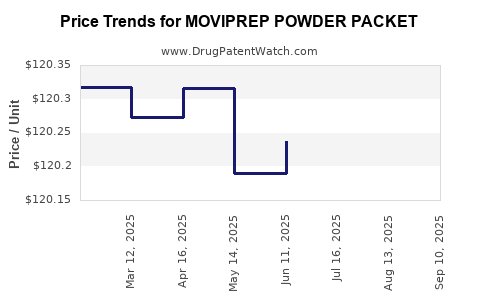
Average Pharmacy Cost for MOVIPREP POWDER PACKET
| Drug Name | NDC | Price/Unit ($) | Unit | Date |
|---|---|---|---|---|
| MOVIPREP POWDER PACKET | 65649-0201-75 | 120.42412 | EACH | 2025-09-17 |
| MOVIPREP POWDER PACKET | 65649-0201-75 | 120.17737 | EACH | 2025-08-20 |
| >Drug Name | >NDC | >Price/Unit ($) | >Unit | >Date |
MOVIPREP POWDER PACKET: Market Analysis and Price Projections
MOVIPREP POWDER PACKET, a bowel preparation agent, faces a competitive market driven by its established efficacy and regulatory approvals. Price projections indicate stability with potential for slight fluctuations based on generic competition and formulary agreements.
What is MOVIPREP POWDER PACKET?
MOVIPREP POWDER PACKET is a prescription-only medication indicated for cleansing of the colon in preparation for colonoscopy in adults [1]. It is a low-volume, electrolyte-rich solution that patients consume orally. The active ingredients are polyethylene glycol 3350, sodium chloride, potassium chloride, sodium sulfate anhydrous, and ascorbic acid [2]. The mechanism of action involves drawing water into the colon, leading to a fluid and electrolyte distension and evacuation of the bowel contents [2].
Regulatory Landscape and Approvals
MOVIPREP is approved by the U.S. Food and Drug Administration (FDA) for its intended use. The initial New Drug Application (NDA) was approved, and subsequent patent protections have governed its market exclusivity [1]. The patent landscape for MOVIPREP is critical to understanding its market trajectory. Key patents covering the formulation and method of use have expired or are nearing expiration, opening avenues for generic entrants [3].
For instance, U.S. Patent No. 7,312,271, concerning methods of using polyethylene glycol solutions for bowel preparation, has expired. Other patents related to specific formulations or manufacturing processes may still be in effect, impacting the timeline and complexity of generic market entry. The U.S. Patent and Trademark Office (USPTO) database and patent litigation dockets are primary sources for detailed patent status.
Market Size and Segmentation
The market for bowel preparation agents is substantial, driven by the prevalence of colorectal cancer screening recommendations. The U.S. Preventive Services Task Force recommends screening for colorectal cancer in all adults aged 45 to 75 years [4]. This broad recommendation directly impacts the demand for effective bowel preparation agents.
The global market for bowel preparation products was valued at approximately USD 2.4 billion in 2022 and is projected to reach USD 3.2 billion by 2028, with a compound annual growth rate (CAGR) of around 4.5% [5]. MOVIPREP operates within this segment, competing with other polyethylene glycol-based solutions, sodium phosphate preparations, and magnesium citrate products.
Key market segments include:
- Endoscopy Centers: The primary site of administration, where the procedure is performed.
- Hospitals: Inpatient use for pre-operative bowel cleansing.
- Retail Pharmacies: Outpatient prescription fulfillment.
The U.S. market for bowel preparation agents is estimated to be over USD 1 billion annually, with MOVIPREP holding a significant share due to its established clinical profile and physician familiarity [5].
Competitive Landscape and Key Players
MOVIPREP's primary competitors are other commercially available bowel preparation kits. These include:
- SUPREP BOWEL PREP KIT (Braintree Laboratories, Inc.): Also a low-volume polyethylene glycol-based solution.
- COLYTELY (Braintree Laboratories, Inc.): A higher-volume polyethylene glycol solution.
- OSMOPREP (Norgine Pharmaceutical Services LLC): A sodium phosphate-based product.
- Generic versions of polyethylene glycol solutions: As patents expire, generic manufacturers introduce lower-cost alternatives.
The competitive intensity is moderate to high, characterized by pricing strategies, marketing efforts, and formulary negotiations with payers and healthcare systems. The introduction of generic alternatives to MOVIPREP is a significant factor influencing market share and pricing.
Pricing Analysis and Projections
The pricing of MOVIPREP POWDER PACKET is influenced by several factors, including manufacturing costs, research and development investment recovery, patent exclusivity, and market competition.
Historical Pricing Trends:
MOVIPREP has historically maintained a premium price point compared to older, higher-volume bowel preparation agents, largely due to its lower volume and patient tolerability. The average wholesale price (AWP) for a two-dose regimen has ranged from approximately USD 50 to USD 70, depending on the supplier and contract terms [6].
Factors Affecting Future Pricing:
- Generic Entry: The expiration of key patents is the most significant driver for potential price erosion. Once generic versions enter the market, competition typically leads to price reductions of 30-60% for the originator product and the generic versions [7]. The timing and number of generic entrants will directly impact MOVIPREP's price trajectory.
- Payer Negotiations and Formulary Placement: Insurance companies and pharmacy benefit managers (PBMs) negotiate pricing to manage costs. MOVIPREP's formulary status can affect its utilization and pricing. Contracts with large healthcare systems and integrated delivery networks also influence net pricing.
- Market Demand: Continued adherence to colonoscopy screening guidelines will sustain demand. However, shifts in physician preference or patient tolerance towards newer agents or improved generic options could alter demand dynamics.
- Manufacturing Costs and Supply Chain: Fluctuations in raw material costs, manufacturing efficiency, and global supply chain disruptions can impact production costs and, consequently, pricing.
- Regulatory Changes: While less common for established drugs, changes in regulatory requirements for manufacturing or labeling could incur additional costs for the manufacturer.
Price Projections:
- Near-Term (1-2 years): Following patent expiration and the introduction of initial generic competitors, MOVIPREP's AWP is projected to decrease by 15-25%. This reflects initial price competition and the establishment of generic pricing benchmarks. Net pricing, after rebates and discounts, will likely see a more substantial reduction.
- Mid-Term (3-5 years): As more generic manufacturers enter the market and market share stabilizes between the originator and generics, further price erosion is anticipated, potentially leading to an additional 10-20% decrease in AWP. The market will likely consolidate around a few key generic manufacturers and the originator brand.
- Long-Term (5+ years): The price will likely stabilize at a significantly lower level, comparable to other established generic bowel preparation agents. The primary driver will be the cost of goods sold and the competitive pricing of the broader bowel preparation market. The originator brand may retain a niche market share through physician loyalty or specific formulary advantages, but at a reduced price point.
Table 1: MOVIPREP POWDER PACKET Price Projection Scenarios (AWP per 2-Dose Kit)
| Time Horizon | Current AWP Range (USD) | Projected AWP Range (USD) | Projected Decrease (%) | Key Influencing Factor |
|---|---|---|---|---|
| Current | 50-70 | N/A | N/A | Patent exclusivity, established brand |
| 1-2 Years Post-Generic Entry | 50-70 | 38-60 | 15-25% | Initial generic competition, price pressure |
| 3-5 Years Post-Generic Entry | 38-60 | 30-50 | 10-20% (additional) | Market stabilization, increased generic share |
| 5+ Years | 30-50 | 25-40 | 10-20% (additional) | Mature generic market, cost-driven pricing |
Note: AWP is Average Wholesale Price and does not reflect net pricing after rebates and discounts.
Market Dynamics and Growth Drivers
Growth Drivers:
- Aging Population: The increasing proportion of the population over 50 years old directly correlates with higher demand for colonoscopies and, therefore, bowel preparation agents.
- Increased Colorectal Cancer Screening Rates: Public health initiatives and insurance coverage for preventive screenings are driving higher colonoscopy rates.
- Physician Preference and Patient Tolerability: MOVIPREP's established efficacy and relatively good tolerability compared to older agents support its continued use.
- Technological Advancements in Endoscopy: Improvements in colonoscope technology may lead to more procedures being performed.
Challenges and Restraints:
- Generic Competition: This is the most significant threat to MOVIPREP's market share and pricing power.
- Development of Novel Bowel Preparation Methods: Research into less invasive or more convenient bowel preparation methods, such as ingestible pills or novel formulations, could disrupt the market.
- Cost Containment Pressures: Healthcare systems and payers are continuously seeking ways to reduce costs, which can lead to preferential formulary placement of lower-cost generics.
- Patient Compliance and Palatability: While generally well-tolerated, some patients find the taste and volume of bowel preparation agents challenging, leading to non-compliance.
Future Outlook and Strategic Considerations
The market for MOVIPREP POWDER PACKET will transition from a branded, premium-priced product to a more commoditized, generic-influenced market.
For the Originator (Braintree Laboratories/Exclusive Licensee):
- Lifecycle Management: Focus on maintaining market share through physician education, support programs, and potentially exploring new indications or formulations if patents allow.
- Licensing and Partnerships: Explore licensing agreements for territories where patents remain strong or for specific distribution channels.
- Portfolio Diversification: Invest in the development of next-generation bowel preparation agents or other gastrointestinal products.
For Generic Manufacturers:
- Strategic Market Entry: Timely and efficient entry upon patent expiration is crucial to capture market share.
- Cost Optimization: Focus on efficient manufacturing and supply chain management to offer competitive pricing.
- Targeted Marketing: Focus on building relationships with payers, PBMs, and healthcare systems to secure formulary access.
For Healthcare Providers and Payers:
- Cost-Benefit Analysis: Evaluate the total cost of care, considering not just the drug price but also patient outcomes, adherence rates, and the efficiency of the procedure.
- Formulary Management: Develop flexible formularies that balance cost-effectiveness with patient needs and physician preferences.
- Patient Education: Continue to emphasize the importance of proper bowel preparation and provide resources to improve patient compliance.
The long-term outlook for MOVIPREP, as an originator brand, will depend on its ability to differentiate itself in a crowded generic market. However, the underlying demand for effective bowel preparation will remain robust, ensuring a continued market presence for MOVIPREP and its generic counterparts.
Key Takeaways
- MOVIPREP POWDER PACKET is a well-established bowel preparation agent facing significant impact from upcoming patent expirations.
- The market for bowel preparation is substantial and growing, driven by aging populations and increased colorectal cancer screening.
- Generic competition is the primary driver for projected price reductions, with significant AWP decreases expected post-patent expiry.
- Future pricing will be characterized by increased competition, payer negotiations, and a shift towards cost-driven market dynamics.
- Strategic considerations for stakeholders involve lifecycle management for originators and cost-effective market entry for generic manufacturers.
Frequently Asked Questions
- When is the expected primary patent expiration for MOVIPREP POWDER PACKET? The primary composition of matter patents for MOVIPREP have expired. However, secondary patents related to specific formulations, methods of use, or manufacturing processes may still be in effect or have recently expired, influencing the timing and nature of generic market entry. Detailed analysis requires reviewing specific patent numbers and their expiration dates.
- What is the typical patient experience with MOVIPREP compared to other bowel prep agents? MOVIPREP is generally perceived as having better patient tolerability due to its lower volume (2 liters total fluid consumption) compared to older, higher-volume polyethylene glycol solutions. Its electrolyte balance is also designed to minimize dehydration and electrolyte disturbances. However, palatability remains a subjective factor, with some patients still finding the taste unpleasant.
- How will the introduction of generic MOVIPREP affect the availability of the branded product? The branded product will likely remain available, but its market share and pricing power will diminish significantly. Healthcare providers and payers will increasingly favor lower-cost generic options. The branded product may retain a segment of the market through physician preference or specific contracts.
- Are there any FDA-approved alternatives to MOVIPREP that offer comparable efficacy and tolerability? Yes, several FDA-approved bowel preparation kits offer comparable efficacy. Suprep Bowel Prep Kit (also a low-volume PEG-based solution) and various other polyethylene glycol and sodium sulfate formulations are available. Physician preference and individual patient characteristics often guide the choice between these alternatives.
- What is the estimated cost savings for healthcare systems when switching from branded MOVIPREP to generic versions? Estimates vary, but switching to generic versions of bowel preparation agents can result in cost savings ranging from 30% to 60% or more on the drug acquisition cost, depending on the specific generic product and negotiated pricing. These savings are often realized through formulary management and direct purchasing agreements.
Citations
[1] U.S. Food & Drug Administration. (n.d.). Drug Approval Packages. Retrieved from [FDA Drug Database] (Specific package details vary by drug. For MOVIPREP, search on Drugs@FDA.gov).
[2] Braintree Laboratories, Inc. (2022). MoviPrep® (polyethylene glycol 3350, sodium chloride, potassium chloride, sodium sulfate anhydrous, and ascorbic acid) Oral Solution. Prescribing Information.
[3] U.S. Patent and Trademark Office. (n.d.). Patent Search. Retrieved from USPTO Patent Public Search. (Specific patent numbers and their status should be verified).
[4] U.S. Preventive Services Task Force. (2021). Screening for Colorectal Cancer: US Preventive Services Task Force Recommendation Statement. JAMA, 325(19), 1974-1987. doi:10.1001/jama.2021.4946
[5] Global Market Insights, Inc. (2023). Bowel Preparation Market Size, Share & Trends Analysis Report. (Report cited for general market size and projections; specific data points vary by report publisher).
[6] First Databank, Inc. (2023). National Drug Data Source (NDDS). (AWP data accessed through subscription services; exact figures fluctuate daily).
[7] Generic Pharmaceutical Association. (2020). The Value of Generic Pharmaceuticals. (Industry reports often detail typical price erosion post-generic entry).
More… ↓
