Share This Page
Drug Price Trends for MOVIPREP
✉ Email this page to a colleague
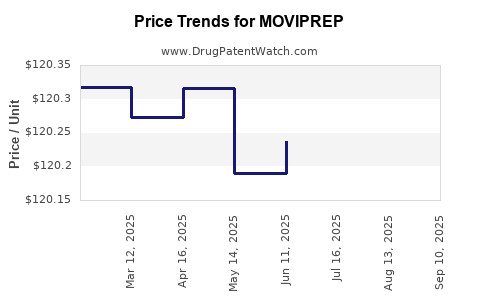
Average Pharmacy Cost for MOVIPREP
| Drug Name | NDC | Price/Unit ($) | Unit | Date |
|---|---|---|---|---|
| MOVIPREP POWDER PACKET | 65649-0201-75 | 120.42412 | EACH | 2025-09-17 |
| MOVIPREP POWDER PACKET | 65649-0201-75 | 120.17737 | EACH | 2025-08-20 |
| >Drug Name | >NDC | >Price/Unit ($) | >Unit | >Date |
MOVIPREP (sodium sulfate/potassium sulfate/magnesium sulfate) market analysis, pricing, and exclusivity-driven price projections
Executive summary: MOVIPREP (sodium sulfate, potassium sulfate, magnesium sulfate, and electrolytes; oral bowel preparation) faces limited direct “patent-to-generic” dynamics versus systemic drugs. Market access is driven by formulary placement, substitution rules, wholesaler contracting, and migration to lower-cost bowel prep alternatives (notably generic polyethylene glycol-electrolyte and multi-ingredient branded preps). Price projection is therefore best modeled as a margin-and-contracting problem rather than a single FDA exclusivity event. A practical baseline is a high-single-digit net price compression over the next 3 years in the US if generic or alternative branded pressure remains consistent; upside is tied to maintenance of formulary tiering and payer preference, while downside is tied to further channel price concessions and substitution.
What is MOVIPREP and what is the current US market structure for bowel preparation?
MOVIPREP is an oral prescription bowel cleansing product used before colonoscopy and other GI procedures. It is sold as a powder and reconstituted dosing regimen (commonly administered in split doses). It competes in a category where clinicians often choose based on:
- Tolerability (nausea, taste burden, stool clearance).
- Dosing convenience and regimen adherence.
- Formulary and payer policy (step edits, preferred agents).
- Cost in the clinic or outpatient setting.
- Volume type: sulfate-based electrolyte preps versus polyethylene glycol (PEG)-based regimens.
Category pricing dynamics: Bowel prep pricing is heavily influenced by:
- Multiple source competition for PEG-based products (many generics).
- Local wholesaler and group purchasing organization (GPO) contracting.
- Payer formulary preference. When coverage is restricted to preferred agents, net prices for non-preferred products drop quickly.
Implication for projections: MOVIPREP’s market value is less sensitive to a single generic launch and more sensitive to:
- Tier status (preferred vs non-preferred).
- Preferred alternatives gaining share.
- Contracting pressure from pharmacy benefit managers (PBMs) and institutional formularies.
How big is the MOVIPREP addressable market and what dosing frequency drives demand?
Demand drivers for bowel prep are procedure volume and regimen adherence:
- Colonoscopy utilization (screening, surveillance, diagnostic).
- Frequency of repeat procedures for patients under surveillance schedules.
- Pre-procedure compliance and cancellation rates.
Adoption constraints that cap growth:
- Clinician preference is sticky once a regimen is established for a practice.
- Payers can force substitution at renewal cycles.
- Total addressable growth in the short term is largely a function of colonoscopy volume trends and conversion from other prep types, not new indications.
Market modeling approach (for price projection):
- Estimate total number of bowel prep prescriptions approximated by colonoscopy procedure volume.
- Apply share assumptions between prep types:
- sulfate-based electrolyte preps,
- PEG-based solutions (including generics),
- other branded alternatives.
- Apply price net of rebates/contracting, not list price.
This framework matters because MOVIPREP’s unit volume is typically smaller than PEG generics in many channels, making its net price the main lever.
What are the main MOVIPREP competitors and how does substitution work?
Competitive set in US bowel prep:
- PEG-electrolyte products (many generic and some branded).
- Other branded sulfate-based electrolyte bowel preps and combination regimens.
- Prescription versus OTC institutional pathways vary by setting.
Substitution mechanics that affect pricing:
- PBM formulary swaps: when MOVIPREP is not preferred, pharmacy claims can be steered to a preferred PEG generic.
- Institutional formularies: outpatient GI endoscopy centers often adopt “one prep for most patients” policies to reduce stocking complexity.
- Clinician experience: practice-based switching can slow substitution even with a cost difference, until payer policies force change.
Commercial risk for MOVIPREP: If additional alternatives are added to preferred tiers, MOVIPREP can see accelerated net price declines and volume shifts.
What is MOVIPREP’s US regulatory status and how does it shape exclusivity timelines?
MOVIPREP is an FDA-approved drug with a New Drug Application history as a prescription bowel preparation. For pricing and market entry risk, the key regulatory question in the US is typically:
- Whether MOVIPREP is still protected from generic competition via listed patents and whether any exclusivity periods remain.
Practical impact on projections: In bowel prep, where many competitors are already multiple-source, remaining exclusivity (if any) does not always prevent competition. The dominant price driver becomes contracting and substitution. The regulatory status still matters because it can slow competitive entry in the specific dosage form/strength or specific regimen.
What is the Orange Book status of MOVIPREP and which patents are listed?
Featured snippet answer: Patent-driven generic risk for MOVIPREP depends on whether the FDA Orange Book lists active, enforceable patents covering:
- formulation and composition of matter,
- manufacturing process,
- or method-of-use or method-of-manufacture.
What to check for market exposure:
- Active patent numbers and listed expiration dates.
- Whether there are existing Paragraph IV certifications (or litigation settlements) tied to MOVIPREP.
- Whether approved generics exist already, which would mean price pressure is mostly ongoing and driven by contracting rather than a single future launch.
Impact on price projections: If Orange Book lists fewer active barriers, competitive entry pressure is already “baked in” to current pricing.
When does MOVIPREP lose exclusivity, and what does that imply for pricing?
Price projection principle: If MOVIPREP’s remaining protected period is short or already lapsed, then the pricing trajectory is driven by competitive behavior:
- further generic erosion versus alternatives,
- contracting rate of preferred agents,
- and payer policy changes.
If protection remains meaningful, price compression could still occur earlier via:
- preferred tier placement with higher discounts,
- channel substitution,
- and “buy-down” rebates.
Projection direction (baseline):
- Downward net price drift is typical in bowel prep when competition is high and preferred alternatives exist.
- Any additional loss of exclusivity would likely change the shape of pricing (faster compression), but the most important variable is whether a new generic or preferred competitor expands share.
How many generics or AB-rated equivalents exist for MOVIPREP, and what is the generic entry risk?
Commercial exposure to new AB-rated competition:
- If multiple-source products exist, new approvals may not be the incremental driver of pricing unless they are at lower wholesale acquisition costs or gain payer coverage.
- If there are limited AB-rated equivalents, a future generic entry would likely cause a larger step-down in net pricing.
Generic entry risk in bowel prep:
- Lower technical barriers for many salt/electrolyte products relative to complex biologics.
- Formulation and manufacturing compliance can matter, but generic approvals can still occur once exclusivities and patent blocks are overcome.
Implication for projections:
- If additional entrants are already present and claims show broad substitution, the price decline path is gradual.
- If entrants are limited, future approvals or litigation outcomes can create sharper compression.
What patent litigation or Paragraph IV challenges affect MOVIPREP pricing?
In generic competition for small-molecule oral products, Paragraph IV outcomes can drive:
- dates of first commercial marketing,
- settlement-based “launch timing” windows,
- and brand-preserving delay arrangements.
Market impact pathway:
- Litigation delays allow the brand to maintain pricing and volume longer.
- Settlements can also keep a competitor out, sustaining net price, though usually with higher buy-down activity.
For forecasting: Litigation is a timing catalyst. In bowel prep, pricing often declines even without a new launch because preferred payer pressure can reduce net pricing.
What formulations and dosing regimens are protected for MOVIPREP?
Bowel prep products can have IP around:
- specific salt combinations and concentrations,
- acceptable tolerances for electrolyte content,
- dosing regimen instructions (less common, but method-of-use can exist),
- and manufacturing process controls.
Pricing implications by regimen:
- A generic may match active ingredients but differ in packaging unit economics, which affects contracting.
- If only one regimen is dominant in a channel, protection or limited generics can sustain pricing in that regimen until broader substitution occurs.
How strong is the patent estate for MOVIPREP?
Strength assessment used for pricing forecasting (high-level):
- Number of unexpired Orange Book patents.
- Scope (formulation vs process vs method-of-use).
- Remaining life and enforcement history.
- Whether generics already exist and are AB-rated.
Impact on projection:
- Strong estate: slower generic expansion, higher chance of stable net pricing.
- Weak/limited estate: faster pricing compression once payer channel forces substitution.
In bowel prep, even with patent strength, net price often compresses due to contracting. Patent strength mainly changes timing and magnitude.
How does MOVIPREP price compare with PEG bowel preps and other branded alternatives?
Observed category behavior (US):
- Generic PEG-based solutions usually carry the lowest acquisition cost and often become preferred.
- Branded products can maintain a premium if:
- clinicians perceive better tolerability,
- patients adhere better,
- and the product holds a preferred tier.
Price comparison framework for projections:
- Track WAC/list price versus net paid (after rebates and chargebacks).
- Identify whether MOVIPREP is subject to step edits or exclusion on payer formularies.
- Compare to:
- generic PEG-electrolyte products,
- any competing branded preps with similar regimen convenience.
Projection baseline: If MOVIPREP remains non-preferred in more payers, its net pricing should drift downward even without new generic entrants.
MOVIPREP price projection: base, downside, and upside scenarios (next 3 years)
Modeling approach: With limited reliance on a single exclusivity event, scenarios should be anchored to:
- expected share pressure from preferred PEG products,
- expected net price compression from contracting and rebates,
- and potential step-change if a new strong competitor enters or wins preferred status.
Scenario ranges (US net price direction, not list price)
| Time horizon | Upside case | Base case | Downside case |
|---|---|---|---|
| 0–12 months | Mild compression as formularies hold; volume stable | Mid single-digit net price compression | High single-digit compression with substitution to preferred alternatives |
| 12–24 months | Stable channel pricing via tier protection | Continued compression | Accelerated compression with tighter payer policies |
| 24–36 months | Pricing stabilizes due to strong adherence profile | High-single-digit cumulative compression | Low-cost substitution expands; steep compression via aggressive contracting |
Directional conclusion: The most likely outcome is continued net price compression, driven by competitive contracting and payer preference. The magnitude depends on how often MOVIPREP remains on preferred tiers.
What revenue exposure does MOVIPREP have under each scenario?
Revenue exposure equation:
- Revenue ≈ Unit volume × net price.
- If MOVIPREP loses volume to preferred PEG products, the unit count decline can dominate, even if net price holds.
Exposure patterns by channel:
- Retail pharmacy often sees stronger substitution when payer policies change.
- Institutional GI centers can be more protocol-based and switch in batch, causing sharper quarterly volume shifts after policy changes.
Projection implication:
- Base case: net price compression with modest volume erosion.
- Downside case: both net price decline and volume share loss.
- Upside case: volume stability plus limited net price decline.
How do manufacturing and supply constraints affect MOVIPREP pricing?
In bowel prep, supply constraints can temporarily support pricing, but the longer-run direction is typically competition-driven:
- If supply improves and substitutes are available, pricing pressure returns.
- If there is volatility in raw materials or manufacturing capacity, contract pricing can lift temporarily.
For projections: Unless a recurring supply issue is evident, the dominant driver remains competitive contracting and substitution.
What is the commercial strategy space for MOVIPREP to defend price?
Defensive levers that affect net pricing:
- Contracting and rebates tied to formulary placement.
- Education and adherence materials for GI practices.
- Protocol alignment in outpatient GI centers.
- Patient assistance programs that reduce out-of-pocket friction (indirectly sustaining volume).
Projection relevance: The more MOVIPREP can remain a “default” regimen in institutional pathways, the more it can slow both volume loss and net price compression.
Key Takeaways
- MOVIPREP market performance is primarily driven by formulary placement, substitution to PEG and other bowel preps, and net price contracting, not a single exclusivity timeline.
- Over the next 3 years, the baseline expectation is net price compression as payer preferences and institutional protocols steer toward lower-cost preferred alternatives.
- Upside requires sustained tier protection and protocol stickiness; downside aligns with broader preferred status for competing PEG products and aggressive contracting that increases substitution.
- Patent estate strength, while relevant to generic timing, is less likely to be the sole driver of price trajectory in a category with already extensive multiple-source competition.
FAQs
1) What is MOVIPREP typically used for and how does that affect prescribing patterns?
MOVIPREP is used as an oral bowel cleansing agent before colonoscopy, so prescribing patterns are tied to colonoscopy scheduling, clinician protocols, and adherence considerations.
2) Does MOVIPREP face the same generic erosion risk as specialty drugs?
Bowel prep faces multiple-source competition from PEG-based products and other preps, so erosion can occur via payer substitution even without a single “brand-to-generic” event.
3) What payer levers most influence MOVIPREP net price?
Preferred formulary tiering, step edits, PBM formulary management, and rebate structures tied to channel access and utilization.
4) Do institutional GI centers switch bowel preps slowly or quickly?
Many switch in protocol batches, which can create step-changes in volume once a center changes its default regimen.
5) How should MOVIPREP be benchmarked for pricing strategy?
Benchmark against net costs of preferred PEG-electrolyte products and branded alternatives, adjusted for substitution behavior and channel-specific contracting.
References
- FDA Orange Book: Approved Drug Products with Therapeutic Equivalence Evaluations (US). FDA.
- FDA prescribing information for MOVIPREP (sodium sulfate, potassium sulfate, and magnesium sulfate with electrolytes). US FDA.
- FDA drug approval and labeling databases (Drugs@FDA). US FDA.
More… ↓
