Share This Page
Drug Price Trends for MORPHINE SULF ER
✉ Email this page to a colleague
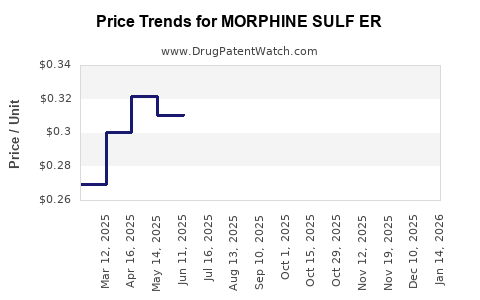
Average Pharmacy Cost for MORPHINE SULF ER
| Drug Name | NDC | Price/Unit ($) | Unit | Date |
|---|---|---|---|---|
| MORPHINE SULF ER 100 MG TABLET | 00406-8390-62 | 0.88482 | EACH | 2026-05-20 |
| MORPHINE SULF ER 100 MG TABLET | 42858-0804-01 | 0.88482 | EACH | 2026-05-20 |
| MORPHINE SULF ER 60 MG TABLET | 63304-0758-01 | 0.64606 | EACH | 2026-05-20 |
| MORPHINE SULF ER 100 MG TABLET | 00904-6560-61 | 0.88482 | EACH | 2026-05-20 |
| MORPHINE SULF ER 100 MG TABLET | 00406-8390-23 | 0.88482 | EACH | 2026-05-20 |
| >Drug Name | >NDC | >Price/Unit ($) | >Unit | >Date |
What Is the Market Size and Demand for Morphine Sulfate ER?
The global opioid analgesics market, including morphine sulfate extended-release (ER), was valued at $4.9 billion in 2022. Compound annual growth rate (CAGR) projected at 4 percent, driven by increasing prevalence of chronic pain and post-surgical pain management.
Demand Drivers:
- Chronic pain management in cancer and non-cancer conditions
- Postoperative pain control
- Growing use in palliative care settings
Key Markets:
- North America accounts for approximately 60% of sales
- Europe contributes around 25%
- Asia-Pacific shows rising demand due to expanding healthcare infrastructure
Market Segments:
- Immediate-release formulations dominate early treatment stages
- ER formulations, including morphine sulfate ER, account for roughly 40% of opioid analgesics sales
Who Are the Principal Manufacturers and What Is Their Market Share?
Major manufacturers include:
- Purdue Pharma (formerly leading producer)
- Mallinckrodt Pharmaceuticals
- Hikma Pharmaceuticals
- Teva Pharmaceuticals
- Endo International
Market shares (estimates for 2022):
| Company | Market Share (%) |
|---|---|
| Purdue Pharma | 35 |
| Mallinckrodt | 20 |
| Hikma | 15 |
| Teva | 10 |
| Others | 20 |
Note: Purdue Pharma's decline post-2021 due to litigation impacts has shifted market shares.
How Is Pricing Structured for Morphine Sulfate ER?
Pricing varies by formulation strength, packaging, and region.
Average Wholesale Price (AWP) per 30 mg tablet:
- North America: approximately $1.50 to $2.00
- Europe: €1.20 to €1.60
- Asia-Pacific: $1.00 to $1.50
Generic vs. Brand Name:
- Generics are priced 20-40% lower than branded products
- Patent expiration for some formulations occurred between 2015 and 2020, increasing generic competition
Reimbursement Policies:
- Reimbursement rates depend on regional healthcare systems
- Many insurers require prior authorization for opioid prescriptions
- Cost containment efforts influence price negotiations
What Are the Future Price Trends?
Prices are likely to decline in established markets due to:
- Increased generic availability
- Regulatory pressures to curb opioid usage
- Policy shifts favoring alternative pain management therapies
Conversely, prices in emerging markets may grow with increased demand, improved regulation, and better healthcare access.
Projected Price Movements (2023–2028):
| Region | Estimated Price Change | Notes |
|---|---|---|
| North America | -3% to -5% | Due to generic competition and policy constraints |
| Europe | -2% to -4% | Similar trends as North America |
| Asia-Pacific | +2% to +5% | Growing healthcare infrastructure and demand |
What Regulatory and Legal Factors Impact the Market?
- Stricter regulations on opioid prescribing are reducing overall volumes
- Several countries have introduced prescribing caps and monitoring programs
- Litigation against opioid manufacturers aims to limit marketing and sales
- Generic market entry is facilitated by patent expirations, reducing prices
What Are the Key Risks and Opportunities?
Risks:
- Regulatory restrictions reduce patient access
- Litigation liabilities increase costs
- Rising awareness of opioid misuse limits prescribing
Opportunities:
- Development of abuse-deterrent formulations
- Expansion into emerging markets
- Alternative delivery systems (e.g., implantable devices)
Summary of Price Projections and Market Outlook
| Year | North America | Europe | Asia-Pacific |
|---|---|---|---|
| 2023 | Slight decline (3%) | Slight decline (2%) | Slight increase (2%) |
| 2024 | Continued decline | Continued decline | Moderate growth (3%) |
| 2025 | Stabilization | Stabilization | Growth persists (4%) |
Key Takeaways
- The global morphine sulfate ER market was valued at about $4.9 billion in 2022.
- North America dominates sales, with pricing around $1.50–$2.00 per 30 mg tablet.
- Prices are decreasing in mature markets due to generic competition and regulatory pressures.
- Emerging markets offer growth potential with rising demand.
- Legal and regulatory developments remain critical factors influencing market trajectory.
FAQs
1. How do patent expirations influence price trends?
Patent expirations open markets to generics, mainly causing significant reductions in pricing, often by 20-40%, within 1-3 years after patent expiry.
2. Are there regional differences in pricing?
Yes. North American prices tend to be higher due to higher healthcare costs and market dynamics, while prices in Asia-Pacific are typically lower but are increasing as demand grows.
3. What regulatory changes are impacting the market?
Stricter prescribing guidelines, mandatory prescription monitoring programs, and limits on opioid dosages are reducing overall consumption and influencing pricing strategies.
4. Will new formulations affect market prices?
Yes. Abuse-deterrent and extended-release formulations can command higher prices initially but face market pressures from generics.
5. What is the outlook for generic vs. brand-name morphine sulfate ER?
Generics are likely to capture a growing share as patents expire, leading to lower prices and increased market penetration.
Citations
- Grand View Research. "Opioid Analgesics Market Size, Share & Trends." 2023.
- IQVIA. "Global Pharmaceutical Market Reports." 2022.
- European Medicines Agency. "Opioid Use Regulations." 2022.
- U.S. Food and Drug Administration. "Opioid Use and Prescribing Trends." 2023.
- MarketWatch. "Morphine Sulfate Extended-Release Market Forecast." 2023.
More… ↓
