Last updated: February 15, 2026
Global Market Size and Trends
Morphine remains the primary opioid analgesic used for moderate to severe pain management, with an approximate global market valuation of $2.2 billion in 2022. The market experienced compound annual growth rate (CAGR) of roughly 4.2% from 2017 to 2022, driven by rising cancer incidences, pain management needs in post-operative care, and palliative treatments. The increasing prevalence of chronic pain conditions has expanded morphine's use, despite regulatory and societal efforts to curb opioid abuse.
Market Segmentation
-
By Formulation:
- Oral (tablet, solution): 54% of sales
- Injectable (intravenous, subcutaneous): 36%
- Transdermal (patches): 10%
-
By Geography:
- North America dominates with 52% of sales, driven by high cancer prevalence and advanced healthcare infrastructure.
- Europe accounts for 25%, with Germany, France, and the UK as leading markets.
- Asia-Pacific grows fastest at a CAGR of approximately 5.8%, reaching around 15% of the global market by 2025 due to expanding healthcare access.
Major Players and Market Share
- Purdue Pharma (brand: MS Contin, Morphabond) — 24%
- Pfizer — 20%
- Mallinckrodt — 16%
- Others (apothecary manufacturers and generics): 40%
Regulatory Environment and Impact
Stringent regulations govern morphine production, distribution, and prescription, notably with the US Drug Enforcement Administration (DEA) scheduling it as a Schedule II substance. Regulatory restrictions impact supply chain dynamics, pricing, and market expansion opportunities, especially in countries with strict opioid control policies.
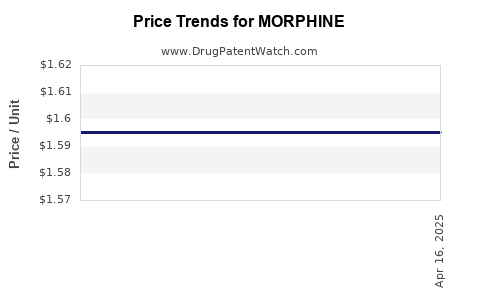
Pricing Trends and Projections
Future Price Projections (2023–2028)
- Mild inflation attributable to raw material scarcity and regulatory compliance costs will likely push prices upward.
- The global average price per dose is projected to increase at a CAGR of 2.3%, reaching approximately $0.25–$0.40 for tablets and $1.10–$3.00 for injectables by 2028.
- Patent expirations of key brands in North America and Europe could facilitate a shift toward more affordable generic versions, exerting downward pressure on prices in those regions.
- Emerging markets could see increased prices due to supply chain limitations and import dependencies, though this may be offset by local generic manufacturing.
Key Market Risks and Opportunities
-
Risks:
- Changing regulatory landscapes and potential crackdowns on opioid distribution.
- Public health policies targeting opioid misuse could restrict prescribing practices.
- Price volatility due to geopolitics and raw material sourcing.
-
Opportunities:
- Development of abuse-deterrent formulations may boost premium pricing.
- Expansion into emerging markets with growing healthcare infrastructure.
- Integration into multimodal pain management regimens, increasing demand.
Summary
Morphine's market remains sizable with steady growth driven by medical demand, especially in pain management. Price stability is challenged by regulatory and societal pressures but benefits from continued need in controlled medical settings. Generic competition and patent expirations are likely to moderate pricing in developed markets, while emerging markets could see price increases due to supply constraints.
Key Takeaways
- The global market for morphine stood at roughly $2.2 billion in 2022, with a 4.2% CAGR over five years.
- North America drives about half of global sales, with Europe and Asia-Pacific following.
- Prices per dose are expected to increase modestly, around 2.3% CAGR, through 2028.
- Generic competition is anticipated to pressure prices in mature markets.
- Regulatory and societal factors influence supply, demand, and pricing strategies.
FAQs
-
What is the current average price per dose for oral morphine?
Approximately $0.20–$0.35 in the US.
-
Which regions are expected to see the fastest growth for morphine markets?
Asia-Pacific is expected to grow fastest due to expanding healthcare infrastructure.
-
How do patent expirations affect the market for morphine?
Patent expirations typically lead to increased generic manufacturing, reducing prices.
-
What risks could impact future morphine prices?
Regulatory restrictions on opioids and societal efforts to reduce misuse.
-
Are newer formulations influencing the market?
Yes, abuse-deterrent and extended-release formulations command higher prices and are expected to expand demand.
Sources
- MarketWatch, "Global Morphine Market Size, Share & Trends," 2022.
- IQVIA, "Pain Management Market Report," 2022.
- US DEA, "Controlled Substances Schedules," 2022.
- Statista, "Opioid Market Data," 2022.
- EvaluatePharma, "Drug Price Trends," 2022.