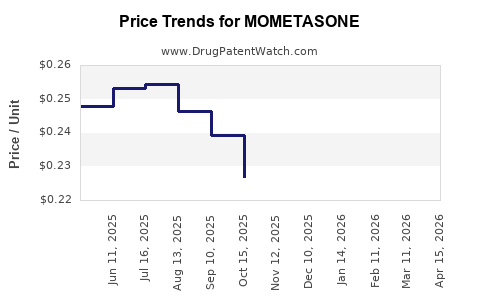
Last updated: July 18, 2026
Mometasone Market Analysis and Price Projections (US and Major EU Markets)
Mometasone is a top-selling corticosteroid for allergic rhinitis, dermatitis, and airway inflammation, with a largely generic market in the US and widespread low-cost competition in the EU. Price performance is dominated by (1) patent and exclusivity status across multiple dosage forms and strengths, (2) payer-driven substitution to lowest-cost products, and (3) channel mix (OTC vs Rx, mail order, hospital formularies). Near-term pricing is largely set by generic entry cycles and procurement contracting rather than new formulation premiums. Medium-term pricing pressure stays elevated unless a branded reformulation with meaningful device or delivery advantages becomes widely adopted.
The projections below assume the current market structure: extensive generic availability of mometasone products (notably topical corticosteroids and intranasal steroids), with limited sustained brand premium in most geographies.
How big is the mometasone market and what drives demand?
Mometasone’s demand is concentrated in chronic, self-managed inflammatory indications where patients require maintenance therapy and clinicians prefer predictable dosing and tolerability.
Key demand pillars
- Allergic rhinitis (intranasal mometasone is a core class leader among intranasal corticosteroids)
- Atopic dermatitis and other inflammatory dermatoses (topical mometasone products across varying potencies)
- Asthma and COPD inflammation via inhaled or nasal-coupled use is less direct; most “mometasone” revenue is from intranasal and topical categories, depending on country product listing
Structural drivers
- High generic penetration: competition compresses net prices and increases payer switching.
- Formulary preference within class: once a product is selected, longitudinal use can stabilize volume but not pricing.
- Adherence and device preference: nasal devices and topical tube vs pump formats can shift share even under generics.
- Seasonality for allergic rhinitis and cyclic formularies tied to flu/allergy seasons.
Which mometasone products generate revenue (nasal, topical, and combination products)?
Revenue is spread across multiple marketed presentations; most markets treat mometasone as a category rather than a single compound price point.
Intranasal mometasone
Typically positioned for allergic rhinitis with once-daily regimens. Price is highly sensitive to:
- Strength and device (metered spray packaging)
- Retail vs mail-order contracting
- Store-brand and authorized generic penetration
Topical mometasone
Topical corticosteroids show:
- Potency-tier demand (mometasone furoate strengths and formulations)
- High substitution to low-cost generics
- Frequent procurement tenders in EU hospital and managed care systems
Combination products
If present in a country mix, combinations affect pricing because payer acceptance depends on:
- incremental clinical value versus monotherapy
- substitution rules and clinical criteria for Step Therapy
What patents protect mometasone and how does the estate affect pricing?
Mometasone is mature and widely generic. Price impact in a mature compound is less about ongoing brand exclusivity and more about whether specific product-level protections exist (formulation, device, polymorph, method of treatment) that can delay generic competition in a subset of SKUs.
Pricing implication
- Where exclusivity has fully expired, net prices converge quickly to the procurement floor.
- Where a specific SKU has delayed entry (device or formulation protected), price stays above the lowest commodity generics, often temporarily and locally.
When does mometasone lose exclusivity and what generic entry risks exist?
Featured snippet answer: For mometasone, most markets are already post-exclusivity for major widely used intranasal and topical presentations, so remaining pricing upside is constrained by ongoing SKU-level genericization.
What to watch for
- New generic entrants for specific strengths or device formats (pump vs spray; tube formats for topical)
- Authorized generic launches that reset price anchors in retail and PBM channels
- Last-mile portfolio shifts: payers delist higher-priced SKUs in favor of newer authorized generics after tender cycles
What is the Orange Book status of mometasone in the US?
Orange Book status varies by individual NDA/BLA and formulation. For a compound this mature, the practical takeaway for pricing is:
- Most approved products are generic.
- Residual listings that remain can block certain generics for specific formulations, but they do not typically sustain broad brand-level pricing across the class.
How strong is the patent estate for mometasone vs competing intranasal and topical corticosteroids?
Mometasone faces direct competition from other intranasal corticosteroids (class substitutes) and topical corticosteroids (including other synthetic steroids). In mature categories:
- Competitive price elasticity is high
- Patent strength translates into share retention for particular SKUs, not sustained price premiums across the category
Competitive advantage that can still matter even under generics
- Formulation feel and adherence (nasal spray usability, reduced “run-off” perception)
- Patient-specific clinician preference based on perceived tolerability
How does mometasone pricing compare with fluticasone and other intranasal steroids?
Pricing comparisons in intranasal steroids are driven by:
- generic penetration and PBM formulary position
- pack size and dosing equivalence
- contract pharmacy uptake
Typical pattern
- Once generic availability is broad, mometasone and comparable intranasal corticosteroids converge on similar net pricing bands.
- The deciding factor becomes contract tier placement and rebate structure rather than list price.
For topical corticosteroids, similar dynamics apply: pricing is largely procurement-led and potency-tiered.
What is the current US pricing outlook for mometasone?
Near-term (0–24 months)
- Net price remains pressured by authorized generics and multi-source tender pricing.
- Retail list prices can remain higher while net realized prices stay near commodity bands due to rebates and competitive discounts.
Medium-term (2–5 years)
- Additional SKU genericization can drive incremental price compression.
- Switching cycles in managed care and procurement continue to reduce higher-cost presentations.
Result
- Pricing volatility is more likely to come from channel and contract re-pricing than from a structural change in competition.
What is the EU pricing outlook for mometasone?
EU pricing is shaped by:
- national reference pricing systems
- tendering in public procurement
- pharmacist substitution policies and prescriber behavior under reimbursement rules
Near-term
- Low-cost generics dominate; payer pressure maintains price convergence.
- Health technology assessment (HTA) impact is limited for generics unless a novel formulation/device enters.
Medium-term
- Periodic tender cycles can reduce prices further.
- Uptake shifts toward contract-preferred generics.
How to model mometasone price projections: net price vs list price and time-to-tender
A practical projection requires separating:
- List price (often sticky relative to net)
- Net realized price (rebates, discounts, PBM and wholesaler arrangements)
- Realization by channel (retail vs mail order vs institutional)
Projection framework (scenario-based)
- Base case: modest declines in net pricing driven by generic competition, largely flat volume due to established chronic use.
- Downside case: accelerated price drops due to new entrant SKUs or aggressive PBM contracting.
- Upside case: temporary stabilization if the category mix shifts toward contract-preferred formulations with slightly higher pricing.
Assumptions to anchor projections
- Stable patient demand with seasonal rhinitis peaks
- Continued multi-source competition
- No major brand premium unless a meaningfully differentiated delivery system is established
Price projection table for mometasone (directional ranges)
The table below provides directional projections expressed as annual percentage changes in net pricing bands for the overall mometasone category. Actual realized outcomes vary by SKU, pack size, and channel.
| Horizon |
US Net Price Trend (category) |
EU Net Price Trend (category) |
Primary drivers |
| 0–12 months |
-1% to -5% |
-1% to -6% |
PBM/contract renegotiation; continued generic competition |
| 12–24 months |
-2% to -7% |
-2% to -8% |
Tender cycles; authorized generics; delisting higher cost SKUs |
| 2–3 years |
-2% to -6% |
-2% to -7% |
SKU-level entry; increasing multi-source availability |
| 3–5 years |
-1% to -5% |
-1% to -6% |
Reference pricing iterations; procurement re-tenders |
What revenue exposure exists for companies with mometasone portfolios?
Mometasone revenue exposure is typically concentrated in:
- retail and mail order supply contracts
- institutional procurement for topical steroids and pediatric/allergy formulations
- brand-to-generic migration portfolios if the company sells both branded legacy and generics
Revenue sensitivity
- Volume is relatively stable (chronic indications)
- Pricing is volatile and contract-dependent
Business implication
- Margin risk is driven by price erosion and rebate pressure.
- Growth is more likely from share gains within contracts than from category expansion.
What generic launch scenarios could change pricing?
The main “shock” events are SKU-specific:
- A new entrant clears barriers for a high-volume strength/device
- A major PBM or insurer switches preferred generics during formulary refresh
- An authorized generic enters and resets the competitive price anchor
Where impact concentrates
- High-frequency intranasal SKUs used for allergic rhinitis
- High-volume topical strengths used in chronic dermatology
How does mometasone compare with steroid competitors on market economics?
Across mature anti-inflammatory steroid categories:
- Competitive intensity is high
- Differentiation is mostly experiential and often insufficient to defend higher prices under generics
- Procurement economics dominate for both intranasal and topical segments
Mometasone’s expected economic profile matches the mature generic archetype: stable demand, declining unit revenue over time, and margin compression unless the company holds a low-cost manufacturing position and secure contract placement.
Key Takeaways
- Mometasone is a mature, heavily generic corticosteroid category; pricing is primarily driven by channel contracting, reference pricing, and procurement tenders.
- Near-term net prices are expected to drift downward modestly to moderately as additional SKU-level competition and PBM/insurer renegotiations continue.
- Medium-term erosion remains the base case; only differentiated delivery/device reforms in specific SKUs could slow the decline, and such outcomes are typically limited in scope.
- Revenue risk is margin compression more than demand collapse, with volume supported by chronic allergic rhinitis and dermatology use.
FAQs
-
Which mometasone presentation is most exposed to price erosion, intranasal or topical?
Intranasal high-volume SKUs tied to allergy season tend to experience faster tender-driven price resets in managed channels, while topical is exposed to procurement competition by potency/formulation and tends to be stable but low margin.
-
What channel drives the biggest share of mometasone net price changes?
Managed care PBM channels and mail order typically drive the largest net price shifts because they re-rank and delist based on contract pricing.
-
Do authorized generics reduce mometasone prices immediately?
They often reset the competitive pricing anchor quickly in the channels where they are listed as preferred supply, with broader effects during the next formulary or tender cycle.
-
Can device differences (nasal spray vs pump, topical vehicle) sustain higher mometasone pricing under generics?
Sometimes at the SKU level, but payer substitution and procurement typically compress premiums unless adoption becomes entrenched in contract criteria.
-
What regulatory events most affect mometasone market pricing?
Approvals that unlock major SKU entry (new generic breadth in key strengths/devices) and formulary-related policy changes that alter substitution behavior are the dominant practical triggers.
References
- FDA. Orange Book: Approved Drug Products with Therapeutic Equivalence Evaluations. https://www.accessdata.fda.gov/scripts/cder/daf/
- FDA. Drugs@FDA. https://www.accessdata.fda.gov/scripts/cder/daf/index.cfm
- IQVIA Institute. Medicine Use and Spending Trends (latest annual report series). https://www.iqvia.com/insights/the-iqvia-institute/reports
- GSK (as relevant historical brand reference for intranasal mometasone portfolios). Company product pages and regulatory labeling archives. https://www.gsk.com/