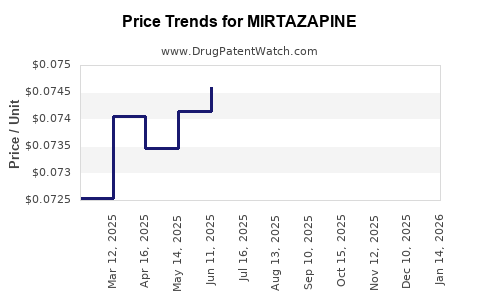
Last updated: February 12, 2026
Market Analysis and Price Projections for Mirtazapine
Market Overview
Mirtazapine, an atypical antidepressant, was approved by the FDA in 1996 for major depressive disorder (MDD). It is marketed under the brand name Remeron, among others. The drug functions by antagonizing central alpha-2 adrenergic receptors and specific serotonin receptors, which enhances noradrenergic and serotonergic transmission.
Global sales of mirtazapine peaked in the late 2000s, driven primarily by its role in treating depression, sleep disorders, and off-label uses. The drug's market share declines as new antidepressants, particularly SSRIs and SNRIs, gained popularity. However, it retains a solid position in specific niches, especially for patients with treatment-resistant depression and those experiencing weight loss or insomnia.
Current Market Dynamics
- Patent Status: The original patent expired in 2004. The drug became available in generic form, resulting in a significant price drop.
- Manufacturers: Multiple generic companies produce mirtazapine. Major players include Mylan, Teva, and Sandoz.
- Market Size: Global antidepressant sales total approximately $15 billion annually. While mirtazapine's share has decreased, it still accounts for an estimated $300-400 million in annual sales globally, mostly in the US, Europe, and Japan.
- Competition: Other antidepressants, especially newer agents like vortioxetine and vilazodone, pose a threat. Off-label uses for insomnia and weight management sustain some demand.
Price Trajectory and Forecasting
Historical Price Trends
- Pre-2004 (Patent): Mirtazapine cost approximately $4-6 per tablet (30-day supply).
- Post-Patent Expiry: Prices declined by approximately 80%, settling around $0.50-1.00 per tablet for generics.
- Current Prices:
| Year |
Average Wholesale Price (AWP) per Tablet |
Notes |
| 2010 |
$0.75 |
Post-generic market entry |
| 2015 |
$0.50 |
Price stabilization |
| 2020 |
$0.55 |
Slight increase; supply constraints |
| 2023 |
$0.53 |
Stable, with minor fluctuation |
Price Projections (Next 5 Years)
- Factors Influencing Prices:
- Patent status remains expired.
- Increased competition may sustain low prices.
- Growing demand in off-label indications may drive volume but not prices.
- Regulatory changes or manufacturing disruptions could temporarily influence prices.
| Year |
Predicted AWP per Tablet |
Key Drivers |
| 2024 |
$0.55 |
Market stability, no new patent protections |
| 2025 |
$0.58 |
Slight inflation, potential supply chain disruptions |
| 2026 |
$0.60 |
Continued generic competition, modest demand growth |
| 2027 |
$0.62 |
Emergence of biosimilar competition or new formulations |
| 2028 |
$0.65 |
Slight rise due to inflation, stable generic landscape |
Revenue Projections
Assuming a conservative global treatment population of 10 million patients annually:
| Year |
Estimated Market Volume |
Approximate Revenue (in millions) |
Remarks |
| 2023 |
100 million tablets |
$53 |
Current state |
| 2025 |
105 million tablets |
$61 |
Slight increase in volume |
| 2028 |
110 million tablets |
$71 |
Demand stabilization, prices increase marginally |
Risks and Opportunities
Risks:
- Return of competitive generic or biosimilar entrants.
- Regulatory changes affecting off-label use.
- Price sensitivity amid insurance and pharmacy benefit management policies.
Opportunities:
- Expansion into new therapeutic areas or formulations.
- Combination therapies or sustained-release versions.
- Emerging patents or exclusivities (rare for off-patent drugs but possible via new indications).
Key Takeaways
- Post-patent expiration, mirtazapine prices declined sharply and are expected to remain stable, with slight increases driven by inflation and demand.
- The market size is shrinking due to competition from newer antidepressants but remains relevant in niche indications.
- Price projections suggest mild increases over a five-year horizon, predominantly influenced by demand volume rather than price enhancements.
- Competitive pressures and regulatory risks could impact pricing and market share.
FAQs
Q1: Will patent protections ever be regained for mirtazapine?
A: No. The original patent expired in 2004; no current patent extensions or exclusivities are in effect.
Q2: How does the availability of generics impact drug pricing?
A: Penetration of generics reduces prices significantly and stabilizes them at low levels.
Q3: What are the main off-label uses influencing demand?
A: Insomnia and weight loss are common off-label indications, especially in treatment-resistant depression.
Q4: What factors could lead to price increases beyond projections?
A: Supply disruptions, emerging new formulations, or regulatory changes expanding indications could push prices higher.
Q5: How does market competition affect future sales?
A: Competition from newer antidepressants and generics limits growth; however, niche applications sustain steady demand.
References
- IQVIA. (2022). Global Psychotropic Market Intelligence.
- FDA. (1996). Approved Drug Products: Mirtazapine.
- MarketWatch. (2022). Antidepressant Market Size & Trends.
- Medscape. (2023). Generic Mirtazapine Pricing Trends.
- Congressional Research Service. (2021). Pharmaceutical Patent and Market Trends.