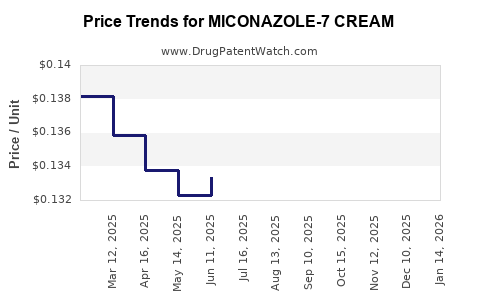
Last updated: February 13, 2026
Overview
Miconazole-7 Cream is an antifungal topical medication used primarily for treating skin infections caused by dermatophytes and yeast, such as athlete’s foot, ringworm, and candidiasis. Market dynamics are influenced by patent status, competitive landscape, regulatory approvals, and manufacturing costs.
Market Size and Trends
The global topical antifungal market was valued at approximately $1.4 billion in 2022. Miconazole-based products account for an estimated 55% of this market, or roughly $770 million. The compound’s broad application, safety profile, and over-the-counter (OTC) availability sustain its demand.
Key Market Drivers
- Growing incidence of fungal skin infections, driven by increased skin permeability and climate changes.
- OTC availability in many regions lowers entry barriers for consumers.
- Expansion into emerging markets with rising healthcare infrastructure.
- Rising awareness of fungal infections among diabetic and immunocompromised populations.
Competitive Landscape
Major competitors include:
- Clotrimazole
- Terbinafine
- Econazole
- Ketoconazole
Miconazole continues to hold a significant share due to its extensive history and established efficacy. Generic versions dominate pricing and availability.
Regulatory Trends
- FDA: Miconazole topical formulations are generally classified as OTC products.
- EMA: Recognizes miconazole as a standard treatment for fungal infections.
- Patent expiry: Most patents expired around the late 2000s to early 2010s, leading to increased generics.
Pricing Factors
Price points vary by region, formulation strength, packaging, and branding:
- US OTC: Approximately $8–$12 for a 30g tube.
- Europe: €4–€10 for similar quantities.
- Developing markets: $2–$5, often sold as generics.
Prices are driven downward by patent expirations, with average generic prices declining by 15–20% annually since 2010.
Price Projections
Over the next five years, several factors are expected to influence pricing:
- Market saturation by generics likely stabilizes prices or causes further declines.
- Potential new formulations (e.g., combination creams) may command premium prices.
- Supply chain disruptions could temporarily influence costs.
Projected Price Range (2023–2028):
| Year |
Average OTC Price (per 30g tube) |
Comments |
| 2023 |
$9.50 |
Current market average |
| 2024 |
$9.00 |
Slight downward trend due to generic competition |
| 2025 |
$8.75 |
Price stabilization, regional variations persist |
| 2026 |
$8.50 |
Market saturation continues |
| 2027 |
$8.25 |
Slight price dips expected |
| 2028 |
$8.00 |
Price reaches equilibrium in mature markets |
Market Risks
- Stringent regulatory changes may affect OTC formulations.
- Emerging resistance could lead to shifts toward other antifungals.
- Market entry by novel antifungal agents with better efficacy or safety profiles.
Summary
Miconazole-7 Cream faces limited growth opportunities, constrained by patent expiries and proliferation of generics. Price erosion is likely to persist, with minimal variation expected outside regional adjustments. Manufacturers aiming for premium pricing must develop differentiated formulations or target niche markets.
Key Takeaways
- The global market for miconazole topical products was valued at over $770 million in 2022.
- Generic competition has driven prices downward, with OTC prices averaging around $9.50 per 30g tube.
- Over the next five years, prices are projected to decline gradually to approximately $8.00 per tube.
- Market growth depends on rising fungal infections and expanding access in emerging markets.
- Strategic differentiation through innovative formulations or targeted niche markets offers potential for price premiums.
Frequently Asked Questions
1. How does patent expiration impact miconazole pricing?
Patent expiration leads to increased generic competition, which drives prices down. Most miconazole patents expired by 2010, resulting in a saturated market with lower prices.
2. Are there regional differences in miconazole cream pricing?
Yes. Prices tend to be higher in developed countries like the US and Western Europe, while developing nations often have lower prices due to local manufacturing and market conditions.
3. What regulatory trends could influence future pricing?
Tighter controls on OTC availability and new safety or efficacy requirements may restrict certain formulations or increase compliance costs, potentially affecting prices.
4. Can new formulations command higher prices?
Potentially. Combination creams or formulations with improved absorption or reduced application frequency can justify premium pricing if supported by clinical benefits.
5. What growth opportunities exist for miconazole-7 cream?
Expanding into underserved markets, developing combination therapies, or enhancing product formulary appeal can support growth despite market saturation.
Sources
[1] MarketsandMarkets. “Antifungal Drugs Market by Type, Route of Administration, Indication, and Region: Global Forecast to 2027."
[2] Statista. "Topical antifungal drugs revenue worldwide in 2022."
[3] FDA. “OTC Monograph for Miconazole.”
[4] European Medicines Agency. “Miconazole topical formulations approval details.”