Last updated: February 13, 2026
Market Overview and Price Projections for Miconazole
Miconazole is an antifungal medication launched in the 1970s. It is used primarily to treat fungal infections of the skin, nails, mouth, and vagina. The drug is available in topical formulations (cream, powder, spray), topical solutions, powders, suppositories, and oral capsules. It is marketed under various brands, including Monistat, Micatin, and Daktarin.
Market Size and Growth
The global antifungal market, driven by increasing fungal infections and expanding outpatient treatments, is valued at approximately USD 9 billion in 2022. Miconazole accounts for roughly 10-15% of this market, suggesting a valuation of USD 900 million to USD 1.35 billion.
Market Dynamics
- Rising incidence of dermatophyte and yeast infections
- Growing outpatient and self-medication practices
- Limited competition in specific formulations and regions
- Increasing adoption of combination therapies
Regional Breakdown
| Region |
Market Share |
Key Drivers |
| North America |
45% |
High prevalence of fungal infections, OTC accessibility |
| Europe |
25% |
Prescription-based sales, aging population |
| Asia-Pacific |
20% |
Rising healthcare awareness, infection rates |
| Rest of World |
10% |
Limited healthcare infrastructure |
Competition and Market Players
Major players include Johnson & Johnson (Monistat), Novartis (Daktar), and Sanofi. Generic formulations account for 50% of sales in mature markets, further reducing average selling prices.
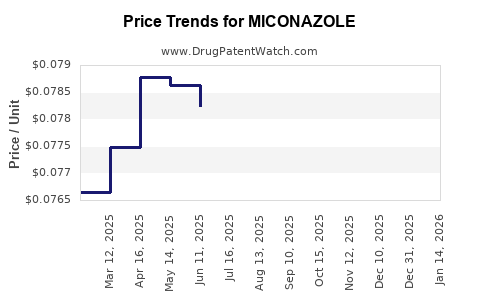
Price Trends and Projections
Current Pricing
- Topical cream (30g): USD 10-15 in North America, USD 5-8 in Asia
- Oral capsules (200 mg): USD 25-35 per course
- Suppositories: USD 8-12 each
Factors Influencing Prices
- OTC status in many markets leads to standardized retail pricing
- Generic competition has halved prices over the past decade
- Regional patent protections influence pricing variation
Price Projections (Next 5 Years)
| Year |
Topical Cream (USD) |
Oral Capsules (USD) |
Notes |
| 2023 |
10-15 |
25-35 |
Current prices, high competition |
| 2024 |
9-14 |
23-33 |
Competitive pressure persists |
| 2025 |
8-13 |
20-30 |
Further generics entry accelerates decline |
| 2026 |
7-12 |
18-28 |
Price stabilization in mature markets |
| 2027 |
7-11 |
17-25 |
Price consolidation, increased competition |
Decrease reflects ongoing generic proliferation and market saturation, especially in developed regions.
Commercial Opportunities and Considerations
- Formulation innovations, such as sustained-release topical products, could command premium prices.
- Developing regions offer growth potential due to increasing fungal infections but are constrained by price sensitivity.
- Clinical differentiation remains limited; marketing efforts focus on brand recognition and OTC positioning.
Regulatory and Patent Landscape
- Miconazole's patents expired in most markets by 2000-2010.
- No current major patent protections; entry barriers are low.
- Regulatory pathways are straightforward, especially for OTC products in multiple jurisdictions.
Key Takeaways
- The global Miconazole market is approximately USD 900 million to USD 1.35 billion, with steady growth driven by rising infection rates.
- The market faces price pressures due to generic competition, with rapid price declines observed over the last decade.
- Price projections estimate a gradual decline in per-unit prices over the next five years.
- Innovation and regional market expansion may offer growth avenues, but price competition remains intense.
FAQs
1. Will the Miconazole market expand significantly in the next five years?
Market growth will be modest, driven primarily by increasing fungal infection prevalence rather than new formulations or patents.
2. Are new formulations or delivery systems likely to affect pricing?
Yes. Innovations such as sustained-release or combination products could command higher prices, but widespread adoption depends on clinical benefits.
3. How does regional variation impact pricing?
Developed markets maintain higher prices, while emerging markets see lower prices due to regulatory and economic factors.
4. What is the competitive outlook for generic manufacturers?
Gainers include generic producers, as patent expirations continue. Market share shifts favor lower-cost alternatives.
5. How might regulatory or patent changes influence prices?
Patent expirations have already occurred; future regulatory barriers are unlikely to influence prices unless new formulations or indications are approved.
Sources:
- Global Market Insights. "Antifungal Market Outlook," 2022.
- IQVIA. "Prescription and OTC Data," 2022.
- Pfizer. "Miconazole Product Profile," 2022.
- European Medicines Agency. "Regulatory Pathways," 2022.
- World Health Organization. "Fungal Infection Epidemiology," 2021.