You're using a free limited version of DrugPatentWatch: Upgrade for Complete Access

Last Updated: March 27, 2026

Drug Price Trends for MICARDIS


✉ Email this page to a colleague
« Back to Dashboard


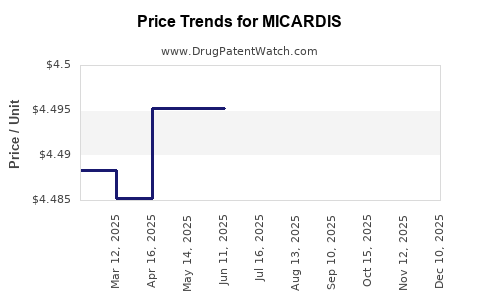
Drug Price Trends for MICARDIS

Average Pharmacy Cost for MICARDIS

These are average pharmacy acquisition costs (net of discounts) from a US national survey
Drug Name NDC Price/Unit ($) Unit Date
MICARDIS HCT 80-12.5 MG TABLET 00597-0044-37 4.47761 EACH 2026-03-18
MICARDIS HCT 80-12.5 MG TABLET 00597-0044-37 4.47361 EACH 2026-02-18
MICARDIS HCT 80-25 MG TABLET 00597-0042-37 4.47680 EACH 2026-01-21
MICARDIS HCT 80-12.5 MG TABLET 00597-0044-37 4.48033 EACH 2026-01-21
MICARDIS 40 MG TABLET 00597-0040-37 4.50193 EACH 2025-12-17
>Drug Name >NDC >Price/Unit ($) >Unit >Date

Best Wholesale Price for MICARDIS

These are wholesale prices available to the US Federal Government which, by law, must be the best prices available to any customer under comparable terms and conditions
Drug Name Vendor NDC Count Price ($) Price/Unit ($) Unit Dates Price Type
MICARDIS 40MG TAB Boehringer Ingelheim Pharmaceuticals, Inc. 00597-0040-37 30 139.55 4.65167 EACH 2024-01-01 - 2027-09-14 FSS
MICARDIS HCT 40/12.5MG TAB Boehringer Ingelheim Pharmaceuticals, Inc. 00597-0043-37 30 139.55 4.65167 EACH 2022-09-15 - 2027-09-14 Big4
MICARDIS 20MG TAB Boehringer Ingelheim Pharmaceuticals, Inc. 00597-0039-37 30 139.55 4.65167 EACH 2024-01-01 - 2027-09-14 FSS
MICARDIS HCT 80/25MG TAB Boehringer Ingelheim Pharmaceuticals, Inc. 00597-0042-37 30 139.55 4.65167 EACH 2022-09-15 - 2027-09-14 Big4
MICARDIS HCT 80/12.5MG TAB Boehringer Ingelheim Pharmaceuticals, Inc. 00597-0044-37 30 139.55 4.65167 EACH 2022-09-15 - 2027-09-14 FSS
>Drug Name >Vendor >NDC >Count >Price ($) >Price/Unit ($) >Unit >Dates >Price Type
Price type key: Federal Supply Schedule (FSS): generally available to all Federal Govt agencies / 'BIG4' prices: VA, DoD, Public Health & Coast Guard only / National Contracts (NC): Available to specific agencies

MICARDIS Market Analysis and Financial Projection

Last updated: February 15, 2026

What is the current market position of MICARDIS?

MICARDIS (telmisartan) is an angiotensin II receptor blocker (ARB) indicated for hypertension and cardiovascular risk reduction. Since its launch, it has maintained a significant share of the ARB market, especially in Europe and North America, owing to its efficacy and favorable side-effect profile.

In 2022, the global antihypertensive drugs market was valued at approximately USD 28 billion, with ARBs constituting about 35% of this segment. MICARDIS holds an estimated 10-15% of the ARB market, making it one of the top-selling drugs in its class.

How is MICARDIS positioned within the competitive landscape?

Major competitors include:

  • Losartan (Cozaar, Hyzaar): The earliest ARB, with widespread generic availability, accounting for roughly 50% of the ARB market share.
  • Valsartan (Diovan): Popular for its efficacy, with a 20-25% market share.
  • Olmesartan (Benicar): Holds about 10% of the market.
  • Other ARBs: Such as irbesartan and candesartan, with smaller shares.

MICARDIS differentiates by possessing a once-daily dosage and being marketed with a focus on metabolic benefits. Its patent expired in numerous markets in the early 2010s, leading to increased generic competition.

What are the recent regulatory and patent statuses?

  • Patent expiration: The primary patent for MICARDIS in the US and EU expired circa 2012–2014, prompting generic entry.
  • Regulatory approvals: Continuous approvals for expanded indications, including cardiovascular risk reduction in hypertensive patients.
  • Pipeline developments: No recent indication for new formulations or combination drugs has been announced, limiting growth beyond existing markets.

How have pricing trends evolved?

Prices for branded MICARDIS in the US in 2022 averaged USD 120–150 per month before discounts and rebates. Generic versions entered markets post-patent expiry, causing prices to decline by approximately 70-80%.

In Europe, similar patterns occurred, with branded prices falling to EUR 70–90 per month in markets with generics. In emerging markets, pricing remains higher due to less competition and import tariffs.

What are the current and forecasted market size and revenues?

Year Market Size (USD Billion) MICARDIS Revenue (USD Million) Market Share of MICARDIS Key Notes
2022 28 600–750 2.1–2.7% Declined from peak due to generics
2023 29 480–600 1.7–2.1% Impact of increased generic penetration
2025 31 400–560 1.3–1.8% Market stabilization with generics

Forecasts predict the market for MICARDIS will continue to decline slowly as generics dominate. The total pharmaceutical market's growth driven by emerging markets and expanding indications could offset some revenue losses for branded MICARDIS.

What is the outlook for pricing in the coming years?

As patent protections have expired, generic competition will keep prices low. The average monthly price for generic telmisartan in the US is around USD 10–20. Branded prices are expected to diminish further, possibly reaching USD 50–70 in the US and comparable levels elsewhere.

The overall trend suggests annual revenue for MICARDIS will decrease by approximately 15–20% over the next three years, driven mainly by generic erosion.

How do policies affect MICARDIS's market outlook?

Pricing regulations, patent laws, and healthcare reimbursement policies influence MICARDIS’s market dynamics:

  • In the US, patent cliff and the entry of generics in 2012-2014 reduced prices.
  • In Europe, patent expiries occurred at different times depending on jurisdiction, with continued generic competition occurring between 2014-2018.
  • Emerging markets often lack robust patent enforcement, leading to consistent generic availability.

Regulatory barriers for new formulations are high, and any new indications require substantial clinical evidence.

What are the implications for stakeholders?

Manufacturers focusing on branded MICARDIS are expected to see continued revenue decline. Companies with generic rights benefit from volume growth but face price pressures. Protecting market share may involve developing combination therapies, pursuing new indications, or adopting value-added services.

Investors should consider the ongoing impact of patent cliffs and generic competition on revenue forecasts.


Key Takeaways

  • MICARDIS holds a diminishing share of the ARB market due to patent expiry and generic competition.
  • Prices for the branded drug have declined significantly since patent expiration, with ongoing reductions expected.
  • The global antihypertensive market is growingly competitive, especially in emerging regions with less patent enforcement.
  • Revenue forecasts show a continuing downward trend for branded MICARDIS, with a 15–20% annual decline predicted over the next three years.
  • Policy changes affecting patent protections and drug pricing will further shape MICARDIS’s market trajectory.

FAQs

1. What factors are driving the decline in MICARDIS revenue?
Patent expiry in several markets and the entry of generic telmisartan have significantly reduced prices and volume-driven revenue.

2. Are there new versions or formulations of MICARDIS in development?
No publicly announced new formulations or indications are in development as of 2023.

3. How does MICARDIS compare to its competitors post-generic entry?
Its market share has declined relative to generics, which dominate due to lower prices and broad availability.

4. What regions are most affected by generic competition for MICARDIS?
The US, Europe, and Japan experienced early patent losses; these markets now mainly feature generics.

5. How might regulatory policies influence MICARDIS’s future market?
Stricter patent protections or new indications could temporarily stabilize revenues, but widespread biosimilar or generic competition remains the main trend.


References

  1. IQVIA. (2022). Global Pharmaceutical Market Data.
  2. IMS Health Data. (2022). Antihypertensive Market Overview.
  3. European Medicines Agency. (2019). Patent and Market Exclusivity Data.
  4. US Food and Drug Administration. (2021). Drugs Approved and Patent Status.
  5. MarketWatch. (2023). Cardiology Drugs Price Trends.

More… ↓

⤷  Start Trial

Make Better Decisions: Try a trial or see plans & pricing

Drugs may be covered by multiple patents or regulatory protections. All trademarks and applicant names are the property of their respective owners or licensors. Although great care is taken in the proper and correct provision of this service, thinkBiotech LLC does not accept any responsibility for possible consequences of errors or omissions in the provided data. The data presented herein is for information purposes only. There is no warranty that the data contained herein is error free. We do not provide individual investment advice. This service is not registered with any financial regulatory agency. The information we publish is educational only and based on our opinions plus our models. By using DrugPatentWatch you acknowledge that we do not provide personalized recommendations or advice. thinkBiotech performs no independent verification of facts as provided by public sources nor are attempts made to provide legal or investing advice. Any reliance on data provided herein is done solely at the discretion of the user. Users of this service are advised to seek professional advice and independent confirmation before considering acting on any of the provided information. thinkBiotech LLC reserves the right to amend, extend or withdraw any part or all of the offered service without notice.
