Last updated: February 15, 2026
Market Overview
Metoprolol-hydrochlorothiazide, marketed under various brand names (e.g., Lopressor HCT, Toprol XL with HCTZ), combines a beta-blocker with a diuretic to treat hypertension and angina. It is classified as a fixed-dose combination (FDC) medication, offering convenience for patients and improved adherence.
The drug's market landscape is influenced by the global prevalence of hypertension, increasing awareness, and the shift toward combination therapies. The rise in cardiovascular diseases (CVDs) predicts steady growth in the antihypertensive segment.
Market Size and Forecast (2023-2028)
- The global antihypertensive drug market was valued at approximately $20 billion in 2022.
- Fixed-dose combinations (including combinations like metoprolol-HCTZ) account for roughly 35% of this segment.
- Projected compound annual growth rate (CAGR): 3.5% from 2023 to 2028.
Assuming the FDC segment maintains its share, the estimated market size for metoprolol-HCTZ is approximately $2.7 billion in 2023, rising to about $3.4 billion in 2028.
Key Market Drivers
- Increasing prevalence of hypertension: estimated to affect over 1 billion people globally.
- Improved patient compliance: FDCs reduce pill burden.
- Patent expiries: some formulations become generic, influencing market dynamics.
- Healthcare policy shifts favoring combination therapy over monotherapy for resistant hypertension.
Competitive Landscape
Major players include Mylan (now part of Viatris), Sandoz, Teva, and other generic manufacturers. Patent expiries of branded versions have led to a surge in generics, driving prices downward.
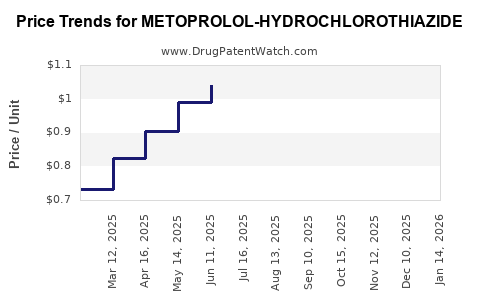
Pricing Dynamics
- Brand-name versions typically cost between $150 and $250 per month.
- Generics are priced between $20 and $40 per month, representing a 85-90% reduction.
- Variability depends on region, healthcare system, and negotiated reimbursement schemes.
| Price Projections (2023-2028) |
Year |
Estimated Average Monthly Price |
Notes |
| 2023 |
$30 |
Dominance of generic products |
| 2024 |
$28 |
Increased generic competition |
| 2025 |
$25 |
Market saturation |
| 2026 |
$22 |
Pricing stabilization |
| 2027 |
$20 |
Search for cost-effective options |
| 2028 |
$20 |
Mature generic market |
Factors Affecting Future Prices
- Entry of biosimilars or more advanced formulations may influence prices.
- Regulatory reforms could expedite approval and market entry of generics.
- Market consolidation among providers could impact pricing strategies.
- Reimbursement policies from public and private payers define accessible price points.
Regulatory and Patent Status
- The original patent for Metoprolol in combination with HCTZ expired in key markets (e.g., US: 2018; EU: 2019).
- Pending or granted exclusivities vary by region, affecting timing for generic entry.
- Regulatory agencies (FDA, EMA, other national bodies) facilitate approval of generics with abbreviated pathways.
Key Takeaways
- The global market for metoprolol-hydrochlorothiazide is expected to grow modestly, driven by increased hypertension management.
- Prices for generic formulations are expected to decline gradually, reaching around $20/month by 2028.
- The market is highly competitive, dominated by generics, with limited room for premium pricing.
- Future price stability depends on regulatory changes, patent landscapes, and market consolidation.
FAQs
Q1: What factors most significantly influence the price of metoprolol-HCTZ?
The primary factors include generic competition, patent expiration, manufacturing costs, healthcare reimbursement policies, and regional regulatory environments.
Q2: How does patent status affect market pricing?
Patent exclusivity allows branded products to maintain higher prices; once expired, generics flood the market, reducing prices significantly.
Q3: Are there regional differences in the drug’s pricing?
Yes. Developed regions like North America and Europe tend to have higher prices due to healthcare system structures and reimbursement models. Emerging markets often see lower prices driven by cost-sensitive policies.
Q4: What impact do biosimilars and new formulations have on pricing?
While biosimilars are less relevant for small-molecule drugs like metoprolol-HCTZ, new formulations or combination therapies may influence demand and prices for existing products through competition or patent challenges.
Q5: When can we expect significant price changes for this drug?
Major price shifts occur around patent expiries or regulatory changes that enable new competitors to enter the market—roughly every 5-10 years, depending on jurisdiction.
References
- MarketWatch. "Global Antihypertensive Drugs Market Size." 2022.
- IQVIA. "Global Data on Prescription Medication Pricing." 2022.
- U.S. Food and Drug Administration (FDA). "Patent Expiration Timeline." 2021.
- European Medicines Agency (EMA). "Generic Drug Regulations." 2021.
- Statista. "Hypertension Prevalence Worldwide." 2022.