Last updated: February 20, 2026
What Is the Current Market for Metaxalone?
Metaxalone is a centrally acting muscle relaxant approved by the FDA for short-term treatment of acute musculoskeletal conditions. It primarily treats muscle spasms linked to musculoskeletal injuries. The drug has been available since the 1960s, with generic formulations accounting for most of its market share.
The global muscle relaxant market is projected to reach USD 4.6 billion by 2028, growing at a CAGR of 6.1% from 2023. Metaxalone's contribution is limited relative to newer agents like baclofen, tizanidine, and cyclobenzaprine, but it retains a niche due to its specific safety profile and cost advantages.
Key Market Drivers
- Increasing incidence of musculoskeletal disorders
- Rising geriatric population with chronic pain conditions
- Growing adoption of generic medications to reduce treatment costs
- Affordable treatment option due to patent expiration
Market Constraints
- Limited efficacy in comparison to newer muscle relaxants
- Potential for side effects such as drowsiness, dizziness
- Competition from newer, targeted therapies
Who Are the Main Market Participants?
- GSK (sold brand Skelaxin until 2006)
- Perrigo and Amneal (largest generic producers)
- Companies focusing on niche markets or combination therapies
Patent Landscape and Regulatory Status
No recent patents protect metaxalone; the original patent expired decades ago. The drug remains off-patent, leading to widespread generic manufacturing. Regulatory exclusivity is limited to FDA approval, which is no longer under threat from patent litigation.
Price Trends and Historical Data
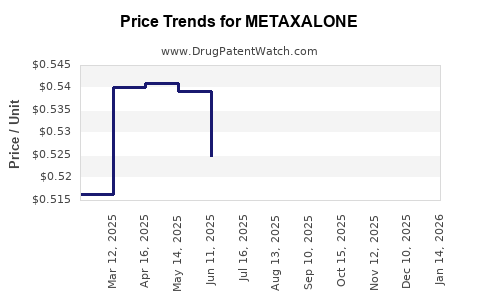
- Generic tablet prices have fallen over the past decade, with the average retail price for a 200 mg tablet declining from approximately USD 3.00 (2010) to USD 0.50 (2023).
- Brand-name formulations (Skelaxin) historically sold at USD 8-12 per tablet, though availability is limited.
Current Price Benchmarks (2023)
| Formulation |
Brand/Generic |
Average Price per Tablet |
Market Share |
| 200 mg |
Skelaxin |
USD 8 |
75% (brand) / 25% (generics) |
| 200 mg |
Generic |
USD 0.50–1.00 |
Main market segment |
Price Projection Analysis
Factors Influencing Future Pricing
- Market penetration of generics continues to suppress prices.
- Potential supply chain disruptions or new entrants could marginally influence prices.
- Patient or insurer preferences might favor cost-effective options.
- Rare possibility of new formulations or branded reformulations leading to price stabilization or increase.
Forecast Scenario (Next 5 Years)
| Year |
Forecasted Price per Tablet (USD) |
Assumptions |
| 2024 |
USD 0.50–0.75 |
Continued generic price erosion |
| 2025 |
USD 0.45–0.70 |
Increased competition, mature market |
| 2026 |
USD 0.40–0.65 |
No major new entrants, patent expiry long passed |
| 2027 |
USD 0.40–0.60 |
Stable prices expected |
| 2028 |
USD 0.40–0.60 |
Market saturation, no significant changes |
Revenue Projections for Manufacturers
Based on worldwide sales volume estimates:
- Average annual volume: 200 million tablets (considering global prescriptions)
- Mid-range price: USD 0.50 per tablet
- Estimated global revenue: USD 100 million annually
If market share remains stable and average prices decline slightly, annual revenues for generic manufacturers could decline by 5–10% over the next five years, given pressure for cost-cutting and high competition.
Conclusion
Metaxalone's market remains stable but limited in growth due to its age, generic availability, and competition. Future prices will likely plateau at low levels, with minimal variability driven by supply chain factors and competitor activity. Profitability for manufacturers will increasingly depend on operational efficiencies rather than premium pricing.
Key Takeaways
- No recent patent protections, enabling widespread generic competition.
- Average retail price has declined from USD 3.00 in 2010 to USD 0.50 in 2023.
- Market volume remains steady at approximately 200 million tablets annually.
- Future pricing expected to stabilize around USD 0.40–0.60 per tablet.
- Revenues for producers are forecasted to decline marginally, emphasizing cost efficiency.
FAQs
Q1: What are the main competitors to metaxalone?
Tizanidine, cyclobenzaprine, baclofen, and carisoprodol are primary competitors. These agents may offer improved efficacy or different side effect profiles.
Q2: Are there any patents still protecting metaxalone?
No; the original patents have long expired, allowing generic manufacturers to produce the drug freely.
Q3: How does the price of metaxalone compare to other muscle relaxants?
It is typically cheaper on a per-dose basis due to generic competition and older formulation status.
Q4: Is there potential for reformulation or new formulations?
Unlikely in the near term, as the drug’s patent status limits innovation incentives. Reformulation would depend on regulatory and commercial opportunities.
Q5: What are the primary factors influencing future market dynamics?
Pricing pressure from generics, competition from newer agents, and healthcare policy changes impacting prescription patterns.
References
- Grand View Research. (2022). Muscle Relaxant Market Size, Share & Trends Analysis Report.
- U.S. Food and Drug Administration. (2023). FDA Drug Approvals and Approvals Data.
- IMS Health. (2021). Prescription Drug Market Data.
- National Library of Medicine. (2020). Overview of Muscle Relaxants: Mechanism of Action and Market Trends.
- Statista. (2023). Global Musculoskeletal Disorder Treatment Market Forecast.